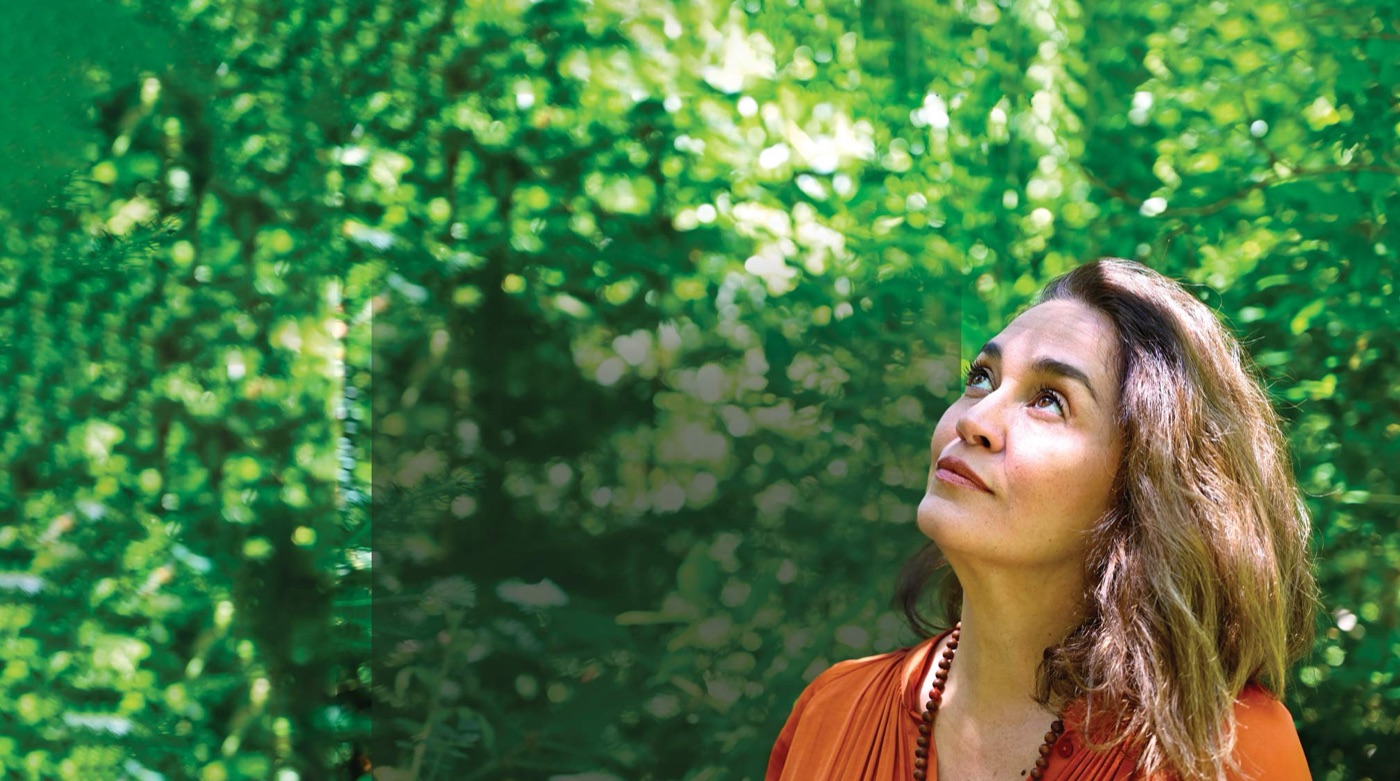

Om Tare is a single, one track released on March 17, 2023. It is a small release, but it is a clear window into what Prashanti Paz does best: taking a single mantra and giving it room to breathe.
Prashanti Paz was born in Patagonia, Argentina, spent her childhood in Sao Paulo, studied film in Buenos Aires, and trained in screenwriting in New York. Her first film job, in 1997, was as a production assistant on Seven Years in Tibet, shot in the Andes, where she worked daily alongside Tibetan monks, Rinpoches and scholars. In 2016 she moved from screenwriting to full-time sacred music and teaching, and now lives in The Hague.
Her full-length albums are Inner Light (2017), Into the Heart (2019) and Beyond (2023). Between them she has released singles that each spotlight one practice, among them Ganesha Sharanam and Mere Ram in 2022. Om Tare belongs to that line of focused singles and arrived in the same year as Beyond. Of the singles, it is the one most directly connected to the Tibetan Buddhist path that shaped her.
Her voice is often described as luminous and soothing, and elsewhere as a clear alto that favors clarity and restraint over display. Her typical palette is sparse: harmonium as the main companion, occasionally light strings, and plenty of silence. Pacing follows the breath. There is no driving rhythm and no urgency, and the pauses between phrases let the syllables settle.
I can't give you a track-by-track account of the instrumentation on this particular release, since credits aren't detailed in the information available. What can be said is that her work as a whole is built on acoustic, traditional sound rather than synths or drum machines, and that her voice is the primary instrument. The mood is intimate and tender, closer to a private practice than a gathering.
There is only one, and it is the whole point.
"Om Tare" is a mantra to Tara, the Buddhist deity associated with compassion and swift protection. It lands because of what a single-track release makes possible: no sequence to follow and no arc to manage, just one mantra repeated and deepened. Her gift for restraint suits this form. The syllables are articulated clearly, the voice stays calm, and the repetition does the work. It is also a good illustration of her bridging role. Someone who has never encountered Tara can simply listen to the sound and let the meaning come later.
Her practice is rooted in Tibetan Buddhism, and she has studied for over two decades with teachers including the Dalai Lama, Kyabje Kalu Rinpoche and Gyetrul Jigme Rinpoche. Yet her catalog is ecumenical, drawing on Hindu, Buddhist, Sikh and shamanic mantras, which reflects her interfaith upbringing with a Jewish father and a Christian mother.
Om Tare is the Buddhist entry in that spread. Spotify often files her under kirtan, but this is not the call-and-response of group kirtan. It is a solo, carefully arranged devotional interpretation, nearer to sadhana than to a communal singalong. Krishna Das, a prominent kirtan artist, has said, "I love Prashanti Paz's voice!", a sign of respect from within the devotional world.
This release speaks most to listeners who already keep, or want to begin, a quiet daily practice: someone with an altar, a cushion, or a habit of sitting in the evening. It suits people drawn to Tara's themes of compassion and protection, perhaps during a stretch that calls for gentleness. It also suits newcomers who want one clear mantra rather than a full album to commit to.
It is less suited to anyone wanting high-energy group ritual, electronic textures, or ambient wallpaper. Her voice and the Sanskrit are the center, not the background.
Choose a quiet evening and listen alone, ideally with headphones so the small details of breath and phrasing come through. Keep the lights low and don't multitask. Listen once straight through, simply receiving it. Then play it again and softly join in, or use it as a focal point for sitting practice. If you have a devotional space, this is a natural piece to play there. Because it is a single, you can let it repeat and watch how the same mantra feels different the third time than the first.