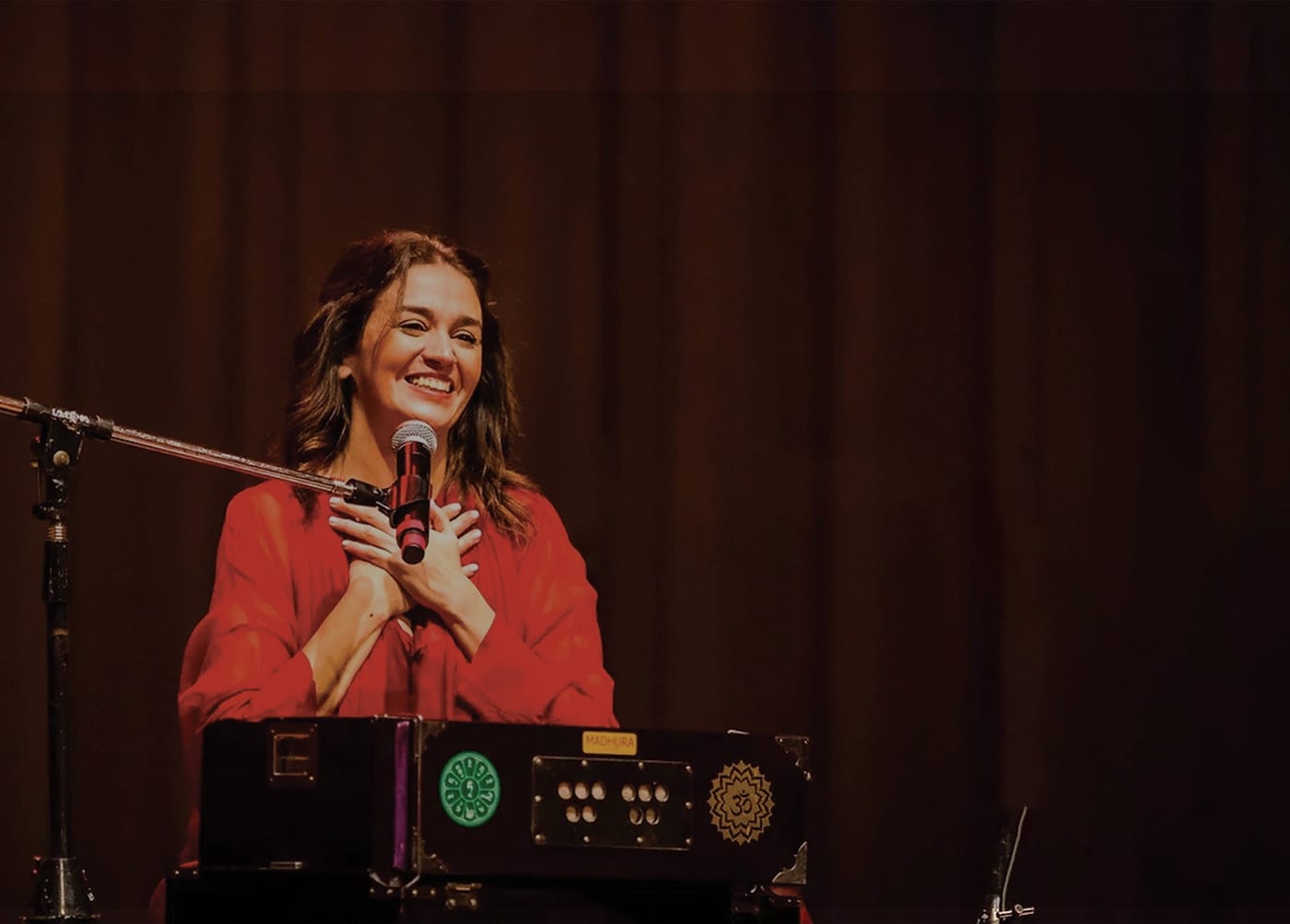

Released on August 3, 2023, Beyond is the third full-length album in Prashanti Paz's catalog, following Inner Light (2017) and Into the Heart (2019). Between those records came a run of singles and the heart songs of the pandemic years, including Lokah Samastah, Coming Home and A New Day. Seen against that backdrop, the seven tracks of Beyond read as a crystallization rather than a departure. This is the album where a voice shaped by years of devotional practice, and by a path that began in film and screenwriting before turning fully to sacred music in 2016, arrives at its most assured form. It was produced by Anibal Kerpel and her long-time collaborator Diego Marchionatti, and it is generally regarded as her most polished record. It rewards listeners who have already spent time with the earlier work.
The defining instrument is her voice: a clear alto, often described as luminous and soothing, with Sanskrit articulation that stays precise without turning stiff. The pacing follows the rhythm of breath rather than any pulse. Phrases are given room, and silence between them is part of the architecture.
Her usual palette is harmonium at the center, with sparing string colors added in places. On Beyond, the production is slightly fuller than on her earlier albums, but it keeps its restraint. Think of it as chamber music for chanting: the voice is supported rather than surrounded. There are no drum machines or synthetic beds here, and the mood sits somewhere between tenderness and steadiness. It is a record that invites you toward it instead of reaching out to grab you.
I can't responsibly map a track list that isn't in front of me, so rather than guess at the album's sequencing, I'll point to the mantras closely associated with her recent work and worth listening for as you move through the record.
Om Tare. Released in 2023, this is a mantra to Tara, the Buddhist deity associated with compassion and swift protection. It is the clearest expression of the Tibetan Buddhist foundation beneath her music, and it suits dedicated practice or altar use. What makes it land is the combination of devotional intent and vocal restraint: the plea is never oversold.
Ganesha Sharanam. Dating from 2022, this chant to Ganesha is traditionally sung to open ceremonies and remove obstacles. It works as a threshold piece, ideal for beginning a sitting or a yoga class, and it shows how freely she crosses from Buddhist to Hindu devotional territory.
Check the album's Spotify page for the full sequence and see where these and her other mantras fall.
Paz's practice is rooted in Tibetan Buddhism, yet her music is deliberately ecumenical, drawing on Hindu, Buddhist, Sikh and shamanic mantras. That outlook grew from an interfaith upbringing, with a Jewish father and Christian mother who honored both traditions. Her music is often filed under kirtan, and Krishna Das has said, "I love Prashanti Paz's voice!" But her approach differs from the call-and-response gathering most people associate with the form. These are carefully arranged, solo vocal interpretations, closer to personal sadhana than communal singing. Beyond sits at the contemplative, introspective end of devotional music, and its slightly richer production shows that a tradition of restraint can still evolve.
This album is for listeners who want the voice and the mantra to be the center, not wallpaper. It speaks to people with an existing meditation or yoga practice, to those who find group kirtan too boisterous and want something quieter, and to anyone moving through a period that calls for steadiness: grief, transition, or a deliberate slowing down. It also suits listeners who value the sound of Sanskrit without needing to follow the translation, since the repetition and tone do much of the work.
It is less suited to anyone seeking high-energy singalong ritual, electronic-leaning meditation music, or ambient textures with minimal vocals. The austerity is intentional, and there is no lush orchestral swell to soften it. Newcomers may also prefer to begin with Inner Light and return here afterward.
Give Beyond a single uninterrupted sitting. At seven tracks, it holds together as a whole, and the albums reward sequential listening more than shuffled singles. Evening is the natural time, once the day's noise has settled. Use headphones or a quiet room so the pauses between phrases register as part of the music, and resist the urge to multitask.
If you practice, treat it as a companion to your sitting: let the opening chant set the pace of your breath, and allow the silences to do their work. If you don't, simply lie back, close your eyes, and let the voice lead. Then, on a second or third pass, listen for what the production adds, the subtle fullness that distinguishes this record from its predecessors, and notice how little it needs to say to say a great deal.