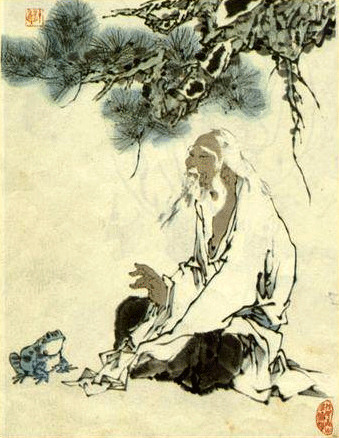
Chuang Tzu's assertion that "The Way bestows life. Virtue rears it" invites us to contemplate the profound relationship between existence and ethical living. At its core, this quote suggests that the essence of life is inherently tied to the natural flow of the universe, or the Tao, while virtue acts as the nurturing force that cultivates and sustains that life. Understanding this relationship is crucial, as it challenges us to consider how we engage with the world around us and the values we embody in our daily lives.
In a world often dominated by ambition and competition, Chuang Tzu's wisdom serves as a gentle reminder of the importance of aligning ourselves with the natural order. The Way, or Tao, is not merely a path to be followed; it is the very essence of existence that flows through all things. By recognizing this interconnectedness, we can begin to appreciate how our virtues—our kindness, compassion, and integrity—play a vital role in nurturing not only our own lives but also the lives of those around us. This understanding is not just philosophical; it has practical implications for how we choose to live each day.
The image / the metaphor
The imagery in Chuang Tzu's quote evokes a sense of harmony and balance. The term "Way" suggests a path or a flow, reminiscent of a river that courses through the landscape, shaping and nourishing everything in its path. The verb "bestows" implies a generous act, as if life is a gift that the Way offers freely to all beings. In contrast, "virtue" is depicted as a nurturing force, one that actively cultivates and raises life, much like a gardener tending to a garden. This duality of giving and nurturing encapsulates the essence of existence as a dynamic interplay between the natural world and our ethical choices.
Diving deeper into the metaphor, we can see that the Way represents the underlying principle of the universe—an ever-present force that guides and sustains life. Virtue, then, is not merely an abstract quality but a practical expression of our alignment with this cosmic flow. It suggests that to truly live, we must engage with the world in a way that reflects our highest values. This relationship between the Way and virtue is not static; it is a dance, a continuous movement that requires our active participation and awareness.
In the speaker's tradition
Chuang Tzu's teachings are deeply rooted in the Taoist tradition, which emphasizes living in harmony with the Tao, or the natural order of the universe. This concept resonates with ideas found in other spiritual traditions, such as dharma in Buddhism, which refers to the ethical path one must follow to live a fulfilling life. Similarly, the notion of kenosis in Christian mysticism, which speaks to the self-emptying of one's will to align with divine purpose, echoes the Taoist emphasis on surrendering to the flow of life. In this way, Chuang Tzu's wisdom transcends cultural boundaries, inviting seekers from all backgrounds to explore the interconnectedness of existence.
In the Zhuangzi, the text attributed to Chuang Tzu, we find numerous anecdotes that illustrate the importance of aligning oneself with the Way. One such story involves a butcher who, through deep understanding and practice, learns to cut meat in a way that flows with the natural structure of the animal, demonstrating how mastery arises from attunement to the Tao. This narrative serves as a powerful reminder that true skill and virtue emerge not from forceful effort but from a deep connection to the rhythms of life.
Living the teaching
Consider a modern scenario where this teaching can be applied: a workplace filled with competition and stress. In such an environment, individuals often prioritize personal success over collaboration, leading to burnout and disconnection. By embracing the idea that the Way bestows life and virtue rears it, one might shift their focus from individual achievement to fostering a supportive atmosphere. This could involve actively listening to colleagues, offering assistance, and celebrating collective successes, thereby nurturing a culture of cooperation that enhances everyone's well-being.
Another application of this teaching can be found in personal relationships. Imagine a moment of conflict with a loved one, where emotions run high and misunderstandings abound. By recalling Chuang Tzu's wisdom, one might choose to approach the situation with patience and compassion, recognizing that both parties are navigating their own paths. Instead of reacting defensively, embracing the nurturing aspect of virtue allows for a deeper understanding and connection, ultimately fostering a more harmonious relationship. This practice of virtue in action not only rears the life of the relationship but also enriches the lives of those involved.
A reflection
As we contemplate Chuang Tzu's profound insight, we are invited to reflect on our own lives: How can we better align ourselves with the Way and embody virtue in our daily actions? This question encourages us to explore the ways in which we can cultivate a deeper connection to the natural flow of existence while nurturing the values that sustain us and those around us. In this exploration, we may discover that the path to a more fulfilling life lies not in striving for success, but in harmonizing with the world and nurturing the virtues that arise from that connection.


