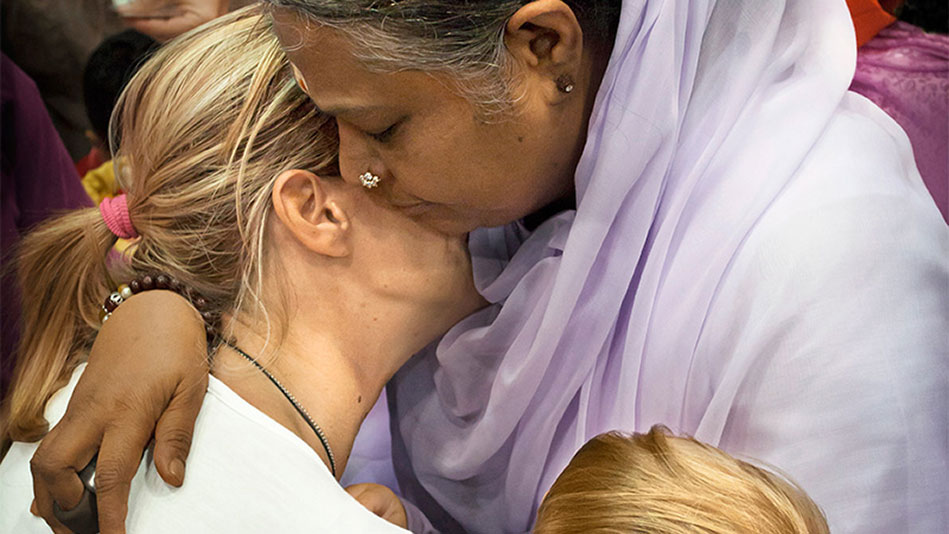
Amma's profound statement, "In the heart, all are children of the One Mother," invites us to recognize the inherent unity that binds us as human beings. This quote speaks to the essence of our shared existence, transcending the boundaries of culture, religion, and personal identity. In a world often divided by differences, Amma's words remind us of our common origin and the nurturing spirit that connects us all. Understanding this unity is not merely an intellectual exercise; it is a call to embody compassion and love in our daily lives.
Delving deeper into this sentiment, we find that the metaphor of the "One Mother" evokes a sense of belonging and unconditional love. It suggests that regardless of our individual paths, we are all nurtured by the same source, akin to children cradled in the arms of a loving mother. This imagery resonates with the heart's capacity for empathy and connection, urging us to look beyond superficial distinctions and embrace the shared humanity that lies within each of us. In doing so, we cultivate a sense of peace and harmony that can transform our relationships and communities.
The image / the metaphor
At its core, Amma's quote employs the imagery of motherhood to convey a deep emotional truth. The heart, often regarded as the seat of love and compassion, serves as the canvas upon which this unity is painted. The choice of the word "children" evokes innocence and vulnerability, suggesting that we are all in a state of learning and growth, regardless of our age or experience. The phrase "One Mother" encapsulates a universal nurturing force, inviting us to consider the divine feminine that exists within and around us, fostering a sense of safety and belonging.
Going deeper into the metaphor, we can explore the implications of being "children" of this One Mother. It implies a relationship characterized by care, support, and unconditional love. Just as a mother nurtures her children, we are called to nurture one another, recognizing that our differences are merely expressions of a singular essence. This perspective encourages us to cultivate a spirit of inclusivity and understanding, allowing us to see ourselves in others and to respond to their needs with compassion and kindness.
In the speaker's tradition
Amma's teachings are deeply rooted in the bhakti tradition, which emphasizes devotion and love as pathways to spiritual realization. Central to this tradition is the concept of unity with the divine, often expressed through the idea of surrendering the self to a higher power. This notion of kenosis, or self-emptying, aligns beautifully with the idea that we are all children of the One Mother, as it invites us to let go of our ego-driven identities and embrace a collective existence. In this way, bhakti becomes a practice of recognizing the divine in every being, fostering a sense of interconnectedness.
In the Bhagavad Gita, a foundational text of the bhakti tradition, we find echoes of Amma's sentiment in the teaching that all beings are manifestations of the divine. The Gita encourages us to see beyond the illusion of separateness, reminding us that we are all part of the same cosmic fabric. This perspective aligns with Amma's call to recognize our shared origins and to act with love and compassion toward one another, reinforcing the idea that our spiritual journey is inherently communal.
Living the teaching
Consider a modern scenario where this teaching can be applied: a workplace filled with diverse individuals from various backgrounds. In such an environment, it is easy to become entrenched in our differences, leading to misunderstandings and conflict. However, by embracing the idea that "in the heart, all are children of the One Mother," we can approach our colleagues with empathy and openness. This perspective encourages us to seek common ground, fostering collaboration and harmony, ultimately transforming the workplace into a nurturing space where everyone feels valued and understood.
Another application of this teaching can be found in personal relationships, particularly during moments of conflict. When faced with disagreements, it is easy to lose sight of our shared humanity and to view the other as an adversary. However, by remembering that we are all children of the same Mother, we can approach these situations with a spirit of compassion and understanding. This shift in perspective allows us to engage in constructive dialogue, paving the way for healing and reconciliation, and reminding us that love is the foundation of all relationships.
A reflection
As we contemplate Amma's profound words, we are invited to reflect on our own lives and the ways in which we can embody this teaching. How can we cultivate a deeper sense of connection with those around us, recognizing their inherent worth as fellow children of the One Mother? In what ways can we practice compassion and understanding in our daily interactions, fostering a sense of unity that transcends our differences? These contemplative questions serve as a guide for our spiritual journey, encouraging us to live in alignment with the truth of our shared humanity.