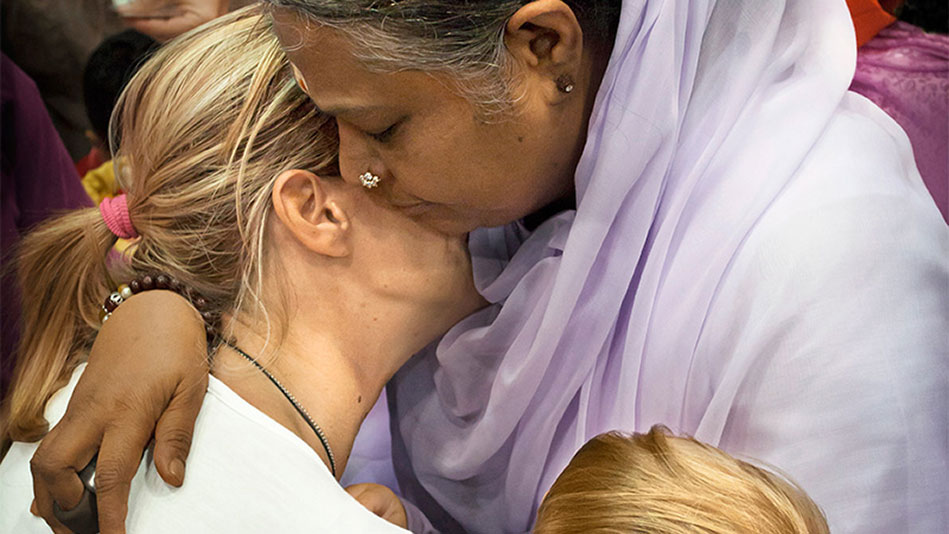
Amma's poignant assertion, "In the embrace of love, all wounds heal," invites us to reflect on the transformative power of love in our lives. This statement suggests that love is not merely an emotion but a profound force capable of mending the deepest of hurts. In a world often marked by suffering and disconnection, understanding this truth becomes essential, as it offers a pathway toward healing and wholeness.
To delve deeper, we must consider the nature of love itself. It is an expansive, nurturing energy that transcends the boundaries of the self, inviting us into a shared experience of vulnerability and connection. When we allow ourselves to be embraced by love—whether from others or within ourselves—we create a fertile ground for healing, where wounds can be acknowledged, processed, and ultimately transformed. This exploration of love as a healing balm is not just a poetic notion; it is a lived reality that many have experienced in their journeys.
The image / the metaphor
The imagery in Amma's quote evokes a sense of warmth and safety, suggesting that love acts as a protective embrace. The word "embrace" implies a closeness, a physical and emotional holding that fosters trust and acceptance. This act of being held can be seen as a metaphor for the unconditional support that love provides, allowing us to confront our wounds without fear of judgment or rejection.
Diving deeper into the metaphor, we can understand that wounds are not solely physical; they encompass emotional and spiritual scars as well. Love, in this context, serves as a salve that soothes these deeper pains. It invites us to acknowledge our vulnerabilities and to share them with others, creating a space where healing can occur. The act of embracing one another in love becomes a sacred ritual, a reminder that we are not alone in our suffering and that healing is possible through connection.
In the speaker's tradition
Amma's teachings are rooted in the bhakti tradition, which emphasizes devotion and love as pathways to spiritual realization. In this context, love is not merely an emotion but a divine force that connects us to the essence of existence. Concepts such as bhakti, or devotion, and dharma, or righteous living, intertwine to create a framework where love becomes the guiding principle for healing and transformation. The practice of kenosis, or self-emptying, further complements this understanding, as it encourages us to let go of our ego and open ourselves to the love that surrounds us.
In the Bhagavad Gita, a foundational text in the bhakti tradition, we find references to the power of love and devotion as means to transcend suffering. The Gita teaches that surrendering to divine love allows us to release our burdens and find solace in the embrace of the divine. This aligns beautifully with Amma's assertion, as it underscores the idea that love is not only a healing force but also a pathway to spiritual liberation.
Living the teaching
Consider a modern scenario where this teaching resonates: a person grappling with the aftermath of a painful breakup. The emotional wounds may feel insurmountable, leading to isolation and despair. However, when this individual opens themselves to the love of friends and family, they begin to experience healing. Through shared laughter, heartfelt conversations, and the simple act of being present with one another, the wounds of the heart start to mend, illustrating Amma's assertion that love has the power to heal.
Another application of this teaching can be found in the context of self-love. Imagine someone who struggles with self-criticism and feelings of unworthiness. By practicing self-compassion and embracing themselves with love, they can begin to heal the wounds inflicted by negative self-talk. This internal embrace fosters a sense of acceptance and understanding, allowing them to move forward with greater resilience and openness to love from others. In both scenarios, the embrace of love becomes a transformative force, guiding individuals toward healing and wholeness.
A reflection
As we contemplate Amma's profound statement, we are invited to consider the ways in which love manifests in our lives. Are there wounds we have yet to acknowledge, either within ourselves or in our relationships with others? In what ways can we open ourselves to the healing embrace of love, allowing it to transform our pain into a source of strength and connection? Reflecting on these questions can lead us to a deeper understanding of love's capacity to heal and the importance of fostering it in our daily lives.