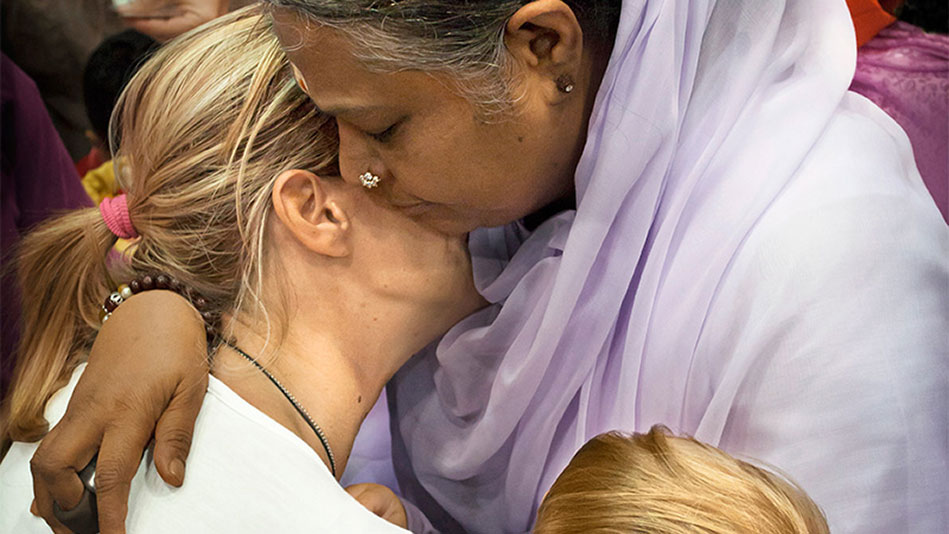
Amma invites us to step back from the tumult of our thoughts, urging us to become mere witnesses to the mental chatter that often consumes us. In her quote, "Be a witness to your thoughts. Don't get lost in them," she emphasizes the importance of observing our inner landscape without becoming entangled in it. This practice is not merely an exercise in mindfulness; it is a profound invitation to cultivate a deeper awareness of our mental processes, allowing us to navigate life with clarity and intention.
In a world where distractions abound and the mind races with incessant thoughts, Amma's guidance serves as a beacon of hope. By adopting the role of a witness, we can create a space between ourselves and our thoughts, fostering a sense of detachment that can lead to greater peace and understanding. This practice is essential for anyone seeking to deepen their spiritual journey, as it encourages us to recognize the transient nature of our thoughts and emotions, ultimately leading us toward a more authentic existence.
The image / the metaphor
The imagery in Amma's quote evokes a sense of spaciousness and clarity. To "be a witness" suggests a position of observation, akin to a spectator at a play, where one can appreciate the unfolding drama without becoming embroiled in the narrative. The verb "witness" implies an active engagement with our thoughts, yet it also carries a sense of detachment, allowing us to observe without judgment or attachment. This duality is crucial; it invites us to recognize that while our thoughts may arise and dissipate, they do not define us.
Diving deeper into the metaphor, we can envision our thoughts as clouds passing through the vast sky of our consciousness. Just as clouds come and go, so too do our thoughts, often driven by external circumstances or internal emotions. By adopting the perspective of a witness, we can cultivate a sense of equanimity, learning to appreciate the beauty of our thoughts without becoming lost in their fleeting nature. This practice encourages us to embrace the impermanence of our mental states, fostering a profound sense of liberation.
In the speaker's tradition
Amma's teachings are deeply rooted in the bhakti tradition, which emphasizes devotion and surrender to the divine. The concept of "witnessing" aligns closely with the idea of "kenosis," or self-emptying, where one relinquishes the ego's grip on thoughts and emotions. In bhakti, the practitioner seeks to cultivate a loving relationship with the divine, often through the practice of devotion and surrender. By witnessing our thoughts, we can create space for divine presence to fill our hearts, allowing us to experience a deeper connection with the sacred.
In the context of bhakti literature, we can draw parallels to the teachings found in the Bhagavad Gita, where Lord Krishna advises Arjuna to observe his thoughts and emotions without attachment. The Gita emphasizes the importance of performing one's duty with a sense of detachment, recognizing that the fruits of our actions are not ours to claim. This wisdom resonates with Amma's call to witness our thoughts, as both teachings encourage us to engage with life fully while maintaining a sense of inner peace and clarity.
Living the teaching
Consider a modern scenario where this teaching can be applied: a busy professional facing the pressures of deadlines and expectations. In such moments, thoughts may spiral into anxiety, leading to a sense of overwhelm. By practicing the art of witnessing, the individual can pause, take a breath, and observe the racing thoughts without judgment. This simple act of stepping back can create a moment of clarity, allowing for more thoughtful responses rather than reactive behaviors.
In relationships, the practice of witnessing thoughts can be transformative. Imagine a heated discussion with a loved one, where emotions run high and misunderstandings abound. By adopting the role of a witness, one can observe their own thoughts and reactions, recognizing patterns of defensiveness or blame. This awareness can foster a more compassionate dialogue, allowing both parties to express themselves without becoming lost in the emotional turbulence. In this way, the practice of witnessing becomes a tool for deeper connection and understanding.
A reflection
As we contemplate Amma's invitation to "be a witness to your thoughts," we are called to explore the nature of our inner dialogue. What thoughts tend to dominate your mind, and how do they shape your experience of the world? In moments of stillness, consider the possibility of stepping back from your thoughts and observing them as they arise. How might this practice transform your relationship with yourself and others?