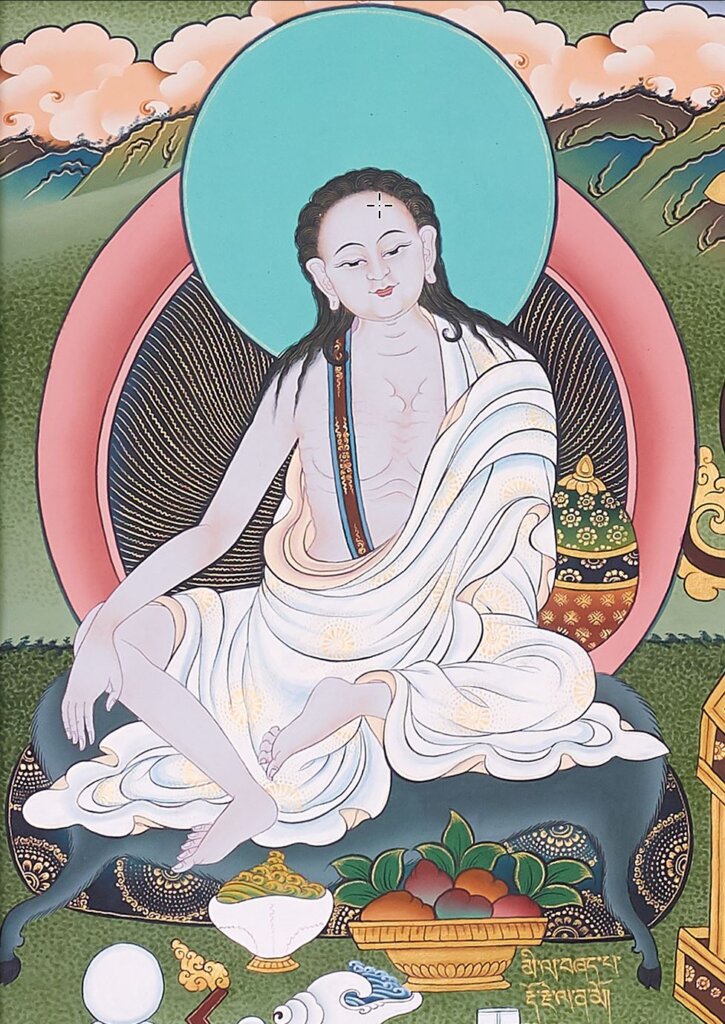
Milarepa's poignant declaration, "The cave was my house; the cloth on my back was my only garment," invites us into a profound exploration of simplicity and the essence of being. In this stark imagery, we encounter a life stripped of excess, where material possessions are reduced to the barest essentials. This quote resonates deeply in a world often overwhelmed by consumerism and distraction, urging us to reconsider what truly constitutes a home and a life well-lived.
As we delve into Milarepa's experience, we find a narrative that transcends mere physicality. His cave, a humble dwelling, symbolizes a sanctuary for spiritual growth and introspection. The cloth on his back serves not only as a garment but as a metaphor for the lightness of being that comes from relinquishing attachments. In this exploration, we are invited to reflect on our own lives and the burdens we carry, both materially and spiritually.
The image / the metaphor
The imagery in Milarepa's quote is strikingly vivid. The cave, often associated with darkness and isolation, transforms into a home, suggesting that true shelter is not found in opulence but in the acceptance of one's circumstances. The choice of the word "house" evokes a sense of belonging, while the "cloth" signifies the bare minimum required for survival. This juxtaposition of the cave and the cloth encapsulates a life of profound simplicity, where the external environment is stripped away to reveal the inner landscape of the self.
On a metaphorical level, the cave represents the mind—a space where one can retreat to confront the shadows of existence. In Buddhist philosophy, this aligns with the concept of sunyata, or emptiness, which teaches that true understanding arises when we let go of attachments and preconceived notions. Milarepa's experience in the cave becomes a powerful metaphor for the journey inward, where the simplicity of his surroundings allows for a deeper connection to the essence of life itself.
In the speaker's tradition
Milarepa, a revered figure in Tibetan Buddhism, embodies the principles of dharma and the transformative power of suffering. His life story illustrates the path of kenosis, or self-emptying, where one relinquishes the ego and material desires to attain spiritual enlightenment. This journey is not merely about physical poverty but rather an invitation to cultivate a rich inner life, free from the distractions of the external world. In this light, Milarepa's cave becomes a crucible for spiritual awakening, where simplicity fosters clarity and insight.
In the context of Buddhist texts, Milarepa's teachings resonate with the Heart Sutra, which emphasizes the notion of emptiness and the interdependence of all phenomena. The sutra states, "Form is emptiness, emptiness is form," echoing the sentiment that our attachments to material possessions can obscure our understanding of reality. Milarepa's life serves as a living commentary on this principle, demonstrating that true wealth lies not in accumulation but in the depth of one's spiritual practice.
Living the teaching
Consider a modern scenario where the teachings of Milarepa might resonate. Imagine a busy professional, overwhelmed by the demands of work and life, who decides to declutter their living space. In this act of simplification, they discover not only a physical lightness but also a mental clarity that allows them to reconnect with their passions and values. By embracing the essence of Milarepa's cave, they find that true fulfillment does not stem from external achievements but from the peace that arises when one is unencumbered by excess.
This teaching can also manifest in relationships. Picture a couple navigating the complexities of modern life, often caught in the web of material pursuits and societal expectations. By consciously choosing to prioritize quality time together over material possessions, they cultivate a deeper connection. In moments of vulnerability, they may find that the richness of their relationship flourishes when they embrace simplicity, echoing Milarepa's wisdom that true wealth is found in the depth of experience rather than in the accumulation of things.
A reflection
As we contemplate Milarepa's profound statement, we are invited to ask ourselves: What do we truly need to feel at home within ourselves? In a world that often equates worth with possessions, how might we redefine our understanding of abundance? This reflection encourages us to explore the spaces in our lives where we can embrace simplicity, allowing us to connect more deeply with our true selves and the essence of existence.
