
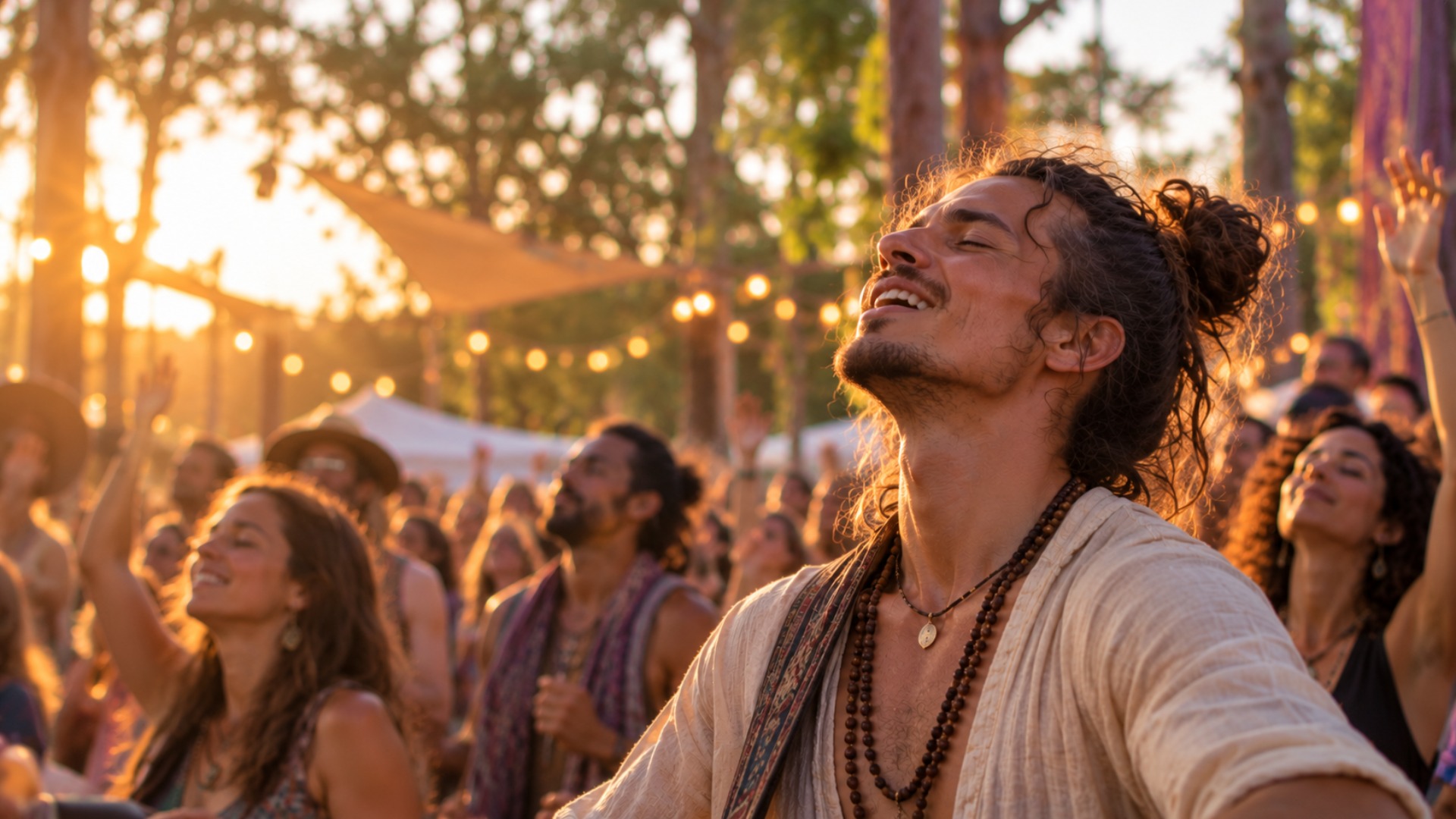



What is Meditative Music?
Meditative music is a broad category encompassing compositions and performances designed to facilitate meditation, contemplation, or states of focused awareness. Unlike ambient or relaxation music—which may serve as pleasant background—meditative music typically functions as an object of attention or a container for practice. It is characterized by slow tempi, sustained tones, deliberate repetition, limited harmonic progression, and an absence of conventional narrative or climax. The music aims not to entertain or emotionally transport but to support inward focus, often through sonic simplicity that allows the mind to settle or expand.
The category includes both sacred music from contemplative traditions (Tibetan singing bowls, Gregorian chant, Sufi dhikr, Vedic chanting) and secular compositions intended for similar states (drone music, certain minimalist works, sound bath recordings). What unifies these disparate forms is functional intent: the music serves the meditator rather than demanding the listener’s narrative attention.
Origins & Lineage
Meditative music as a distinct functional category has ancient roots across multiple traditions. Buddhist chanting practices date to the 5th century BCE, with Pali canon texts describing vocal recitation as both devotional act and concentration tool. Hindu Vedic chanting, codified in texts like the Samaveda (circa 1200-800 BCE), prescribed melodic formulas for ritual and contemplative purposes. Christian monastic traditions developed plainchant by the 6th century CE, with Gregorian chant standardized under Pope Gregory I as a vehicle for prayer and divine contemplation.
Islamic Sufi orders formalized dhikr (remembrance) practices by the 9th century, using repetitive vocal phrases and frame drums to induce trance states. Tibetan Buddhist ritual music, including the use of singing bowls, dungchen horns, and overtone chanting, developed between the 8th and 12th centuries as part of Vajrayana meditation liturgy.
The modern Western conception of “meditative music” as a genre emerged in the mid-20th century. Composer La Monte Young’s sustained-tone works in the 1950s-60s, particularly The Well-Tuned Piano (1964-present), established drone as a meditative form in avant-garde music. Terry Riley’s In C (1964) and Steve Reich’s phase music introduced repetition as a consciousness-altering device. Karlheinz Stockhausen’s Stimmung (1968) explicitly framed overtone singing as a meditative ritual.
The 1970s saw the commercialization of the category: Steven Halpern released Spectrum Suite (1975), marketed explicitly for meditation and healing. Tony Scott’s Music for Zen Meditation (1964) had already introduced the fusion of Japanese shakuhachi with Western instruments to contemplative audiences. By the 1980s, labels like Windham Hill and Hearts of Space distributed meditative music as a consumer product distinct from New Age.
How It’s Practiced
Meditative music practice varies by tradition and intention. In seated meditation, practitioners may use music as an anchor for attention—focusing on a single sustained tone, the texture of a singing bowl’s decay, or the rhythmic pattern of a drum. Vipassana and Zen traditions typically reject musical accompaniment during formal practice, viewing silence as essential, though chanting bookends many sessions.
Sound baths, formalized in the West during the 1980s, position listeners in a supine state while practitioners play crystal or metal singing bowls, gongs, and chimes. Participants report entering hypnagogic states—the threshold between waking and sleep—where auditory processing becomes non-linear.
Kirtan and bhajan practices in Hindu and Sikh traditions use call-and-response chanting, often accompanied by harmonium and tabla, to cultivate devotional absorption (bhakti). Sufi sema ceremonies pair whirling movement with ney flute and percussion, the music serving as both rhythmic guide and trance inducer.
In therapeutic contexts, music therapists use meditative compositions in conjunction with breathwork, body scans, or guided imagery. The music’s predictability—no sudden dynamic shifts or rhythmic surprises—supports nervous system regulation.
Meditative Music Today
Contemporary seekers encounter meditative music in multiple contexts. Urban meditation studios and yoga centers play curated playlists featuring artists like Deva Premal, Krishna Das, or Laraaji. Streaming platforms like Spotify and Apple Music maintain “Deep Focus” and “Meditation” playlists, though these often conflate true meditative music with ambient electronica.
Retreats at centers like Spirit Rock, Kripalu, and Esalen often incorporate live or recorded meditative music into programming. Sound healing practitioners offer private sessions and group experiences, sometimes integrating Himalayan bowls with biofield tuning forks or Native American flutes.
The digital meditation app industry—led by Calm, Headspace, and Insight Timer—features thousands of guided meditations backed by original meditative compositions. Academic research into music’s effects on meditation has increased, with studies examining brainwave entrainment, heart rate variability, and subjective reports of depth.
Contemporary composers like Pauline Oliveros (Deep Listening practice), Éliane Radigue (long-form tape drones), and Arvo Pärt (tintinnabuli technique) have brought meditative aesthetics into concert halls, though debate persists about whether performance contexts negate meditative function.
Common Misconceptions
Meditative music is not synonymous with relaxation music. While both may lower heart rate, relaxation music aims to soothe, whereas meditative music supports alertness and presence—qualities essential to most meditation practices.
Not all “meditation music” sold commercially serves contemplative practice. Much is generic ambient soundscaping—pleasant but lacking the intentional architecture (drone, repetition, harmonic stasis) that supports sustained attention.
The category is not culturally neutral. Sacred music from Buddhist, Hindu, Islamic, and Indigenous traditions carries specific liturgical meanings and protocols. Using Tibetan ritual chants as background music for yoga classes, for example, constitutes a form of cultural extraction that divorces sound from its ceremonial context.
Meditative music does not require a “relaxed” or “peaceful” emotional quality. Some traditions, including certain Tantric practices and shamanic ceremonies, use dissonance, intensity, or rhythmic driving to facilitate altered states.
How to Begin
For those new to meditative music, begin with a tradition-specific example rather than a commercial playlist. Listen to a recording of Gregorian chant (the Benedictine Monks of Santo Domingo de Silos’ 1994 album remains accessible), a Tibetan singing bowl recording (such as those by Joseph Feinstein), or a classical Indian raga designed for contemplation (morning ragas like Bhairav or evening ragas like Yaman).
Pair listening with a simple practice: sit comfortably, set a timer for 10-15 minutes, and place your attention on a single element of the music—the attack and decay of a bowl strike, the grain of a vocalist’s timbre, or the slow evolution of a drone. When attention wanders, return to the sound.
For live experience, attend a public sound bath (many meditation centers and yoga studios offer monthly sessions) or a kirtan gathering (check ISKCON centers or Bhakti Yoga studios). These provide embodied context for how communities use music in contemplative practice.
For deeper study, consult Joachim-Ernst Berendt’s The Third Ear: On Listening to the World (1985) or Pauline Oliveros’s Deep Listening: A Composer’s Sound Practice (2005), both of which examine the phenomenology of meditative listening.