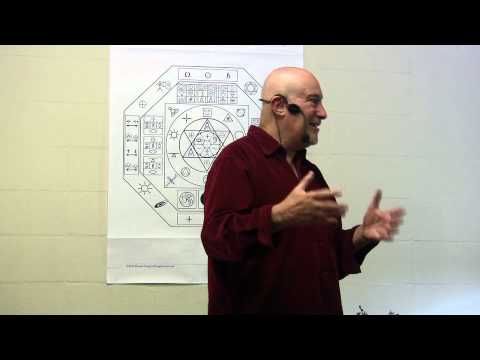
Somewhere in a Southern California meditation hall in May 2013, a student asks the question that serious practitioners eventually ask: is there a quicker way? Shinzen Young, the teacher whose dharma talk from that retreat has drawn close to 200,000 views on YouTube, does not answer with a trick. He answers with a sit. Shinzen calls it strong determination sitting: a session you commit to in advance, one hour or four or longer, during which you do not voluntarily move, while you work deliberately with the physical pain, the thoughts, and the will that arise inside it. He argues that this is one of the most direct routes to deep transformation in the Asian contemplative traditions, and that the practitioners who reach the highest levels of that path have very often done a great deal of it. What follows unpacks his method, the analogies he uses to explain it, and the safety rule he refuses to bend on.
WhatIsStrongDeterminationSitting,Really?
The definition is simple, and Shinzen is careful to make it sound no more dramatic than it is. "That means that you sit down and you say, 'Okay, for the next hour, or the next 90 minutes, or two hours, or three, or four, or whatever, three days, I'm not going to voluntarily move.'" The commitment is the point. Ordinary meditation lets you shift, scratch, adjust your posture, or open your eyes when the discomfort gets loud. Strong determination sitting removes those exits on purpose, and the removal is what makes the practice work.
Shinzen is also quick to deflate the sense of extremity. "First of all, I said it could be just an hour, or ninety minutes. It doesn't have to be three days." The length is something you build toward. The reason he gives for thinking that a motionless session is less alien than it sounds is the subject of the next section.
WhyDoesShinzenCompareaLongSittoChildbirth?
This is the part of the talk that most listeners remember, and Shinzen makes the comparison with a deliberate, almost mischievous directness. "I would suggest to you that at least half of all human beings that ever lived have been through an experience comparable in intensity." Then he states it plainly: "Sitting for eight hours in a posture is not more intense than giving birth to a baby."
He acknowledges the differences. Childbirth has "no way out," and it does not come with a set of distractions for the mind to reach for. Modern medication also changes the picture. But his larger point is about what the experience does. For most of human history, he suggests, childbirth was "nature's way to bring that person to a permanent transcendence." In his framing, labor is a process in which the ordinary self is pushed past its usual boundaries, and strong determination sitting is an intentional, controlled version of the same stripping away.
He reaches for another story to make the point. Shinzen describes a tradition he attributes to the Lakota Sioux, which he tells as follows: originally, Sun Dancing was for men only, and the men wanted to know what it was like to give birth. He points to the symbolism he sees in the ritual. "The men wear skirts, like women. You're attached by a tether, pierced, which is symbolic of the umbilical cord. Then you have to break loose. That's like being born, like a new birth." He adds that in the old days, after a fourth year of Sun Dancing, a participant was considered to have died and to have become a completely new person, giving away all possessions and starting from scratch. Shinzen presents this as a story he tells, and what he draws from it is the idea that deliberate endurance can mark a real rupture with the old self.
"Even though it sounds really far out there, it's actually no more than what at least half of humans do." (Shinzen Young, dharma talk, May 21, 2013, approx. 2:36 to 3:35 in the recording)
IsStrongDeterminationSittingSafe?
This is the question any responsible teacher has to answer, and Shinzen answers it first with a firm rule. "There's one absolute rule: do not, do not, do not physically damage the body." He then explains the method for keeping to it, which is gradual by design. "You gradually train yourself to do this. It's a slow training. You sit for an hour, you've got some pain. You get up, it goes away. You're okay, you haven't damaged the body. Then, you add five minutes, five minutes, five minutes."
The test he offers is practical. If the discomfort fades once you stand and move, and you feel fine within a few minutes, you have not injured yourself. He says that with rare exceptions, most people can sit for four hours and get up without damaging any joints. He is also specific about the familiar sensation of a leg falling asleep: it is "more pressure on nerves that causes that paresthesia thing," not cut-off circulation, and it "disappears as soon as you get up." He notes that people with neurological or circulatory conditions should check with a doctor first.
The real hazard, in his telling, is mechanical rather than tissue-level. "If you try to get up too quickly, your legs will not hold you and you fall." He describes students who did not know this and tried to leap to their feet when a bell sounded, then went sprawling across the meditation hall. His advice is simple: "So, yeah, you have to get up slowly."
WhatDoesShinzenSayActuallyArisesDuringaLongSit?
Shinzen maps the experience into four streams. "You're going to have four things arise. You're going to have physical sensations. Those are going to get more and more and more intense, for sure. Then, you're going to have your thoughts and emotions, and your will and your desire and your judgments arising moment by moment reactively to that." The fourth element is the whole in which the others happen. "That's a pretty big object. That's the whole mind-body self. That's why, if you can have a complete experience of that, it's a powerful transcendence."
This is where the method becomes a skill set rather than a sheer test of endurance. Shinzen describes the practice in terms of noting and sensory clarity, the capacity to see the sensations in fine detail without being swept away by them. His own strategy, he says, is to begin not with the sharpest point of pain but with its spread.
HowDoestheZoomingTechniqueWorkonPain?
Shinzen's most distinctive image is the pond. "After you get really intimate with the body, you realize that the body is like a pond. Not always, but quite often, when there's a local physical or emotional splash, there's a global ripple." Rather than fixing attention on the local intensity, he first detects how that intensity is moving through the body. He calls one of the tools within his noting approach "zooming," and he describes a specific version of it: "Zooming both ways means that you thrust your attention into the local splash, that's contractive, but at the same time, you spread your attention over the whole body."
The logic is physical, and he reaches for chemistry to explain it. "It's analogous to Boyle's Law in physical chemistry. Pressure is inversely proportional to volume, if pressure is analogous to suffering." If a painful knot is held as a dense point, its pressure stays high. If the awareness that holds it spreads through the larger volume of the body, the same sensation is given room, and the density loosens. He admits that conscious spreading is not guaranteed. "It's not always the case that there are conscious spreading sensations." But he believes subtler spreading happens regardless. "It is almost always the case, with rare exception, that there are subconscious spreading sensations going on." The practitioner's job is not to force a result. It is to keep the rails open. "The movement of your attention over the whole body greases the rails, so to speak, for the subconscious processing to spread without impedance."
Note the limit he sets on this. Mindfulness, in his telling, asks you to attend to what is available to conscious experience. If you cannot detect the spread, the instruction is not to invent it. The practice is to keep the broad awareness steady and let the body do what it does.
"Pressure is inversely proportional to volume, if pressure is analogous to suffering." (Shinzen Young, dharma talk, May 21, 2013, approx. 10:27 in the recording)
WhatHappensWhentheFreakoutArrives?
Shinzen does not present the long sit as a serene ascent. He describes a point at which the practice tips into fear. "Then at some point, I start to freak out. The freakout is in the subjective system, and I start to get disconcerting images of being stabbed and burned and what have you." He points to the signs in his own body as well, a subtle tightness that is easy to dismiss. "Subtle, but subtle is significant."
The key, he says, is to separate the strands. Describing the process as it changes, he suggests that the streams of sensation, perception, and reaction do not simply add up but compound, and that a practitioner who lacks clarity experiences "this snowballing overwhelm." With enough clarity, the strands can be tracked and unblocked, so that the intensity rises without collapsing into panic. "Yes, it gets more and more and more, but you don't get this snowballing overwhelm." He describes the pattern as cycles, each one reaching a little further than the last, which is why the sit requires patience as well as courage.
"Gradually, gradually, gradually, you work your way up to this." (Shinzen Young, dharma talk, May 21, 2013, approx. 17:25 in the recording)
WhyDoestheUsualMindLoseItsFooting?
Shinzen names the disorientation honestly. "It's scary, because the ordinary ordering principle is completely unavailable. The ordinary ordering principle for the mind is—get answers. Those are just not available." Normally, the mind resolves discomfort by finding an explanation or an exit. In a long, unmoving sit, both are blocked, and the mind has to learn to stay in the unknown. He describes what this can look like from the outside: "your eyes are sort of rolling in your head and you're right on the verge of passing out."
He also offers a reason the practice is not purely punishing. Describing the moment when difficulty begins to give way to something else, he says, "You're getting an immediate reward." He ties the endurance to memory as well, asking listeners to recall what the body and mind went through in childbirth, and suggesting that the reward of that experience was also not immediate.
WheretoGoFromHere
The talk is a dense and carefully reasoned introduction, and it is worth returning to with specifics in mind. Start small. Sit for an hour, get up slowly, and notice whether the discomfort dissipates. Add time only when the body stays intact. Practice the zooming technique in shorter sits before attempting a long one, paying attention to whether the local splash ripples outward into the whole body. Keep the one rule Shinzen puts above all others: do not physically damage the body. If you have a neurological or circulatory condition, consult a doctor before attempting any extended sit.
For further material from the teacher, his own site is shinzen.org, and the retreat organization that hosts sittings like the one in this talk is listed as vsiretreats.org. The video excerpt used for this article covers the opening portion of the talk; the full recording runs nearly eighteen minutes, and the material here reflects only the part of it available for this piece.
Comments
Loading the conversation…
Transcript
[0:05] Sometimes people ask me,
[0:08] "Is there a really quick way to enlightenment?
There's got to be a quicker way."
[0:12] [laughter]
[0:14] A lot of you know what's coming,
because this is a standard story that I tell, which is...
[0:21] Well, are you sure you want to know?
[0:26] Maybe you won't like what you hear...
[0:29] Yeah, I can tell you some pretty quick ways to transform deeply.
[0:41] Strong determination sitting
[0:44] It's a classic.
[0:46] I won't say that every master has done it,
but I would say that
[0:52] the great majority of people that come to the master level on this path
have done a lot of strong determination sitting.
[1:05] What does that mean?
[1:06] That means that you sit down and you say,
[1:12] "Okay, for the next hour, or the next 90 minutes,
or two hours, or three, or four, or whatever, three days,
[1:21] I'm not going to voluntarily move."
[1:26] I know the prospect of something like that seems horrific.
[1:33] You might not imagine yourself doing that.
[1:36] Well, first of all, I said it could be just an hour, or ninety minutes.
[1:42] It doesn't have to be three days.
[1:49] Secondly, even if it was four hours or eight hours,
[1:55] this is not so extravagantly unrelated to experiences
that normal human beings have.
[2:11] In fact, I would suggest to you that
at least half of all human beings that ever lived
[2:21] have been through an experience comparable in intensity.
[2:27] Do you [laugh] get what I'm talking about? [laughter]
[2:36] Sitting for eight hours in break into a posture is not more
intense than giving birth to a baby.
[2:47] If you've done that...
Now, of course, it's a different circumstance.
[2:52] First of all, there's no way out.
[2:54] [laughter]
[2:56] Secondly, there's a lot to distract,
and yes, nowadays, there are medications and so forth.
[3:02] But the way most people had to give birth to babies,
for most of humanity's history,
[3:10] I think it was nature's way
to bring that person to a permanent transcendence.
[3:20] It sort of makes sense, right?
[3:23] You're doing the activity of the Source,
expanding and contracting.
[3:30] It's interesting.
I talked about the Sun Dance yesterday, of the Native peoples.
[3:35] The story that is told among the Lakota Sioux is that—
[3:42] Originally, Sun Dancing was for men only.
[3:47] Nowadays, it's women, even children, actually.
[3:52] —the men wanted to know what it was like to give birth.
[4:00] If you look at the symbolism of the Sun Dance,
the men wear skirts, like women.
[4:11] You're attached by a tether, pierced,
which is symbolic of the umbilical cord.
[4:20] Then you have to break loose.
[4:24] That's like being born, like a new birth.
[4:30] Actually, in the old days,
after their fourth year of Sun Dancing,
[4:35] they considered that they had died,
and were a completely new person.
[4:42] They actually gave away all their possessions, everything.
[4:47] All their teepees and ponies, everything.
[4:51] They just started from scratch as a new person.
[4:57] Even though it sounds really far out there,
it's actually no more than what at least half of humans do.
[5:11] And the good news is, in strong determination sitting,
you can gradually work up to it.
[5:17] You train yourself slowly to be able to do this kind of thing.
[5:27] There's one absolute rule:
[5:30] Do not, do not, do not physically damage the body.
[5:36] How are you going to know if you're physically damaging the body?
[5:40] Remember, you gradually train yourself to do this.
[5:44] It's a slow training.
[5:46] You sit for an hour, you've got some pain.
[5:49] You get up, it goes away. You're okay, you haven't damaged the body.
[5:54] Then, you add five minutes, five minutes, five minutes.
[5:58] As long as you're getting up and after a few minutes, you're okay,
then you're okay.
[6:05] I can assure you that, with rare exceptions,
[6:09] most people can sit down for four hours and not move and get up
and they haven't damaged any joints or anything like that.
[6:19] You gradually learn how to do this.
[6:22] Oh, by the way, your legs falling asleep isn't going to damage anything.
[6:27] You're not cutting off circulation so much.
[6:32] It's more pressure on nerves that causes that paresthesia thing.
[6:37] That, as you've noticed, disappears as soon as you get up.
[6:43] There might occasionally be exceptions,
where people have neurological or circulatory issues.
[6:50] If you wonder about that, check it with a doctor,
but usually it's not that big a deal.
[6:58] The main danger in your legs falling asleep is not massive necrosis
that you might be fantasizing, the tissues are dying, you know. [laughter]
[7:11] The main danger is, if you try to get up too quickly,
your legs will not hold you and you fall.
[7:19] I've seen some really far out—people that didn't know that—
[7:24] in Zen, and the clackers go, and, okay, everybody jumps up,
[7:30] and they just do a somersault across the zendo.
[7:34] [laughter]
[7:36] So, yeah, you have to get up slowly.
[7:40] What's involved in a strong determination sitting?
[7:45] You're going to have four things arise.
[7:51] You're going to have physical sensations.
[7:55] Those are going to get more and more and more intense, for sure.
[8:00] Then, you're going to have your thoughts and emotions,
and your will and your desire and your judgments
[8:07] arising moment by moment reactively to that.
[8:12] That's a pretty big object.
That's the whole mind-body self.
[8:16] That's why, if you can have a complete experience of that,
it's a powerful transcendence.
[8:25] And that's why, as I say, not everyone that becomes a master,
but in Asian-style training,
[8:34] an awful lot of people that become masters, they do this.
[8:41] What's going to happen?
[8:45] You start to get physical discomfort.
[8:48] What I usually do...
This is my own personal strategy.
[8:54] You'll find whatever strategy works for you,
if you decide to do things like this.
[9:00] My personal strategy is to start by
[9:06] detecting the global spread of the pain,
rather than going immediately to the local intensity.
[9:14] That's the sensory clarity skill.
[9:21] After you get really intimate with the body,
you realize that the body is like a pond.
[9:28] Not always, but quite often,
[9:31] when there's a local physical or emotional splash,
there's a global ripple.
[9:40] One of the options within the noting apparatus is what I call "zooming."
[9:48] You can zoom in, you can zoom out,
you can zoom both ways.
[9:50] Zooming both ways means that you thrust your attention
into the local splash—that's contractive—
[9:59] but at the same time,
you spread your attention over the whole body.
[10:04] You zoom in and out at the same time.
[10:07] What that does is, that greases the rails, so to speak,
for sensations to dissipate in the volume of the body.
[10:22] It's analogous to Boyle's Law in physical chemistry.
[10:27] Pressure is inversely proportional to volume,
if pressure is analogous to suffering.
[10:36] Here's how that works.
[10:39] When you zoom in to a local intensity,
of course that becomes very salient.
[10:45] It intensifies even more.
[10:47] But at the same time, you're zooming out.
[10:50] Now one of two things will happen.
[10:53] Either there will be conscious sensations
that are spreading from that local intensity,
[11:01] and with the zooming out, you will be able to detect that
and open up to it and facilitate that.
[11:10] The other possibility is that actually,
there aren't conscious spreading sensations.
[11:16] That's fine.
[11:18] It's not always the case
that there are conscious spreading sensations.
[11:22] But it is almost always the case, with rare exception,
that there are subconscious spreading sensations going on.
[11:33] An important principle in mindfulness is
we only ask you to attend to what is available in conscious experience,
[11:44] so don't worry if you don't detect any of that subliminal spread.
[11:48] But here's the subtlety of the technique,
the cleverness of the option.
[11:56] If you spread your awareness over the whole body,
zoom out while you zoom in,
[12:05] then even if there's not a conscious awareness
of the spread of the sensation,
[12:12] the movement of your attention over the whole body greases the rails
for the subconscious processing to spread without impedance.
[12:28] You may not consciously be aware,
[12:31] but you're giving the very subtle spreading tendencies of the body
what they need to dissipate the density of things.
[12:44] That's one possible strategy for doing it.
[12:49] I tend to try to get the local splash and the global ripple.
[12:57] Then at some point, I start to freak out.
[13:04] Where does the freakout come?
[13:06] The freakout is in the subjective system.
[13:11] I start to go, "Oh my god, oh my god, no, no,"
[13:15] and I start to get disconcerting images
of being stabbed and burned and what have you.
[13:26] Then the emotions start to come up in the body.
[13:31] There's a subtle hint of teariness locally here.
[13:37] There's a kind of cold fear thing that pervades the body.
[13:47] Subtle, but subtle is significant.
[13:51] Those See In, Hear In, and Feel In reactions are natural.
[13:58] If you can track them and unblock them,
they won't be a problem.
[14:05] If you can't,
then they're going to cross multiply with the physical sensations.
[14:13] Instead of See In plus Hear In plus Feel In plus Feel Out, you're going to get See In times Hear In times Feel In times Feel Out.
[14:27] That's why, if you've ever noticed, it's like,
[14:30] "I can handle it, I can handle it, I can handle it,
no no NO NO, I CAN'T handle it."
[14:36] It's not linear.
[14:38] It's not like it grows like this; it grows like this.
[14:43] That's because things are starting to cross multiply.
[14:48] But if you have enough clarity to separate out the strands
so that they don't...
[14:59] ...they don't tangle and reinforce each other,
then actually, it just grows linearly.
[15:05] Yes, it gets more and more and more,
but you don't get this snowballing overwhelm.
[15:15] It just grows grows grows grows grows grows grows grows grows
and then [makes a crashing sound] something happens.
[15:23] And then, grows grows grows grows grows grows.
[15:27] And then it just flows flows flows flows.
[15:30] And then, yeah, you go through another cycle
and it gets a little more.
[15:36] And then it flows flows flows flows, the whole mind-body process.
[15:45] It's scary, because
the ordinary ordering principle is completely unavailable.
[15:53] The ordinary ordering principle for the body is—get comfortable.
[15:57] The ordinary ordering principle for the mind is—get answers.
[16:02] And, you can't do either.
[16:04] Those are just not available.
[16:06] The mind can't process.
[16:09] In fact, your eyes are sort of rolling in your head
and you're right on the verge of passing out.
[16:19] But, you've got a smile on your face
because you're moment by moment tasting purification.
[16:31] You're getting an immediate reward.
[16:38] Once again, this may sound radical,
but half the people in this room have done this.
[16:46] Remember back, if you had kids.
[16:51] It's just a matter of doing it in a really systematic way.
[17:04] That's a really big object—
the whole mind-body self.
[17:11] If we appreciate it to the extreme, just as it is,
then at some point it becomes flowing space.
[17:25] Gradually gradually gradually,
you work your way up to this.
[17:29] It's the homework assignment
you've got the rest of your life to turn in.
[17:36] And, you don't have to do it if you don't want to.
[17:39] You can just follow the path of bliss, the jhanas,
the absorptions, what have you.
Shinzen Young is an American mindfulness teacher and neuroscience research consultant who developed Unified Mindfulness, a systematic approach to teaching meditation that draws on…
Shinzen Young describes it as committing in advance to sit for a set period, such as an hour, four hours, or longer, without voluntarily moving. The practice works by removing the usual exits so that physical sensations, thoughts, emotions, and reactive desire can be observed in full. He presents it as one of the quicker routes to deep transformation.
Shinzen's central rule is never to physically damage the body, and he recommends building up slowly, adding about five minutes at a time as long as you feel fine after getting up. Leg numbness is caused by pressure on nerves and fades when you stand, but people with neurological or circulatory issues should consult a doctor first. The main physical risk he names is falling if you rise too quickly.
He argues that sitting for several hours is not more intense than giving birth, and that at least half of all humans have had an experience of comparable intensity. He suggests that for most of human history childbirth was nature's way of bringing a person to a lasting transcendence. He also tells a Lakota Sioux Sun Dance story about men wanting to know what childbirth was like.
Zooming is a noting tool in which you thrust attention into a local area of intense sensation while simultaneously spreading awareness across the whole body. Shinzen compares the body to a pond where a local splash creates a global ripple. He argues that this dual attention lets sensations dissipate through the body's volume, drawing an analogy to Boyle's Law.
Shinzen describes a point where the practitioner begins to freak out and see disturbing images, and he advises separating the strands of experience so they do not compound into overwhelm. He says that with clarity you can track and unblock each strand, so intensity rises without snowballing. Patience matters, because the intensity comes in cycles that each reach a little further.
Shinzen does not promise that. He says he would not claim every master has done it, but that the great majority of people who reach the master level in this path have done a lot of strong determination sitting. The practice is presented as a powerful, deliberate tool within a longer training, not a guaranteed result.