Transcript
[0:01] [music]
[0:07] [music]
[0:20] and dream and perfect
[0:28] [singing]
[0:28] with
[0:31] 100,000
[0:32] billion
[0:36] to see and listen to
[0:40] and accept.
[0:42] I [singing]
[0:44] taste the truth of
[0:47] words.
[1:23] Good morning.
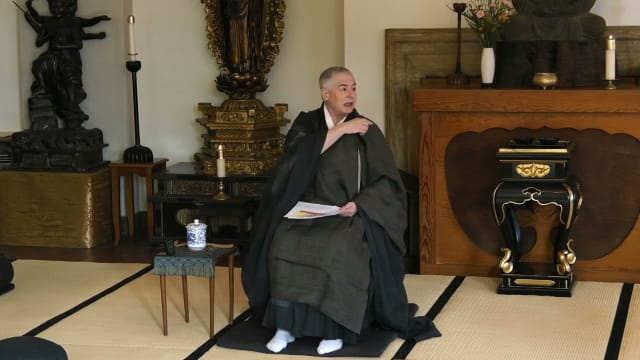
[1:27] Welcome to Beginners's Mind Temple. Uh
[1:29] my name is Erin Murk and I am a San
[1:34] Francisco Zen Center priest, but by day
[1:38] I work as a high school teacher. Um so I
[1:42] come occasionally here to offer talks
[1:45] and I'm really delighted to be able to
[1:47] spend the morning um here with you
[1:50] today. So, thank you very much to Art
[1:52] Tanzo Tim for inviting me to do so. And
[1:56] I truly hope that you leave here with a
[1:59] little practice nourishment to sustain
[2:02] you and to give a little life to your
[2:06] practice. So, thanks very much.
[2:09] Um, this week, perhaps like many of you,
[2:14] I've been thinking a lot about what it
[2:17] means to be a human.
[2:19] What's special about being a human
[2:22] being?
[2:26] What's problematic about being a human
[2:29] being?
[2:31] what our future as humans might be
[2:36] and how we can face all of these
[2:39] questions and all of the emotions that
[2:43] may be arising as we hear and sit in the
[2:47] middle of the onslaught of news. Kind of
[2:51] like the roaring stream of the news
[2:54] cycle.
[2:58] And as I've been thinking about this,
[3:00] just kind of sitting with it, turning
[3:02] it, and um
[3:06] just kind of tending to the experience,
[3:10] I realized that I wanted to go back to
[3:13] an old teaching that I find really quite
[3:17] nourishing and helpful. uh and hopefully
[3:21] will
[3:22] give something to chew on um for that
[3:25] question for feelings that you also may
[3:28] be sharing with me um during this time.
[3:34] So this early teaching comes from one of
[3:38] the earliest collection of the Buddha's
[3:42] actual discourses. It's called the uh
[3:46] Samya Nikaya. And um before I actually
[3:50] dive into the story, um one of the
[3:55] kind of miraculous and hopeful aspects
[3:58] of humanness that I sometimes remember
[4:02] to contemplate is how technologically
[4:08] incredible we actually are just in
[4:10] ourselves. And um we only have access to
[4:15] these teachings because human beings
[4:18] carried them in their bodies for
[4:21] hundreds and hundreds of years before we
[4:24] had the ability to write things down.
[4:29] These teachings were actually memorized,
[4:31] carried, contemplated, turned passed
[4:35] from person to person, from warm hand to
[4:38] warm hand. And when I think about that
[4:41] and kind of what we're able to hold on
[4:44] to and pay attention to now and maybe,
[4:47] you know, some of the skills that we put
[4:49] our attention towards instead of
[4:52] something as possibly potentially
[4:54] tedious uh as memorizing text. Um
[5:00] anyway, I feel inspired and just kind of
[5:03] amazed that we're actually able to
[5:05] access um these very old, precious
[5:10] teachings.
[5:20] So this story that I want to focus on is
[5:24] called the tangle. And I imagine that
[5:28] many of you might be familiar with this
[5:30] story. It's a very um I think it's a
[5:33] story that really speaks to our moment
[5:37] and possibly every moment that humans
[5:39] have experienced since that time.
[5:43] Uh, and like many if not all of the
[5:47] Buddha's discourses, this centers on a
[5:51] real or supposedly real interaction
[5:54] between the Buddha and one of his
[5:57] students. So, it's a teaching story, but
[5:59] it's also a story of people meeting each
[6:03] other face to face, people uh intimately
[6:08] knowing each other, listening to each
[6:10] other's practice, listening to each
[6:13] other's kind of inmost concern and
[6:17] responding, meeting each other. So, I
[6:20] find it a very
[6:23] just a beautiful reminder of h what
[6:28] we're what's possible for us when we
[6:30] actually can slow down enough to find
[6:34] those questions and to be able to create
[6:37] communities where we can ask them
[6:40] together, where we can turn them
[6:42] together.
[6:45] So this story focuses focuses on the
[6:48] meeting between a fellow named Jata and
[6:53] apparently Jata actually means tangle.
[6:57] So the word the person's name means
[7:00] tangle
[7:02] and jata says to the Buddha himself
[7:07] a tangle within a tangle without
[7:11] people are entangled in a tangle.
[7:15] Gotama, which is the name of the Buddha.
[7:19] Gotama, I ask you this. Who can untangle
[7:24] this tangle?
[7:27] A tangle within,
[7:29] a tangle without
[7:32] people are entangled in a tangle.
[7:36] Got Tama, I ask you this. Who can
[7:41] untangle this tangle?
[7:45] So I remember the first time I heard
[7:48] this teaching was actually right here in
[7:51] the Buddha hall and I think it was
[7:53] within the first year of starting to
[7:56] practice here. So it was about 25 years
[7:59] ago which is hard to hard to imagine.
[8:02] And I remember experiencing a kind of
[8:06] resonant surprise at how contemporary,
[8:10] how close this question felt to what I
[8:15] was experiencing to the kinds of
[8:17] questions that brought me into this
[8:19] space and led me to explore what other
[8:23] ways, what else can I do with my human
[8:26] life? What should I do with my human
[8:28] life?
[8:29] >> [snorts]
[8:29] >> So it surprises me every time I hear it.
[8:33] Um, who can untangle this tangle? Feels
[8:36] like such a human, such a familiar
[8:41] question. And even the language, this
[8:44] the visceral feeling and um quality of
[8:48] tangled tangledness feels um so accurate
[8:53] right now. I'm not sure if it resonates
[8:55] for you, but for me still feels very
[8:57] accurate.
[9:00] Um
[9:03] and I feel like the question itself
[9:08] reading it again as I was kind of
[9:11] thinking about how to approach today's
[9:13] the time today um
[9:18] really just pointing me towards
[9:21] how to live how to point my human life
[9:25] in a direction.
[9:28] away from all of the confusion and
[9:30] speed. Away from the distracting
[9:35] um kind of urgent
[9:39] feeling around me towards what's
[9:42] actually going to help me and help
[9:46] others
[9:47] move towards justice, towards
[9:50] liberation,
[9:52] towards a different narrative, a
[9:54] different vision for ourselves as
[9:56] humans.
[10:00] >> [clears throat]
[10:04] >> A tangle within,
[10:07] a tangle without
[10:10] people are entangled in a tangle.
[10:15] Go Tama,
[10:17] I ask you this. Who can untangle this
[10:21] tangle?
[10:39] So while the question itself is quite
[10:43] touching and resonant for me personally,
[10:46] I think it's the Buddha's answer and
[10:48] response that
[10:51] helps nudge me and
[10:54] direct me and kind of shine the light
[10:58] towards
[11:01] how to respond.
[11:03] So, receiving this very heartfelt
[11:06] question from a student, from someone
[11:10] he's working with, um someone he's
[11:13] probably familiar with and intimate
[11:16] intimately engaged in practice with.
[11:21] Uh
[11:23] the Buddha says to Jata,
[11:28] "A person established in virtue,
[11:32] discerning,
[11:34] developing discernment and mind,
[11:37] a practitioner,
[11:39] ardent, astute.
[11:42] She can untangle this tangle.
[11:48] Those whose passion, aversion and
[11:52] ignorance have faded away.
[11:55] Devoted practitioners their affluence
[11:58] ended.
[12:00] For them the tangles untangled.
[12:04] Where name and form along with
[12:07] perception of impingement and form
[12:10] totally stop without trace.
[12:13] That's where the tangle is cut.
[12:24] A person established in virtue,
[12:28] discerning,
[12:30] developing discernment and mind.
[12:33] A practitioner, ardent, astute,
[12:38] she can untangle this tangle. [snorts]
[12:44] Those whose passion,
[12:46] aversion and ignorance have faded away.
[12:51] Devoted practitioners their affluence
[12:54] ended. For them the tangles untangled.
[12:59] Where name and form along with
[13:01] perception of impingement and form
[13:04] totally stop without trace.
[13:07] That's where the tangles cut.
[13:13] So personally
[13:16] I find something quite grounding and
[13:19] also reassuring
[13:22] about the kind of calm matterof fact
[13:27] response to this question that seems
[13:30] potentially so overwhelming and so
[13:35] unanswerable. Who can untangle this
[13:37] tingle? feels
[13:39] like an overwhelming
[13:41] task and responsibility. Feels almost
[13:45] impossible to
[13:48] try to find the pieces to try to figure
[13:51] out
[13:53] where to pull, where to tug, what to do,
[13:56] how to handle this big knotted mess.
[14:05] We want to know how do we untangle this
[14:08] tangle. And the Buddha uh with
[14:11] gentleness I think but also quite firmly
[14:16] pushes the question back to Jata pushes
[14:20] the tangle back towards him and reminds
[14:24] him of practice.
[14:27] We see two simple practices in this
[14:31] response. How do we untangle the tangle?
[14:35] Starts with virtue. Those established in
[14:38] virtue. So starts with precepts. How do
[14:41] we actually
[14:44] where do we aim our actions? Where do we
[14:46] point our actions? How do we at least
[14:50] try to make an effort towards wholeness,
[14:53] towards uprightness, towards skill? Even
[14:56] if it's not perfect, we have a template
[14:59] of precepts.
[15:02] And the next piece of this response to
[15:05] jata, our practice actually starting
[15:09] with ourselves, starting with our own
[15:12] bodies and minds, starting with our own
[15:16] karmic um experience, our karmic
[15:19] conditions. That's really the only place
[15:23] that we can start. Starting with the
[15:26] tangle with the edges of tangle the
[15:29] pieces of tangle that we can contact
[15:33] that we can shine our own practice light
[15:36] on
[15:43] a person established in virtue.
[15:46] So a person who's um
[15:51] who's
[15:53] working who's engaged
[15:57] with precepts with what it means to be
[16:00] an ethical human knowing
[16:04] all the possible routes that we can take
[16:06] as humans.
[16:08] We know that there's some percentage
[16:12] um
[16:13] of chance that we can we can go off and
[16:18] do a lot of harm as humans. We have that
[16:20] tendency. It's right in our first noble
[16:23] truth. Humans have a tendency to uh to
[16:28] be deeply confused.
[16:30] And this deep, deep confusion
[16:33] gives us this itchy, edgy, speedy
[16:37] quality
[16:38] makes us want to run out of our skin to
[16:42] distract ourselves, to numb ourselves,
[16:45] uh to turn away, to do anything but
[16:48] actually face the pieces of the tangle
[16:53] that land inside of us, that are ours to
[16:57] take care of. Um, so the Buddha says,
[17:02] "Here you go. You've got a practice
[17:04] template.
[17:06] You get to untangle the tangle.
[17:18] Where name and form
[17:21] along with perception of impingement and
[17:23] form totally stop without trace.
[17:28] That's where the tangle is cut.
[17:35] Actually gathering our gathering our
[17:38] attention from all the places that it
[17:42] can go and bringing it back to
[17:44] ourselves, turning it back onto our own
[17:48] experience.
[17:50] getting really small and really slow,
[17:53] which in my experience is hard to do,
[17:57] especially when the culture around us is
[18:01] moving so fast and is so complex and
[18:06] takes us really easily out of our
[18:09] grounded and embodied experience.
[18:14] So the Buddha says, "Don't forget your
[18:18] don't forget your inmost requests. Don't
[18:21] forget
[18:22] the vows that you want to take as a
[18:27] human. Don't forget
[18:29] that you can actually stop. You can
[18:32] stop.
[18:34] You can turn your attention to yourself.
[18:38] You can turn your attention to your own
[18:40] piece of the tangle.
[18:45] And bit by bit,
[18:47] you we untangle our tangle. You untangle
[18:51] your tangle. No one's going to untangle
[18:54] the tangle for us.
[19:14] >> [clears throat]
[19:17] >> So working in a high school
[19:21] um myself as you can imagine um
[19:26] is a very speedy vibrant place and
[19:31] because we're an independent high school
[19:33] in San Francisco and
[19:36] lots of competition to kind of both keep
[19:39] the school going, keeping it interesting
[19:42] and relevant um for the time we're in.
[19:47] Very focused on the question of
[19:50] technology of what's the most important
[19:55] what are the most important skills for
[19:58] young people to be engaged in to come
[20:02] away with.
[20:04] What is a portrait of a graduate right
[20:06] now? What skill should they leave with?
[20:09] And sometimes I'm surprised at what um
[20:14] how confusing this question really is,
[20:16] right? Do we prepare? Do we put young
[20:19] people do we equip young people with all
[20:23] of um the technologies blooming around
[20:26] us? Do we kind of immerse them in that?
[20:29] Do we get them ready um to be
[20:31] competitive and to be part of this
[20:35] boom and development and vision that's
[20:39] growing around us?
[20:41] Or do we give them skills to look
[20:46] critically at how the culture is
[20:48] developing? um to be able to look around
[20:52] and see what's happening to actually
[20:56] have contact with their bodies to
[20:59] actually be embodied it's a big question
[21:02] and I happen to work in a department
[21:05] it's unusual it's called body mind
[21:08] education
[21:09] and it's a require it was it is a
[21:12] required course still for 9th and tth
[21:15] graders and we're able to offer
[21:17] practices
[21:19] of various mind body disciplines like
[21:23] yoga um also rock climbing and different
[21:30] somatic um inquiries as well as health
[21:34] education
[21:36] and um our program this year was cut in
[21:41] half. Um so now there's just a little
[21:44] bit of embodiment education for kids. um
[21:49] and a little bit more the technology, a
[21:54] little bit more of kind of staying
[21:57] competitive and keeping up with how the
[22:00] culture is changing
[22:02] and what I'm noticing. And then there's
[22:05] a big question about
[22:07] phones in the classroom and
[22:11] what's okay, what's not okay? uh how do
[22:15] we keep students from using AI or do we
[22:18] let them use AI to teach them how to use
[22:20] the tool? What do we do? And what I'm
[22:24] noticing is
[22:26] how confused, how exhausted, how um in
[22:33] some cases anxious and depressed the
[22:37] students are feeling, how much they just
[22:40] want to be in their bodies really. Um,
[22:43] so almost every day I get a question
[22:46] from kids. Uh, Miss Burke, can we just
[22:50] can we just go outside and like lay down
[22:54] on the grass? It's really what they want
[22:56] to do. It's kind of the most exciting
[22:59] thing that they could imagine,
[23:02] you know, and sometimes I'll be able to
[23:04] say, uh, sure, I think we can do that.
[23:08] And sometimes it feels like there's a
[23:10] lot of pressure, right, to kind of fit
[23:13] um squeeze content into them, which
[23:16] seems ironic given that our, you know,
[23:19] focus is body mind education. But I
[23:22] think there's this sense in our culture
[23:25] um that there's just never enough time,
[23:27] that we're kind of speeding along, that
[23:29] we're um we're not
[23:33] often able to move at a pace that
[23:36] actually lines up with our human uh our
[23:40] human bodies. And so having permission
[23:43] and having reminders to be embodied and
[23:46] even being reminded of the simplest
[23:50] practices that we can do to awaken that
[23:54] sense, that incredible human capacity to
[23:58] be present with ourselves. Um, it seems
[24:01] so small in the midst of these big
[24:05] emerging advancements to our culture and
[24:08] society, but it's otherwise really
[24:11] otherwise we're we're making ourselves
[24:15] very sick in my opinion. We're making
[24:17] ourselves um unable to actually be the
[24:22] incredible beings that we are and to
[24:25] realize our potential as humans. And
[24:29] when I think about someone carrying this
[24:32] incredible cannon of teachings in their
[24:34] bodies, it's hard to imagine being able
[24:37] to pay attention that long. Um to
[24:40] remember to take in the not just the
[24:42] words, but the meaning of these
[24:44] teachings, carry them around like
[24:47] they're something precious, and be able
[24:49] to pass them along just through our
[24:52] bodies.
[24:53] So I thought we could do a very um very
[24:57] simple experiment
[25:00] just to kind of show and just to kind of
[25:04] remind ourselves that embodiment is
[25:07] available and we don't you know we have
[25:10] we happen to have this beautiful space
[25:13] um that we can access here at city
[25:16] center and we have these um cushions, we
[25:19] have an altar, we have a lot of
[25:21] beautiful um forms and structures around
[25:25] us that can be very helpful to and help
[25:27] us feel like this is important and this
[25:30] is maybe ceremonial and something that's
[25:33] going to help us make meaning. But
[25:35] really, even when you're just on the bus
[25:37] or walking down the street, embodiment
[25:42] is available. You don't have to actually
[25:44] be in these special conditions.
[25:48] So I want us to experiment with a very
[25:52] very simple practice of just noticing
[25:56] the breathing body if you're willing.
[25:59] And if you're not so into it, it's okay.
[26:01] No one will know whatever you're we
[26:03] can't really see into your mind. So you
[26:06] do you. Uh but to do this practice,
[26:10] I want to recommend that you actually
[26:12] close your eyes, which is not something
[26:14] that we do in our zazen practice. This
[26:17] we usually practice with eyes open.
[26:20] Just close your eyes to take that sense
[26:23] of vision to give it a break
[26:28] and take a moment just to
[26:33] locate
[26:36] the movements of your breathing body.
[26:45] And you perhaps can envision your
[26:49] awareness or your perception
[26:53] as a very soft flashlight.
[26:57] Just a very soft light.
[27:02] So not like trying to chase
[27:07] a mountain lion through the city.
[27:11] More like just very gently,
[27:14] very gently noticing.
[27:28] As you locate your
[27:33] breathing body,
[27:40] take a moment just to notice.
[27:52] [clears throat]
[27:54] Can you find? Can you sense
[28:00] the particular
[28:03] textures, feelings, shape
[28:08] of your breath?
[28:15] If you picture your breath like
[28:19] ink spreading on a tissue paper,
[28:23] what shape does it make?
[28:39] Can you find
[28:41] [clears throat]
[28:42] Can you find the point of
[28:45] beginning
[28:46] of your inb breath.
[28:57] What happens
[29:01] just before you take your exhale?
[29:15] If you let go of [snorts]
[29:19] you
[29:21] breathing
[29:28] just relax into this
[29:32] body breathing itself.
[29:41] How does it feel for you?
[30:00] And now if we transition back into um
[30:07] just allowing you can open your eyes
[30:09] just a little bit if you want to.
[30:14] What is it?
[30:16] What's it like to
[30:18] include a little bit
[30:22] of vision, a little bit of
[30:25] sense of sight.
[30:28] Do we lose the breath? What happens?
[30:54] So I want to propose that this kind of
[30:58] simple very basic
[31:02] [snorts]
[31:03] present moment
[31:05] awareness and present moment embodiment
[31:10] is really fundamental
[31:14] towards
[31:16] untangling our tangles.
[31:19] And I think um
[31:23] I'll speak for myself sometimes I feel a
[31:27] lot of pressure to do and feel like I
[31:30] almost can't do enough. I can't be
[31:33] enough or be in as many places doing as
[31:37] many things as I
[31:40] feel like I should be.
[31:45] And that's true. Right? We really we're
[31:47] embodied creatures. We live here, right
[31:50] here. This is where our life is
[31:54] unfolding and it's the only
[31:57] only life that we actually have is right
[32:00] here in our bodies.
[32:02] So
[32:04] finding ways
[32:07] back to yourself,
[32:09] finding ways to build capacity for
[32:12] presence
[32:14] and attention
[32:16] is one of the most important
[32:20] paths and practices that we can do
[32:22] together.
[32:26] And I know for myself when I see others,
[32:29] for example, my partner uh Mary, she's
[32:34] very very devoted uh every morning to
[32:37] making space for sitting no matter
[32:39] what's happening in her life. And when I
[32:43] see her do that and I'm often very
[32:45] frantic in the morning and getting ready
[32:47] to go,
[32:49] it just it's a mirror.
[32:51] echoes back to me and I feel like oh
[32:54] yeah embodiment is
[32:57] don't [clears throat] leave the house
[32:59] don't try to form relationships connect
[33:02] with others before
[33:05] that connecting and reconnecting
[33:08] with myself without um really being in
[33:12] my body being grounded
[33:15] understanding and feeling and sensing
[33:18] all those points
[33:20] of tangle kind of understanding what I'm
[33:23] working with before I leave the house.
[33:28] So this practice may seem
[33:31] too simple and you know there's more
[33:34] obviously um the precepts are a whole
[33:39] other practice.
[33:42] I think the two really go hand in hand.
[33:46] And so, um,
[33:49] being able to cultivate, to be able to
[33:51] stand it enough to be in your body, to
[33:54] be present with yourself is
[33:57] makes the space to actually be able to
[34:00] receive some of the other teachings that
[34:03] may help us
[34:05] really tangle through
[34:07] the questions that we have about how
[34:11] like what do we do? How do I engage? how
[34:13] do I really engage with the question?
[34:16] Um, but if we do that from a space
[34:18] that's not grounded and embodied, then
[34:21] we're just, you know, it's just an
[34:23] intellectual question and we're not
[34:26] we're kind of disconnected from this
[34:29] field
[34:31] of our actual life of our actual present
[34:36] body awareness.
[34:41] So obviously here at city center um
[34:45] there are lots of opportunities for
[34:48] people to come and join um the community
[34:52] for practice and to practice together.
[34:56] And just by
[34:58] your choice to be here today, um,
[35:01] already shows and already kind of speaks
[35:06] to
[35:08] a shared vision, a shared value for
[35:12] doing something that's really quite
[35:15] different than what's going on um, out
[35:19] there around us. Um and if
[35:24] if people need more inspiration and
[35:28] connection
[35:31] that is also available and in in our in
[35:35] Zen tradition
[35:37] we're so much about having
[35:40] a warm hand to warm hand connection with
[35:44] teachers and with with our um kind of SA
[35:48] with our
[35:50] dharma friends that practicing alone,
[35:54] right, is not recommended is not
[35:57] recommended. It's not our it's not
[35:59] really the the particular way or flavor
[36:02] of Zen. Um, which is, I think, what also
[36:06] makes it very
[36:11] relevant to this collective tangle that
[36:14] we're in. That is something we we need
[36:18] to have that space where we take care of
[36:22] our own pieces
[36:24] of the tangle. We need to have that um
[36:28] time and devote that time and
[36:32] actual slowing down enough to do that.
[36:36] But we're also going to be doing it
[36:38] together. We also want to open our eyes
[36:42] and see the people around us and
[36:45] interact and engage and connect and talk
[36:49] about what's actually happening. Talk
[36:51] about what we're actually experiencing
[36:53] when we close our eyes and try to be
[36:56] present with ourselves.
[36:58] So, just a plug for community, for the
[37:02] community space here, um, right in the
[37:05] middle of the city and all of the ways
[37:08] that y'all can come and, you know, be
[37:12] part of what's happening here as you
[37:14] already are.
[37:17] So, in closing, I want to share
[37:21] the end of this particular story of Jata
[37:24] and the Buddha.
[37:27] Uh okay.
[37:29] So after receiving the Buddha's response
[37:33] and the Buddha's teaching,
[37:36] Jata experiences an incredible shift of
[37:39] mind. So after
[37:45] a person established in virtue,
[37:48] discerning, developing discernment and
[37:51] mind, a practitioner,
[37:54] ardent, astute,
[37:58] she can untangle this tangle.
[38:01] Those whose passion, aversion, and
[38:03] ignorance have faded away. devoted
[38:07] practitioners. Their affluence ended for
[38:10] them. The tingles untangled
[38:13] where name and form along with
[38:15] perception of impinch impingement and
[38:17] form totally stop without trace. That's
[38:22] where the tangle is cut.
[38:26] Hearing the Buddha's words, the Brahman
[38:29] Jata Buradvaja said to the blessed one,
[38:33] "Magnificent Master Gotama,"
[38:35] Magnificent, just as if he were to place
[38:38] upright what was overturned, to reveal
[38:41] what was hidden, to show the way to one
[38:44] who was lost, or to carry a lamp into
[38:47] the dark so that those with eyes could
[38:49] see forms. In the same way has master
[38:52] Goautma through many lines of reasoning
[38:55] made the dharma clear. I go to the
[38:58] blessed one for refuge to the dharma and
[39:01] to the community of monks. Let me obtain
[39:04] the going forth in master Gotama's
[39:06] presence. Let me obtain admission.
[39:11] Then the Brahman Jata Paradvaja received
[39:15] the going forth and the admission in the
[39:17] blessed one's presence. And not long
[39:20] after his admission, dwelling alone,
[39:22] secluded, heedful, ardent, and resolute,
[39:25] he in no time reached and remained in
[39:28] the supreme goal of the holy life for
[39:31] which the song rightly go forth from
[39:34] home into homelessness, knowing and
[39:36] realizing it for himself in the here and
[39:38] now. So miraculous change of heart.
[39:43] So, thank you again for your just your
[39:47] choice to be here today. There are lots
[39:50] of places that you could be um besides
[39:54] choosing a Dharma talk. Um and just
[39:58] wanting to extend out there wishes again
[40:03] that you each find courage and support
[40:07] that you need for your practice journey.
[40:10] um that the people around you offer
[40:13] inspiration and support and that
[40:16] together we
[40:19] meticulously
[40:20] untangle this tangle. So, thank you very
[40:24] much.
[40:28] [cough]
[40:36] >> Yes, I would.
[40:41] >> [snorts]
[40:55] >> place
[40:57] with the true
[41:03] They
[41:06] are.
[41:09] I
[41:12] save them.
[41:19] I
[41:25] [singing]
[41:35] unsurpassable.
[41:37] I [singing] bow to