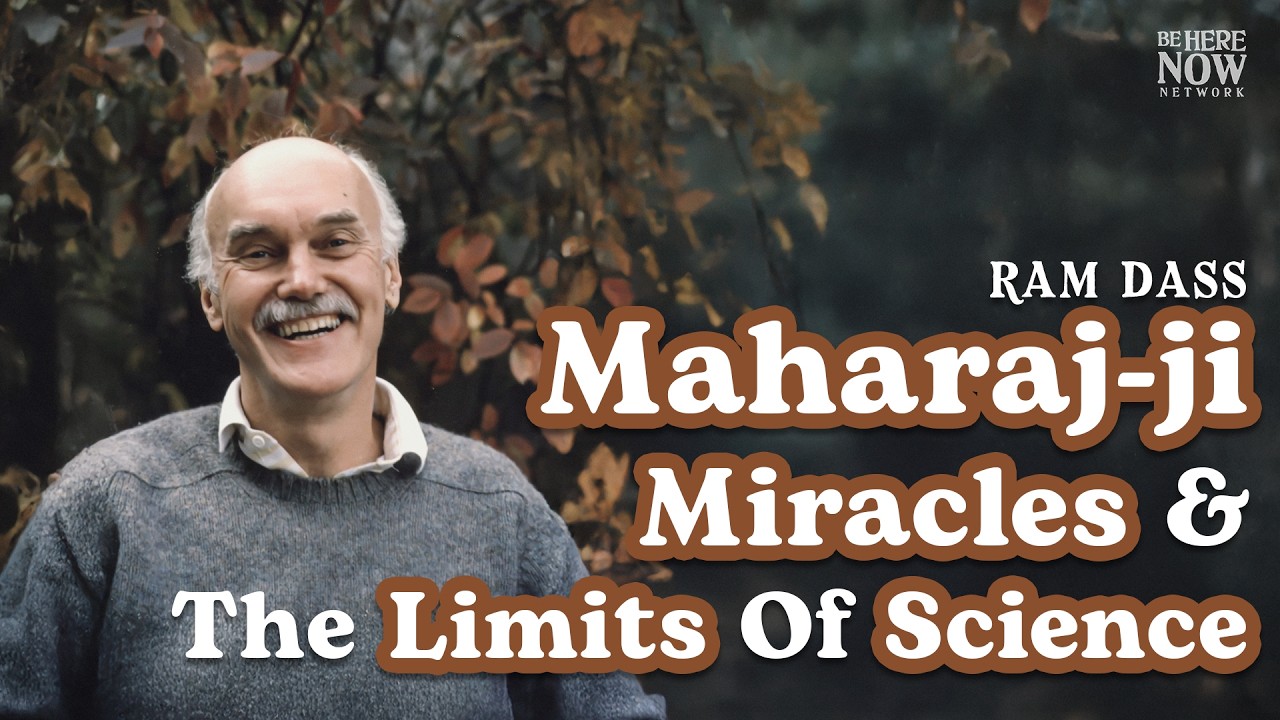
In a 1970 talk from Arlington Street Church in Boston, Ram Dass unpacks the central spiritual task: tuning up our vibrational rate to move from dualistic thinking (separation, judgment, "me vs. other") into nondual awareness (unity, presence, "here and now"). He explains that spiritual practice is not about tuning out of the world, but tuning into reality as it actually is—where the One and the many coexist. Drawing on figures like John the Baptist and Lao Tzu, Ram Dass demonstrates how consciousness can shift frequencies while living an ordinary life, and reveals the humor and vulnerability involved in maintaining that shift.
Ram Dass opens with a deceptively simple assertion: "We're not tuning out, we're tuning up. We're changing our vibrational rate." This distinction cuts to the heart of his teaching. Many people assume spiritual practice means withdrawing from life—becoming a monk, abandoning worldly concerns, checking out. Ram Dass proposes the opposite. Tuning up is about recalibrating your frequency while remaining engaged with existence.
The metaphor of tuning draws on music and radio. A radio tuned to the wrong frequency picks up static; tuned correctly, it receives a clear signal. Similarly, consciousness operates at different frequencies. Most everyday awareness operates at a dualistic frequency—we experience separation, judgment, comparison. The ego-self perceives itself as distinct from and in competition with others. Tuning up means shifting that frequency toward nondual awareness, where subject and object merge, where the perceiver and perceived are one.
Ram Dass frames this as the core work of spiritual life: "Tuning out of dualism into nondualism. Tuning into being here and now." The direction is clear—away from fragmentation and anxiety, toward wholeness and presence. But he emphasizes that this tuning happens not by escaping life, but by transforming how we engage with it.
A central question in Ram Dass's talk is how the One and the many can exist simultaneously. This is not an abstract philosophical puzzle—it's the lived reality anyone attempting spiritual practice encounters. You are one unified consciousness, yet the world presents endless multiplicity. You are here now, yet your mind pulls you into past and future. How do these truths harmonize?
Ram Dass draws on traditional wisdom to navigate this tension. John the Baptist appears in his talk as an example of someone embodying the paradox—announcing the coming of Christ while acknowledging his own subordinate role. Lao Tzu, the legendary Taoist sage, offers another model: the idea of effortless action in alignment with the natural flow of being.
The teaching suggests that dualism and nondualism are not opposing states to choose between, but frequencies that can interpenetrate. When your consciousness is tuned to the nondual frequency, the many do not disappear. You still perceive forms, colors, people, time. But the underlying sense of separation dissolves. The many are seen as expressions of the One, like waves on an ocean. Each wave is distinct yet inseparable from the water itself.
This has practical implications. You don't tune up by denying the existence of the world or your role in it. You tune up by perceiving that the world and your role arise within a unified field of consciousness. Actions continue—you work, relate, play—but the doer's sense of separation from the action loosens. The boundary between self and other becomes permeable.
Ram Dass addresses what he calls "the mind-trip of holiness"—a subtle pitfall in spiritual work. The ego, seeking validation and status, can co-opt spirituality. You become attached to being seen as holy, evolved, or advanced. You meditate to impress yourself or others. You adopt spiritual language and postures while the underlying consciousness remains egoic and contracted.
This is one of the great ironies of the spiritual path: the very practice meant to transcend ego can become a vehicle for ego aggrandizement. Ram Dass recognizes this danger and calls it out directly. Real spiritual tuning is not about becoming a better version of yourself—it's about the dissolution of the "self" that seeks improvement. It's not about accumulating spiritual credentials or experiences; it's about surrendering the one who accumulates.
The mind-trip of holiness also manifests as judgment. A spiritually advanced person might look down on those "less evolved," creating a new hierarchy and dualism. This contradicts the essence of nondual awareness, which includes all beings and states equally within consciousness. Tuning up requires noticing when spiritual practice becomes a form of self-aggrandizement and gently releasing that agenda.
Ram Dass illustrates the integration of practice and ordinary life with a memorable example: he mentions taking a night off from his sadhana (spiritual discipline) to go bowling. This seems almost comical—a spiritual teacher choosing bowling over meditation. But the point is serious. The goal of practice is not to achieve some transcendent state and cling to it. It's to develop the capacity to be present in any situation, whether sitting in meditative absorption or rolling a ball down a lane.
Sadhana—disciplined spiritual practice—is the "tuning up" apparatus. It might involve meditation, mantra repetition, service, study, devotion, or other practices. The sadhana creates the conditions and the momentum for consciousness to shift frequency. But the shift itself is not confined to formal practice. The real test is whether your consciousness stays tuned while you move through the world—while you work, relate, play, struggle.
This raises the question implicit in Ram Dass's talk: How do you maintain the tuning when the world is constantly trying to retune you downward? Advertising, social conditioning, fear, desire, conflict—these all pull consciousness back toward dualistic fragmentation. The spiritual work is ongoing precisely because the frequency naturally drifts in a contracted direction. Sadhana provides a counterforce, a regular retuning, so that presence can become more stable in ordinary life.
Ram Dass ends with a story about failing to maintain his consciousness at the right level during a Q&A session. This is a crucial inclusion. He doesn't present himself as having permanently solved the tuning problem. Even an accomplished spiritual teacher, someone who has spent years in intensive practice, still experiences the frequency dropping back toward dualism and ego. Consciousness slips. The teaching voice takes over. Reactivity emerges.
This vulnerability is essential to the integrity of his talk. If Ram Dass claimed to have permanently achieved nondual consciousness and never lost it, he would be participating in the mind-trip of holiness. Instead, he demonstrates that the spiritual path is one of continuous practice, continuous noticing, continuous course-correction. Tuning up is not a destination you arrive at and stay. It's an ongoing process, like tuning a musical instrument. You tune, and then you tune again.
This also addresses a common misconception about spiritual awakening. Many people imagine that enlightenment means never experiencing ego, reactivity, or lost presence again. Ram Dass suggests something different: awakening is noticing the tuning more quickly, returning to presence more readily, being less identified with the contraction when it arises. The frequency may still drop, but you know it and can adjust.
Ram Dass's teaching invites concrete questions and applications. First, can you identify the difference between dualistic and nondual consciousness in your own experience? When you judge someone, split them into "good" or "bad," or feel separate and alone, that's dualism. When you feel connected, when boundaries soften, when all beings appear equal in awareness, that's a taste of nonduality. Noticing this distinction is the foundation.
Second, what sadhana—what regular practice—would support your tuning up? This varies by person and context. For some it is meditation; for others, kirtan, yoga, service, or study. The practice should be something you can sustain, that resonates with you, that gradually shifts your baseline consciousness toward presence and wholeness.
Third, can you bring the fruits of practice into ordinary life? Can you bowl, work, relate, struggle—and still maintain some degree of presence and nondual awareness? This is where the real work happens. The goal of spiritual practice is not escaping the world but transforming your presence within it.
Finally, hold the teaching lightly. Don't make nondualism another concept to grasp or another achievement to pursue. The tuning up that Ram Dass points to is available now, in this breath, in this moment. It requires no special conditions, only attention. The practices and teachings are pointers, not the destination itself.