Amanda Sellers opens her October 2026 video with a question rather than a lecture: how do you want to spend the rest of this year and beyond? The prompt comes out of a real weekend. A voice acting workshop she was invited to teach two and a half hours from home in Regina sold out, and the organizer asked her to run it again the next day. From that small, slightly giddy experience she builds a short meditation on self-doubt, on the old voices that told her she didn't belong, and on a line of thinking she borrows from Oprah Winfrey and Gary Zukav's Seat of the Soul: that the only thing reliably standing between a person and a dream is the person. She closes with three questions meant to help a listener notice what is holding them back and pick one courageous move, one that does not wait for a green light from anyone else.
It is a brief, personal talk, about thirteen minutes long, and it is at its best when it stays close to the workshop floor. What follows explains the ideas in it, what they ask of a listener, and where the reasoning is thinner than the feeling behind it.
The scene Sellers describes is almost comically ordinary. An on-camera actor who had lived in Vancouver, not far from her own years there, moved back to Regina, his hometown. He had heard about her voice work and asked whether she would come teach his community, which had grown into a kind of acting school. Regina, she notes, had a surprising amount of filming going on that she hadn't known about. The flyer went out, the Saturday session sold out, and the Sunday session followed. (She also admits to changing her profile picture to the actor in his brief Deadpool role as the pizza boy, a detail that gets a laugh and tells you something about how loose the room was.)
The workshop matters in the talk for a specific reason. Voice work is, as she puts it, easier when you are alone in a small sound booth where nobody can see you. Standing up in front of fifteen strangers and using your voice is harder. That gap, between private skill and public exposure, is where her argument lives. Nobody needed to approve the workshop for it to happen. The people who showed up had already made the decision; the teacher's job was to make the next step feel possible.
This is the claim the whole talk turns on, and Sellers presents it as an epiphany she had while teaching. She tells viewers she came to a realization "as Oprah would say": that we are the only things that stop ourselves from reaching any goal or dream. She then ties that idea to her own origin story as a teacher.
"I had nobody. I feel like all I had were people telling me why I couldn't do it, why it wasn't possible, and you know, why not to bother." (Amanda Sellers, in her October 2026 video)
That history reframes the claim. In her twenties, she says, she never gave herself permission to feel she belonged. The voices around her were discouraging, and she absorbed them. Later, with hindsight, she came to see that she had been the one who knew what was possible all along. "There's no outside voices that can tell you what you can and can't do," she says.
The argument is worth taking seriously on its own terms. Sellers is not claiming that external obstacles are imaginary. She is claiming that the internal decision to accept a limit, or to wait for someone to grant you a right to try, is the one piece of the obstacle you can actually change. It is a demanding idea, and it can curdle into self-blame if read carelessly. Her framing points the other way: if you are the only one in the way, you are also the only one who can move.
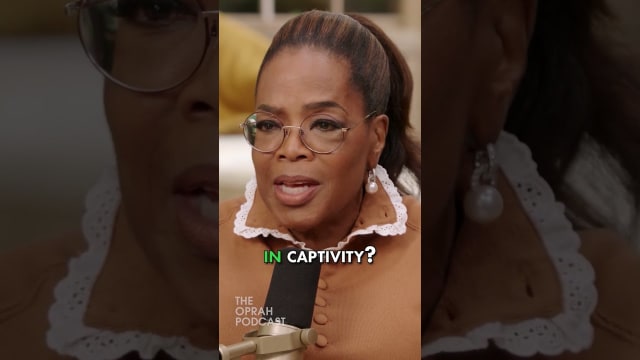
Sellers draws on a podcast conversation between Jay Shetty and Oprah, and she quotes one line from it that she clearly returns to: "My dreams were not big enough to hold what has actually happened to me." The passage continues with a related point about scale: "Lean into a dream that is bigger than the layout that you have planned for yourself." Her reading is that most people draw a plan and then stop imagining, when the more useful move is to lean further into the dream than the plan allows.
She also notes something she found striking about Winfrey. By Sellers's account, Oprah never struggled with imposter syndrome and always believed she belonged in the rooms she entered. Sellers says she envies that certainty and admits she didn't have it in her early twenties. The lesson she draws is not that you must feel confident first. It is that Winfrey "kept believing and she kept showing up and taking the next step." Confidence, in this telling, follows action rather than preceding it.
The middle of the talk introduces what might be its most interesting distinction. Big, vibrant personality is not the problem, Sellers says. The question is where that personality is speaking from. Is it coming from fear and a hunger for recognition and validation? Or can it be aligned with your talents, your vision, and your soul, and used in service of others?
Here she cites Seat of the Soul by Gary Zukav, a book she says she has not read but now wants to. She paraphrases the idea she took from Winfrey's discussion of it: when the personality comes to serve the energy of the soul, it aligns with that energy, and that alignment is what she calls authentic empowerment. The reach does not have to be Oprah's reach. It can be the community you are part of, the people within your range. Sellers is careful to make the scale modest: "It doesn't have to be you become Oprah." What matters is the direction of the energy, not the size of the audience.
She offers a practical test in that same vein. Her best friend, she says, calls her the funniest person she knows, because she is simply herself at her friend's house, with nothing in the way. Authenticity, for Sellers, is not about performing your full self on a stage. It is about dropping the filters and masks so that the service you offer comes from who you actually are.
Sellers distills the talk into three prompts, and they work best as a sequence rather than a checklist.
- Stop scripting your limitations. She reminds listeners that there are 65 days left in the year and asks what needs adjusting, shedding, or letting go. Does it call for a hard conversation, a phone call, an email, some journaling, a shake-out, a scream? If you are the only one blocking yourself, what will you do about it? If you are the only one who truly knows, how do you tap in: through stillness, or through connection?
- Shift from self-conscious to being of service. Here she describes her own slow progress. She says she feels called to help and to show what is possible, and that the more she unblocks herself, the more she can lean into service. She does not require a platform. The question is simply where your particular gifts could be of use.
- Reclaim the captaincy. Her image is a ship with a steering wheel. There are waves and detours, but it is your ship to sail. No green light, validation, course, or extra training is needed more than an inward look. She asks whether there is a bold decision you could make, or an intuitive whisper you have been ignoring.
The third question carries the most weight. Sellers acknowledges that courage is not comfortable. Teaching the Regina workshop, she says, she knew people would feel nervous and exposed, and she could see when she was pushing someone too far, so she eased off. The brave step, in her framing, is not a grand gesture. It is the next honest move, sized to what you can actually take.
A careful reader should notice what the talk leaves undeveloped. Sellers offers a strong emotional frame and a generous reading of Winfrey, but the claim that we alone block ourselves is presented as an insight rather than argued. Some obstacles are structural: money, access, discrimination, a lack of training or opportunity. Her own story is about a person who found a door open once she stepped toward it, and that experience is real. It is not the same thing as proof that the door would open for everyone. The talk works best as an invitation to examine your own part of the picture, not as a complete theory of how change happens.
That caveat does not undercut the questions themselves. "Where can you be of service?" and "Is there an intuitive whisper you've been ignoring?" are useful prompts whatever your circumstances. They ask you to notice, and then to act at a scale you can manage.
If the talk has landed, the most useful next step is small and specific. Take Sellers's three questions and write short answers to each on paper, not on a screen. Name one thing you are scripting as a limitation, one place your gifts could serve people near you, and one decision you could make in the next week that does not wait for permission. Then make that one move. The talk's own logic suggests that the confidence you are waiting for is more likely to arrive after the step than before it.
For further reading, Sellers points listeners to Gary Zukav's Seat of the Soul, which she says she plans to read, and to the Jay Shetty and Oprah podcast conversation she quotes. Both are the sources of her most memorable lines, and both are worth reading or listening to in full rather than relying on her paraphrases alone.