BrightStar

Parcourir tous les Events

Découvre des rassemblements conscients

events

Yoga
Meditation
Breathwork
Qigong
Sacred Music
World Music
Medicine Music
Sound Healing
Ecstatic Dance
Ceremony
Destinations populaires
BaliSedonaLos AngelesCosta RicaNew YorkSan FranciscoAustin
Voir toutes les catégoriesVoir toutes les destinations

Explorer toutes les fonctionnalités

Des outils puissants pour développer tes événements

Fonctionnalités de la plateforme

Tarification dynamique intelligente
Catégories de billets
Places assignées
Récupération des paniers abandonnés
Récupération des visiteurs
Dons & Prix variables
Système d'affiliation
Scanner de billets
Codes promo
Questions personnalisées
Partage de billets
Ventes additionnelles & Options
Analyses & Rapports
Séquences d'emails
Liste d'attente / Notifier / Rappeler
Personnes & Lieux
Artists & TeachersEvent OrganizersVenues & StudiosKnowledge BaseGlossaryInspiration
Voir toutes les fonctionnalitésÀ propos
TarifsBlog
Language
Saved events
Parcourir tous les événements

events

YogaMeditationBreathworkQigongSacred MusicWorld MusicMedicine MusicSound Healing

Destinations populaires

BaliSedonaLos AngelesCosta RicaNew YorkSan Francisco

Personnes & Lieux

Artists & TeachersEvent OrganizersVenues & StudiosKnowledge BaseGlossaryInspiration

Fonctionnalités de la plateforme

Tarification dynamique intelligenteCatégories de billetsPlaces assignéesRécupération des paniers abandonnésRécupération des visiteursDons & Prix variablesSystème d'affiliationScanner de billetsCodes promoQuestions personnaliséesPartage de billetsVentes additionnelles & OptionsAnalyses & RapportsSéquences d'emailsListe d'attente / Notifier / Rappeler
Voir toutes les fonctionnalitésÀ propos
TarifsBlog
ConnexionS'inscrire
  • Parcourir tous les Événements
  • Pour les chercheurs
  • Yoga
  • Méditation
  • Breathwork
  • Qi gong
  • Musique sacrée
  • Musiques du monde
  • Musique médecine
  • Soins sonores
  • Danse extatique
  • Cérémonie
  • Retraites
  • Ateliers
  • Toutes les catégories →
  • Bali
  • Sedona
  • Los Angeles
  • Costa Rica
  • Byron Bay
  • San Francisco
  • Austin
  • New York
  • San Diego
  • Seattle
  • Toutes les villes →
  • Join the Movement
  • Why we list
  • Sell Globally
  • Pour les créateurs
  • Pour les équipes
  • Pour les écrivains
  • Pour les enseignants
  • Pour les artistes de kirtan
  • Pour les studios
  • Pour les festivals
  • Pour les centres de retraite
  • Pour les associations
  • Ambassadeur de marque
  • Billetterie gratuite
  • Elevate
  • Amplify
  • Réseau de 500K+ acheteurs
  • Récupération des paniers abandonnés
  • Tarification dynamique intelligente
  • Catégories de billets
  • Événements récurrents
  • Places assignées
  • Système d'affiliation
  • Liste d'attente / Notifier
  • Scanner de billets
  • Widget intégrable
  • Diffusion d'événements
  • Messagerie
  • Intégrations
  • Rapports
  • Toutes les fonctionnalités →
  • À propos
  • L'écosystème
  • Blog
  • Glossaire
  • Inspiration
  • Centre d'aide
  • Contact
  • Documentation API
  • Ressources de marque
  • Carrières
  • Presse
  • Conditions d'utilisation
  • Politique de confidentialité

Événements

  • Parcourir tous les Événements
  • Pour les chercheurs
  • Yoga
  • Méditation
  • Breathwork
  • Qi gong
  • Musique sacrée
  • Musiques du monde
  • Musique médecine
  • Soins sonores
  • Danse extatique
  • Cérémonie
  • Retraites
  • Ateliers
  • Toutes les catégories →

Destinations

  • Bali
  • Sedona
  • Los Angeles
  • Costa Rica
  • Byron Bay
  • San Francisco
  • Austin
  • New York
  • San Diego
  • Seattle
  • Toutes les villes →

Pour les créateurs

  • Join the Movement
  • Why we list
  • Sell Globally
  • Pour les créateurs
  • Pour les équipes
  • Pour les écrivains
  • Pour les enseignants
  • Pour les artistes de kirtan
  • Pour les studios
  • Pour les festivals
  • Pour les centres de retraite
  • Pour les associations
  • Ambassadeur de marque
  • Billetterie gratuite
  • Elevate
  • Amplify

Fonctionnalités

  • Réseau de 500K+ acheteurs
  • Récupération des paniers abandonnés
  • Tarification dynamique intelligente
  • Catégories de billets
  • Événements récurrents
  • Places assignées
  • Système d'affiliation
  • Liste d'attente / Notifier
  • Scanner de billets
  • Widget intégrable
  • Diffusion d'événements
  • Messagerie
  • Intégrations
  • Rapports
  • Toutes les fonctionnalités →

Entreprise

  • À propos
  • L'écosystème
  • Blog
  • Glossaire
  • Inspiration
  • Centre d'aide
  • Contact
  • Documentation API
  • Ressources de marque
  • Carrières
  • Presse
  • Conditions d'utilisation
  • Politique de confidentialité
BrightStar
Téléchargez l'app
Télécharger dans l'App StoreDisponible surGoogle Play
© 2026 BrightStar. Tous droits réservés.
Inspiration

Six Realms of Mind: What Shifted on Election Day

Susan
Susan
Nov 13, 2026
7 min de lecture

Source : Susan Piver

Something shifted on November 3rd. Not in the mechanics of government or the balance of power alone, but in the texture of collective experience itself—the felt quality of what it means to inhabit a shared world. The explanations are familiar: economic anxiety, war fatigue, institutional decay. But beneath the surface causes lies a deeper question that Buddhist philosophy addresses with unusual precision: What kind of consciousness were we experiencing, and what kind have we entered?

Susan Piver, a meditation teacher and dharma communicator, turns to one of Buddhism's oldest cosmological maps—the teaching of the six realms of existence—to make sense of national shifts in consciousness. The six realms are not literal places in the Buddhist view, but rather descriptions of mental and emotional states that human beings cycle through individually and, implicitly, collectively. They are governed by different emotional colorations: pleasure, jealousy, craving, fear, and pain. Understanding them offers a vocabulary for discussing not just what we think, but how we think—the underlying tone and texture of our minds.

Lecture · 5 sections

The Mandala of Mental States

In traditional Buddhist cosmology, the six realms form a mandala—a circular diagram that maps the landscape of consciousness. Each realm describes a distinct quality of experience. The gods dwell in pleasure and complacency; the demigods are consumed by jealousy and competition; humans occupy a middle ground of mixed experience; animals are trapped in confusion and instinct; the hungry ghosts are defined by craving and deprivation; and the hell realm is characterized by aversion, rage, and fear.

These are not punishment or reward systems imposed from outside. Rather, each realm emerges naturally from the mind's habitual patterns. A mind dominated by jealousy and the need to win creates, from within itself, the experience of the demigod realm—a realm of constant striving, perpetual comparison, and the exhaustion that comes from never being satisfied. Similarly, a mind organized around craving experiences the deprivation of the hungry ghost realm regardless of material abundance, because the inner structure of desire always exceeds what can be satisfied.

What makes this teaching relevant to contemporary American experience is its suggestion that societies, like individuals, can inhabit these realms. A culture built on competition, aggression, and the accumulation of status—where success is measured by victory over others and where pleasure comes from dominance—is, in Buddhist terms, inhabiting the demigod realm. The emotional signature of such a realm is jealousy, comparison, and a chronic sense of insufficiency that no external victory fully resolves.

Why the Human Realm Holds Unique Potential

Among the six realms, the human realm occupies a unique position in Buddhist thought. It is not the most pleasant—the gods experience far more comfort—nor is it the most orderly. But it contains something the other realms lack: a balance of pleasure and pain, comfort and difficulty, that creates the conditions for awakening. The Buddha himself chose to be born in the human realm and taught that it is the ideal platform for spiritual liberation precisely because humans encounter genuine choice.

Unlike the gods, who are too comfortable to question their experience, or the hell beings, who are too overwhelmed by suffering to think clearly, humans live in a zone where both reflection and action are possible. We experience enough security to ask "What is this?" and enough challenge to care about the answer. This is why contemplative traditions universally recognize human birth as precious.

Piver's suggestion—that the United States may have shifted from a demigod realm (competition, aggression, winning-at-all-costs) into a more human realm (mixed experience, genuine choice, the possibility of wisdom)—proposes that the election itself was a transition in consciousness. Not into perfection or permanent peace, but into a realm where authentic change becomes possible. The demigod realm is exhausting precisely because it is never satisfied; the human realm is workable precisely because it asks us to think.

Fighting with the Wrong Weapons

A critical insight emerges from understanding these realms: they each have their own logic and their own weapons. The demigod realm operates through competition, accumulation, and domination. Its weapons are aggression, cunning, and the relentless drive to win. But if a society has shifted into a more human realm—one capable of genuine care, logic, and interdependence—then fighting with the weapons of the demigod realm becomes not just wrong but ineffective.

This is a subtle but powerful reframing. It suggests that the call for kindness, compassion, and fierce logic in response to collective challenges is not sentimental; it is practical. These are the weapons appropriate to the realm we now inhabit. Trying to build a world of care and cooperation using the tools of aggression and domination is like trying to win a game of chess with boxing gloves. The tools and the terrain are mismatched.

Conversely, entering a demigod realm and trying to respond with only gentleness and appeasement is equally ineffective—it looks like weakness to those operating in a realm where dominance is the only recognized currency. The question becomes: What weapons, what approaches, what qualities of mind are actually appropriate to the realm we occupy?

Can Kindness Become the Operating System?

The broader question Piver raises is whether a world built on competition and aggression can transform into one built on kindness, compassion, and mutual care. This is not a soft question. It cuts to whether human consciousness itself can change at scale, and whether such change is durable.

Buddhist philosophy suggests it is possible, but not inevitable. The realms are not fixed; consciousness moves between them. Individuals can slip from a demigod realm of constant striving into a human realm of genuine reflection. Societies can do the same. But the shift requires more than electoral change; it requires a shift in the underlying emotional and mental structures that organize experience.

The teaching on the six realms offers a framework for understanding what such a shift would actually entail. It would mean moving from an operating system based on comparative advantage and dominance to one based on recognition of our actual interdependence and shared vulnerability. This is radical. It means that the currency of status, which organized the previous regime, would need to lose its power over us. It means that kindness, fierce logic, and care for others would need to become not peripheral virtues but the central pillars of how we organize society.

Is this realistic? The Buddhist answer is yes, but with caveats. The realms shift. People wake up. Societies change. But they do so through consistent practice and through the accumulation of small shifts in consciousness—moments where we choose the weapon appropriate to the realm we inhabit, rather than the weapon we learned in the realm we left behind.

Where to Go From Here

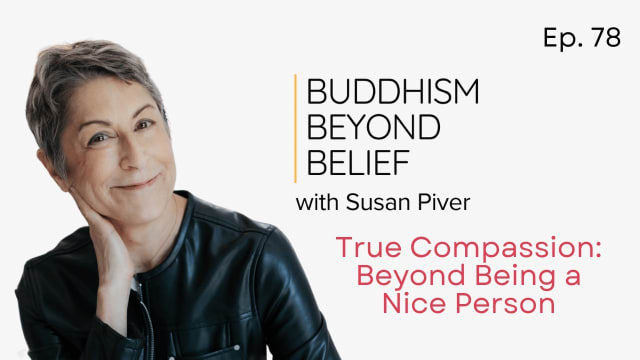
For those interested in exploring these teachings more deeply, Piver has recorded a full episode on Buddhist cosmology and the six realms as part of her podcast series Buddhism Beyond Belief, specifically Episode 12, which provides more detailed analysis of each realm and its characteristics. Additionally, a workshop on the Five Buddha Families—a related but distinct teaching that explores how different confusion states can fuel creativity and transformation—offers a practical application of these same Buddhist psychological principles. These resources provide both theoretical grounding and practical approaches to working with consciousness at the individual and collective level.
Comments

Loading the conversation…

Susan
ArtistSusan

Susan Piver is a Buddhist teacher, New York Times bestselling author, and founder of the Open Heart Project, a dharma community of nearly 20,000 members living an awakened life.

Voir le profilSite web
Explorer les thèmes
Buddhism-cosmologySix-realmsConsciousnessSocial-changeKindness-compassion

Des questions ?

Questions fréquemment posées

The six realms are maps of mental and emotional states rather than literal places: the god realm (pleasure, complacency), demigod realm (jealousy, competition), human realm (mixed experience and choice), animal realm (confusion), hungry ghost realm (craving), and hell realm (rage, aversion). Each realm emerges from habitual patterns of mind and describes a quality of consciousness.
The human realm balances comfort with challenge in a way that enables genuine reflection and choice. Unlike gods who are too comfortable to question their experience or hell beings too overwhelmed to think clearly, humans have enough security and enough difficulty to ask meaningful questions and take wise action.
Societies can inhabit these realms through their collective consciousness. A culture built on competition and dominance inhabits the demigod realm (exhausting, never satisfied). A shift toward recognizing interdependence and care moves toward the human realm, where genuine change becomes possible through clearer thinking and appropriate action.
Each realm has its own logic and tools. The demigod realm uses aggression and domination; the human realm operates through kindness, logic, and mutual care. If society has shifted realms, using aggression to build a world of compassion becomes not just wrong but ineffective—like trying to win chess with boxing gloves.
Buddhist philosophy says consciousness can shift between realms, making such transformation possible but not inevitable. It requires more than political change; it requires shift in the underlying emotional and mental structures that organize how we value things, understand others, and make choices.
Kindness alone is insufficient in a realm still partly organized by competing interests. Fierce logic—clear thinking about cause and effect, interconnection, and what actually works—is an essential weapon for building systems of care. Wisdom combines compassion with sharp reasoning about how to act effectively.

Continuer la lecture

More from Susan

Voir tout
Relative vs. Absolute Compassion: Beyond Being Nice
Inspire

Relative vs. Absolute Compassion: Beyond Being Nice

Relative compassion begins with allowing our own anger and sorrow; absolute compassion reaches toward all beings. Here is how the two connec…

9 min read
Why Overly Positive Thinking Can Work Like an Intoxicant
Inspire

Why Overly Positive Thinking Can Work Like an Intoxicant

Susan Piver argues that constant positive thinking can function as an intoxicant, a way to avoid grief, sadness, and anger. Here's what she …

3 min read
Chanting as a Path to Seeing Yourself Clearly
Inspire

Chanting as a Path to Seeing Yourself Clearly

Krishna Das explains how kirtan practice works: not through forced experience, but by paying attention to what's real. A 3-hour workshop fro…

9 min read
Palms Open: Love Without Condition in Appalachian Song
Inspire

Palms Open: Love Without Condition in Appalachian Song

Peia's "Palms Open" is a folk meditation on surrendered love, built from raw imagery of seasons, breaking hearts, and the courage to remain …

5 min read

Continue d’explorer

Poursuis ton chemin

Plus de sagesse et de rassemblements dans tout l’annuaire BrightStar.

Plus d’articles

Parcours toute la bibliothèque d’enseignements, d’entretiens et de guides.

Retour à tous les articles →

Enseignants et artistes

Découvre les lignées, les musiciens et les guides du monde conscient.

Explorer les artistes →

Trouver un événement

Kirtan, retraites, bains sonores, breathwork, festivals — bientôt près de chez toi.

Parcourir les événements →