BrightStar

Parcourir tous les Events

Découvre des rassemblements conscients

events

Yoga
Meditation
Breathwork
Qigong
Tai Chi
Sacred Music
World Music
Medicine Music
Sound Healing
Ecstatic Dance
Destinations populaires
BaliSedonaLos AngelesCosta RicaNew YorkSan FranciscoAustinMiamiJoshua TreeTulum
Voir toutes les catégoriesVoir toutes les destinations

Explorer toutes les fonctionnalités

Des outils puissants pour développer tes événements

Fonctionnalités de la plateforme

Tarification dynamique intelligente
Catégories de billets
Places assignées
Récupération des paniers abandonnés
Récupération des visiteurs
Dons & Prix variables
Système d'affiliation
Scanner de billets
Codes promo
Questions personnalisées
Partage de billets
Ventes additionnelles & Options
Analyses & Rapports
Séquences d'emails
Liste d'attente / Notifier / Rappeler
Personnes & Lieux
Artists & TeachersEvent OrganizersVenues & StudiosKnowledge BaseGlossaryInspiration
Voir toutes les fonctionnalitésÀ propos
TarifsBlog
Language
Saved events
Parcourir tous les événements

events

YogaMeditationBreathworkQigongTai ChiSacred MusicWorld MusicMedicine Music

Destinations populaires

BaliSedonaLos AngelesCosta RicaNew YorkSan Francisco

Personnes & Lieux

Artists & TeachersEvent OrganizersVenues & StudiosKnowledge BaseGlossaryInspiration

Fonctionnalités de la plateforme

Tarification dynamique intelligenteCatégories de billetsPlaces assignéesRécupération des paniers abandonnésRécupération des visiteursDons & Prix variablesSystème d'affiliationScanner de billetsCodes promoQuestions personnaliséesPartage de billetsVentes additionnelles & OptionsAnalyses & RapportsSéquences d'emailsListe d'attente / Notifier / Rappeler
Voir toutes les fonctionnalitésÀ propos
TarifsBlog
ConnexionChercheursCréateurs
  • Parcourir tous les Événements
  • Pour les chercheurs
  • Yoga
  • Méditation
  • Breathwork
  • Qi gong
  • Tai-chi
  • Musique sacrée
  • Musiques du monde
  • Musique médecine
  • Soins sonores
  • Danse extatique
  • Retraites
  • Ateliers
  • Toutes les catégories →
  • Bali
  • Sedona
  • Los Angeles
  • Costa Rica
  • Tulum
  • Byron Bay
  • San Francisco
  • Austin
  • New York
  • San Diego
  • Denver
  • Seattle
  • Portland
  • Miami
  • Toutes les villes →
  • Join the Movement
  • Why we list
  • Sell Globally
  • Pour les créateurs
  • Pour les équipes
  • Pour les écrivains
  • Pour les enseignants
  • Pour les artistes de kirtan
  • Pour les studios
  • Pour les festivals
  • Pour les centres de retraite
  • Pour les associations
  • Ambassadeur de marque
  • Billetterie gratuite
  • Elevate
  • Amplify
  • Réseau de 500K+ acheteurs
  • Récupération des paniers abandonnés
  • Tarification dynamique intelligente
  • Catégories de billets
  • Événements récurrents
  • Places assignées
  • Système d'affiliation
  • Liste d'attente / Notifier
  • Scanner de billets
  • Widget intégrable
  • Diffusion d'événements
  • Messagerie
  • Intégrations
  • Rapports
  • Toutes les fonctionnalités →
  • À propos
  • L'écosystème
  • Blog
  • Glossaire
  • Inspiration
  • Centre d'aide
  • Contact
  • Documentation API
  • Ressources de marque
  • Carrières
  • Presse
  • Conditions d'utilisation
  • Politique de confidentialité

Événements

  • Parcourir tous les Événements
  • Pour les chercheurs
  • Yoga
  • Méditation
  • Breathwork
  • Qi gong
  • Tai-chi
  • Musique sacrée
  • Musiques du monde
  • Musique médecine
  • Soins sonores
  • Danse extatique
  • Retraites
  • Ateliers
  • Toutes les catégories →

Destinations

  • Bali
  • Sedona
  • Los Angeles
  • Costa Rica
  • Tulum
  • Byron Bay
  • San Francisco
  • Austin
  • New York
  • San Diego
  • Denver
  • Seattle
  • Portland
  • Miami
  • Toutes les villes →

Pour les créateurs

  • Join the Movement
  • Why we list
  • Sell Globally
  • Pour les créateurs
  • Pour les équipes
  • Pour les écrivains
  • Pour les enseignants
  • Pour les artistes de kirtan
  • Pour les studios
  • Pour les festivals
  • Pour les centres de retraite
  • Pour les associations
  • Ambassadeur de marque
  • Billetterie gratuite
  • Elevate
  • Amplify

Fonctionnalités

  • Réseau de 500K+ acheteurs
  • Récupération des paniers abandonnés
  • Tarification dynamique intelligente
  • Catégories de billets
  • Événements récurrents
  • Places assignées
  • Système d'affiliation
  • Liste d'attente / Notifier
  • Scanner de billets
  • Widget intégrable
  • Diffusion d'événements
  • Messagerie
  • Intégrations
  • Rapports
  • Toutes les fonctionnalités →

Entreprise

  • À propos
  • L'écosystème
  • Blog
  • Glossaire
  • Inspiration
  • Centre d'aide
  • Contact
  • Documentation API
  • Ressources de marque
  • Carrières
  • Presse
  • Conditions d'utilisation
  • Politique de confidentialité
BrightStar
Téléchargez l'app
Télécharger dans l'App StoreDisponible surGoogle Play
© 2026 BrightStar. Tous droits réservés.
Inspiration

Shoulder, Chest & Upper Back Yoga: 20-Minute Posture Flow

FP
Five Parks Yoga
Nov 1, 2026
8 min de lecture

Source : Five Parks Yoga w/ Erin Sampson

À regarder · 7

Erin Sampson of Five Parks Yoga built a 20-minute class around one stubborn problem: the muscles that are supposed to hold the shoulders back are the first to quit when a day is spent at a desk, behind a steering wheel or over a phone. In this session, filmed outdoors at Hovenweep National Monument in Utah, she moves from seated breathwork into scapula push-ups, a forearm plank, prone and cobra-style back work, broken wing, a standing sequence of crescent lunge, warrior two and humble warrior, and a closing savasana. The method is less about stretching for its own sake than about waking the muscles around the shoulder blades so the chest and upper back can do their share of holding the body upright. What follows explains the logic behind each stage, so the class works as a resource whether or not you press play.

Lecture · 9 sections

Why does a posture class start by sitting on the shins?

Because the first job is attention, not effort. Erin begins in a seated position with the hips back toward the heels, hands resting on the thighs, and asks for a deliberate, slow breath before anything else happens. She also gives the spine a short set of directions: draw the belly button back toward the spine, reach up through the crown of the head, lift the shoulders toward the ears and then roll them down the back. In the class she describes the aim plainly: "We have a tendency to round and roll forward, so we're going to activate the postural muscles and get us back into alignment."

That sequence matters. Rounding is rarely a single bad moment; it is a habit the body settles into. Starting with the spine long and the breath slow gives the rest of the practice a neutral reference point, so the later work has something to return to.

How do you wake up the muscles between the shoulder blades?

The first active movement is the one that gives the class its shape. Arms go straight overhead, fists close, elbows pull down and in toward the ribs, and the shoulder blades squeeze together to form a W. Erin counts it out and uses a precise image for the squeeze: "Imagine you could hold a pencil between your shoulder blades. Squeeze them." That cue is worth borrowing outside the room. Many people, asked to "pull the shoulders back," shrug or arch the low back. A pencil between the blades points the effort at the mid-back, where the rhomboids and lower trapezius do their work.

From there the class moves into eagle arms, with one forearm wrapped over the other and the elbows lifted, then a deep rounding curl that Erin describes as "a super duper deep stretch for your upper back, expanding through the scapula." The pattern teaches a useful principle. Strength and mobility are being trained in the same range, so the body learns to hold the shoulder blade in position while it is free to move.

What are scapula push-ups, and why offer three versions?

Scapula push-ups are one of the most underrated tools for the upper back. From tabletop, the chest drops toward the floor between the hands, then the arms press away and the upper back rounds, lifting the body slightly. The movement is small and easy to do wrong: it is about the shoulder blades sliding, not about bending the elbows. Erin cues the sequence with a steady rhythm, then counts it down from five.

The class offers three options, and the choice of version is itself a lesson in working to your own strength. The first is tabletop, with knees on the floor. The second, in her words, is to "come to bear," tucking the toes and lifting the knees so the same chest-up-and-down motion happens with a little more load. The third walks the feet back into high plank. She keeps the rhythm open: "Down and up, whatever rhythm you're at." Scapula push-ups are a good example of how a single pattern can scale from gentle to demanding without changing its shape.

Why does a forearm plank follow immediately?

The plank comes straight after the push-ups, while the upper back is still switched on. Forearms go down, either parallel or in a triangle with fingers released, and knees can rest on the mat at any point. The cues are about the back as much as the core: broaden through the chest, keep the gaze forward, keep the chin away from the chest, press through the forearms to broaden the upper back, and keep the belly drawn in. The hold is short, counted down to one, followed by a half circle of the head that releases the neck. The description for the class states the purpose directly: the plank "keeps the heat in the upper back while everything is still awake."

What do the prone and cobra movements reveal about the upper back?

Once the front of the body has been worked, the class turns face down. Arms extend into a capital Y and then a capital T, with thumbs and pinkies spun toward the ceiling, lifting the chest and arms off the floor for short counted lifts. The Y and T are a classic way to engage the middle and lower trapezius without straining the neck, because the gaze stays down and the lift comes from the back of the body. A W shape then returns, with elbows pulled back and in for a counted set.

The class description highlights its cobra variations as "hands-free," and says this is where "you find out how much your upper back has actually been doing." That is a useful test. Without hands pressing, the back has to lift the chest entirely through its own musculature, and many people discover that the effort is coming from the low back or the neck instead. A hands-free cobra is best approached as a question about where the effort is landing, not as a depth goal.

How does broken wing open the chest?

Broken wing is the chest-opening counterpart to all the squeezing that came before. Erin extends one arm out to the side, palm down, while the other hand rests beneath the opposite shoulder. The torso rolls toward the extended arm, the foot plants, and the ear comes down toward the mat. The movement lengthens the front of the chest and the side body while the upper back keeps its work. Erin does both sides, returns to center and moves on, so the chest opening is never allowed to become the only story. Strength is still being asked for while the front of the body opens.

How do standing poses carry the posture work upright?

The flow moves into downward dog, where Erin asks for the heels to press toward the floor and for all ten finger pads to press into the mat, and then spins the triceps down and in to broaden through the upper back. Cross-body taps follow, with a knee drawn toward the opposite elbow from a high plank to build rotation and stability at the same time.

The standing sequence begins with low lunge and crescent lunge, where the W returns overhead. Warrior two adds archer's arms: fists at the front, thumbs on top, then pulled back and released on counts. The pattern builds the posture work into a stance, asking the upper back to hold the same structure while the legs carry the body. Humble warrior follows as a variation: hands behind the back for chest expansion, then the torso folding toward the front thigh with the head hanging. Erin releases from the chest expansion, places the hands down and returns to vinyasa, so that the upright work and the floor work trade places several times.

Why does the class end in a long savasana?

After the stretches and the final flow, Erin brings the class to rest with a few cues that are easy to skip: relax the cheeks, soften the face, open the mouth and exhale slowly. The savasana is not a reward tacked onto the end. For a posture class, it is where the nervous system gets a chance to register that the shoulders are not braced anymore. The class description calls it "a well earned Savasana," and that line lands because the preceding twenty minutes asked real things of the upper body.

"Posture is not something you fix once. It is something you keep taking back."

Five Parks Yoga, class description for the video

That sentence is the honest core of the practice. A single session will not change how a day at a desk shapes the body. What it can do is give the postural muscles a deliberate, repeatable reminder of where they belong.

Where to go from here

If this class is the first Five Parks Yoga session you have tried, the channel holds more than 400 free classes, which the description says can be found at fiveparksyoga.com. For a more intensive route, the site also lists yoga teacher training in Costa Rica from May 3 to 17, 2027, with a waitlist sign-up. To see how the team films its classes on location, the Five Parks Life project, found at FiveParksLife.com, follows Erin and Matt as they film yoga around the world. For this particular practice, a reasonable approach is to repeat the W-shape squeeze and the scapula push-ups on their own a few times a week, choose the easiest version that still challenges the upper back, and let the longer class build from there.
Comments

Loading the conversation…

Transcript

[0:05] Welcome to Utah.

[0:08] >> Hi, I'm [music] Erin with 5 Parks Yoga.

[0:10] Thank you so much for joining me for

[0:12] class today. Today's class is being

[0:15] filmed in Hovenweep National [music]

[0:16] Monument in beautiful Utah.

[0:19] Hello to my friends in Utah.

[0:22] All right, today's [music] class is

[0:24] dedicated to shoulder stability,

[0:27] chest expansion, [music] and upper back

[0:30] strengthening.

[0:32] We have a tendency to round and roll

[0:34] for- [music] forward. So, we're going to

[0:35] activate the postural muscles and get us

[0:38] back into alignment. So,

[0:39] join me and we're going to start

[0:42] on the shins. Sit your back your hips

[0:44] back on your heels.

[0:46] >> [clears throat]

[0:46] >> Rest your hands on your thighs. Draw

[0:48] your belly button back towards your

[0:50] spine. Reach up through the crown of

[0:52] your head. Bring your shoulders up by

[0:54] your ears, and then roll them down your

[0:57] spine. Take a deep breath in through the

[1:00] nose.

[1:02] Big breath out through the mouth.

[1:04] >> [sighs]

[1:08] >> Arrive here.

[1:10] Breathe in through [music] your nose.

[1:14] And breathe out through your nose.

[1:20] One more just like that. Big, long,

[1:22] slow, smooth breath. Inhale.

[1:27] And exhale.

[1:32] All right. I want you to lift your arms

[1:34] straight up. Make um bring them Yeah,

[1:36] straight up overhead.

[1:38] Make your hands into fists. We're going

[1:41] to pull our elbows down [music] and in

[1:44] toward our ribs, and I want you to

[1:45] squeeze your shoulder blades together.

[1:47] You're going to make a W here. W shape.

[1:49] Squeeze. Imagine you could hold a pencil

[1:51] between your shoulder blades. Squeeze

[1:53] them.

[1:53] Okay. Extend up.

[1:56] And make your W.

[1:59] Three.

[2:01] We're doing eight. Four.

[2:06] Five.

[2:08] Six.

[2:10] Seven. Squeeze. Eight. Squeeze.

[2:16] All right, reach up. Release your fists.

[2:19] Bring your right arm underneath your

[2:21] left for eagle arms. Hands on shoulders,

[2:23] palms or backs of hands together.

[2:26] Press your elbows out.

[2:29] Lift your elbows up.

[2:32] And then I want you to round and curl,

[2:34] bringing your elbows in toward your

[2:36] belly. This is a super duper deep

[2:39] stretch for your upper back, expanding

[2:42] through the scapula.

[2:44] All right, come back to center. Release

[2:47] your arms. Just make a big sweeping

[2:49] motion up.

[2:50] And then bring your left arm underneath

[2:52] your right for eagle arms. Press your

[2:56] elbows out. Lift them up.

[2:59] Okay, now a big exaggerated rounding

[3:02] curl forward. Expand through the upper

[3:06] back, bringing your elbows down toward

[3:09] your belly. Bring your chin toward your

[3:12] chest.

[3:13] Okay, release. Big sweeping motion up.

[3:18] And exhale. Release down. Join me now in

[3:22] table top position with your hands

[3:25] underneath your shoulders and your

[3:27] knees underneath your hips. Let's take

[3:31] one cat. Sorry, one cow, breathe in.

[3:35] And one cat, breathe out.

[3:40] Now come to neutral table top. We're

[3:43] going to do some scapula push-ups.

[3:45] So first we're going to start here by

[3:48] releasing the chest down toward the

[3:49] floor between your shoulders. Now I want

[3:52] you to push away from your hands.

[3:55] And then round your upper back. Press

[3:59] up.

[4:00] Okay.

[4:01] Release your chest down. Press up,

[4:06] down and up. Okay, you can continue on

[4:09] here from tabletop. Option two, come to

[4:12] bear. So, tuck your toes, lift your

[4:14] knees, continue your scapula push-ups,

[4:16] chest up and down.

[4:19] Down and up, whatever rhythm you're at.

[4:22] Okay, option three, walk your feet back

[4:25] so you're in high plank and down and up

[4:30] and down and up. So, hopefully you've

[4:33] been doing these all along the way. We

[4:36] are going [clears throat] to do a total

[4:37] of five more. So, five,

[4:41] four,

[4:43] three,

[4:46] two,

[4:48] one scapula push-ups. All right, we're

[4:51] going directly from here into forearm

[4:54] plank. Now, forearm plank, you can bring

[4:57] your arms into your forearms into 11, or

[5:01] you can bring them into a triangle and

[5:03] releasing your fingers. You can have

[5:05] your knees lifted up off the ground, or

[5:08] you can rest your knees down on the

[5:10] ground at any time.

[5:12] So, broaden through your chest, keep

[5:13] your gaze forward,

[5:16] keep your chin away from your chest,

[5:18] press through your forearms to broaden

[5:21] through your upper back,

[5:23] >> [sighs]

[5:23] >> keep your belly pulled back towards your

[5:25] spine, keep your breath steady.

[5:29] We're going to hold for another count of

[5:31] five.

[5:32] Four,

[5:34] three,

[5:36] two,

[5:37] one. Release your hips down,

[5:40] >> [gasps]

[5:40] >> lift the crown of your head up, shine

[5:43] your chest forward.

[5:45] This is being exposed. Lift, lift, lift

[5:47] through the crown of your head, and then

[5:49] just take a half circle, right ear,

[5:51] right shoulder, chin, chest, left ear,

[5:54] and a half circle back.

[5:57] Come back to center, and we're going to

[5:59] continue on.

[6:01] So, go ahead and lower all the way down

[6:04] onto your belly.

[6:06] Extend your arms out into a capital Y.

[6:09] You should look like a capital Y from

[6:11] above.

[6:12] Press into the tops of your feet, your

[6:14] shins, engage through your glutes,

[6:17] engage through your thighs.

[6:19] Lift your chest up off the floor, lift

[6:21] your arms up off the floor.

[6:23] Now I want you to spin your thumbs up

[6:25] toward the ceiling.

[6:27] And from here we're going to lift. It's

[6:29] a mini lift for eight, seven, six,

[6:33] five.

[6:37] Okay, bring your arms into capital T.

[6:40] We're going to spin the pinkies up

[6:43] toward the ceiling.

[6:44] And then we're going to

[6:45] uh circle and back spin the thumbs up to

[6:48] the ceiling.

[6:50] Pinkies up to the ceiling.

[6:53] Thumbs.

[6:55] Five.

[6:58] Four.

[7:00] Three.

[7:02] Two.

[7:05] One. Okay, now bring your arms straight

[7:08] out in front of you, palms face down.

[7:11] We're going to make that W shape again.

[7:13] Keep your chest lifted. Press into your

[7:16] feet. Ready? Pull your elbows back and

[7:18] in for eight,

[7:21] seven,

[7:23] six,

[7:25] five,

[7:28] four. I'm burning it out. Three,

[7:32] two,

[7:34] one. Okay, for that you get broken wing.

[7:38] Extend not a broken wing, the pose.

[7:41] Extend your right arm to the right, palm

[7:43] face down, left hand underneath your

[7:45] left shoulder. Roll to the right.

[7:48] Plant your foot down, rest your ear

[7:50] down.

[7:54] Come back through center, broken wing on

[7:56] the other side. Left Left arm to the

[7:59] left, right arm underneath, right hand

[8:01] underneath, right shoulder, roll to the

[8:03] right. Plant your foot down, rest your

[8:06] ear down.

[8:11] Roll back to center.

[8:13] Press up through table top or high plank

[8:16] and join me in downward facing dog.

[8:23] All right, I want you to settle into

[8:24] downward facing dog. Press your heels

[8:26] down toward the floor. Make them

[8:28] disappear behind your toes so they're

[8:30] invisible to you.

[8:31] And I want you to press into all 10

[8:33] finger pads now. Spin your triceps.

[8:36] That's the backs of your arms

[8:38] down and in toward the mat.

[8:41] That's going to broaden through your

[8:42] upper back. Do you feel that? Spin in

[8:45] your triceps, elbows in and down. So

[8:48] your biceps are rounding toward your

[8:50] face toward your ears. Take another full

[8:53] breath here.

[8:55] All right, we're going to do some cross

[8:56] body taps. So I want you to lift your

[8:58] right leg up.

[9:00] As you exhale, you're going to shift

[9:02] forward into a high plank position and

[9:04] tap your left elbow with your right

[9:07] knee. So twist. Twist and tap.

[9:10] Inhale three-legged.

[9:13] Exhale, twist and tap.

[9:17] Breathe in to extend.

[9:19] Twist and tap. Exhale.

[9:23] Extend.

[9:25] Two more.

[9:26] Twist and tap.

[9:29] Three-legged.

[9:31] Twist and tap.

[9:34] Three-legged.

[9:36] Low lunge. Step forward.

[9:38] Breathe in, crescent lunge.

[9:42] As you exhale, I want you to make that

[9:44] W. Draw your elbows in and down toward

[9:48] your ribs.

[9:50] Extend up.

[9:52] Pull down.

[9:54] Up

[9:56] and down. One more.

[10:03] Extend up.

[10:05] Exhale warrior two.

[10:07] Archer's arms. Bring your hands forward.

[10:09] Make fists, thumbs on top. Breathe in,

[10:12] pull back, exhale, release.

[10:15] Pull.

[10:16] Release.

[10:19] One more.

[10:20] >> [sighs]

[10:21] >> Release. Okay, now pull back to warrior

[10:23] two. We're going to do a variation on

[10:26] humble warrior.

[10:28] From warrior two legs, a little slip

[10:30] there.

[10:31] Bring your hands behind your back for

[10:32] chest expansion. Press your fists down,

[10:34] open through the chest and shoulders.

[10:38] Now, you're going to bring your torso

[10:39] toward your right thigh.

[10:42] And then just a little bit to the

[10:43] inside.

[10:45] Head hangs down.

[10:47] Gaze is back, maybe.

[10:50] Just working in that direction.

[10:54] Now, you're going to release from chest

[10:55] expansion and just place your hands on

[10:57] the floor, so you're in a low lunge.

[10:59] Peel your back heel up off the floor and

[11:02] vinyasa if you want. We're going back to

[11:03] down dog.

[11:05] Chaturanga is your exhale.

[11:08] Breathe in, open your chest in up dog.

[11:12] Breathe out.

[11:14] Press back to downward-facing dog. Now,

[11:16] broaden through the upper back, spin

[11:18] your triceps down. Feel that engagement.

[11:22] Let's do it on the other side. Take your

[11:24] left leg high.

[11:26] Left knee, right elbow. Twist.

[11:29] Tap.

[11:31] Extend, breathe in.

[11:34] Exhale, twist.

[11:36] Tap.

[11:38] Three-legged.

[11:40] Twist.

[11:41] And tap.

[11:44] Two more.

[11:46] Squeeze. See if you can get your knee to

[11:49] your elbow.

[11:51] Last one.

[11:55] Extend.

[11:57] Three-legged, step forward.

[11:59] Low lunge. Rise up.

[12:03] Crescent.

[12:05] All right. Bring your arms into that

[12:08] double, you squeeze your shoulder blades

[12:10] together.

[12:11] Reach up.

[12:13] Squeeze down.

[12:15] And up.

[12:17] And down.

[12:20] One more.

[12:21] Squeeze as much as you can.

[12:24] Okay.

[12:25] Open up warrior two. Let's do archer's

[12:28] arms, right arm forward, fists.

[12:31] Pull back.

[12:33] And release.

[12:35] Pull. I want you to pull like you're

[12:36] pulling something very hard. Release.

[12:40] >> [snorts]

[12:40] >> Do it again.

[12:43] Release.

[12:45] Open up warrior two.

[12:48] Okay, humble warrior style, chest

[12:50] expansion first.

[12:52] You're coming over your warrior two

[12:54] legs, so over your left thigh.

[12:57] And then a little bit to the inside.

[13:00] Let your arms come up and over.

[13:04] Head hang down.

[13:09] Okay, to release, release your chest

[13:11] expansion, bring your hands on either

[13:12] side of your left foot, spin your right

[13:14] heel up, low lunge.

[13:16] Vinyasa or down dog, step back, high

[13:19] plank, lower chaturanga.

[13:23] Breathe in, upward facing dog.

[13:26] >> [snorts]

[13:26] >> Press back.

[13:28] Downward facing dog. All right, from

[13:31] down dog, we're going to stretch the

[13:33] chest and shoulders in puppy pose. So, I

[13:36] want you to keep this long extension in

[13:37] your arms.

[13:39] From here, lower down onto your shins.

[13:42] Keep your hips right over your knees and

[13:45] continue to walk your hands forward.

[13:47] Forward. Bring your chest and your

[13:50] forehead closer down toward the floor.

[13:56] It's a more intense stretch than child's

[13:59] pose, so find a place of, you know,

[14:02] semi-comfort. I'm I'm moving around a

[14:04] lot because I'm trying to find that

[14:05] place for myself.

[14:07] And then, when you're there, you can

[14:09] just kind of press gently. Press your

[14:12] armpits down toward the floor.

[14:18] Press your chest a little bit further

[14:20] down and back.

[14:23] One more breath.

[14:30] Walk your hands back to table top. Let's

[14:32] take an easy thread the needle. Just

[14:34] slide your left arm under behind your

[14:37] right. Come down onto your left shoulder

[14:39] and your left ear.

[14:45] Getting through the back of that

[14:46] shoulder as you press it down. Switch

[14:48] sides. So, slide your right arm behind

[14:50] your left. Right shoulder, right ear.

[14:53] Just press into the back of the right

[14:55] shoulder.

[15:02] And come back to table top and cross

[15:04] over your ankles. Come down onto your

[15:06] back. We're winding down here. We'll

[15:09] take a twist before Savasana. So, lower

[15:12] down onto your back.

[15:17] Bring your knees

[15:19] into your chest.

[15:21] Little squeeze here. Relax the grip and

[15:25] release your knees to the right for a

[15:27] twist.

[15:41] Come back through center. Bring your

[15:42] knees to the left

[15:45] for a twist.

[15:58] Come back to center.

[16:01] Bring your forehead towards your knees.

[16:02] Come into a little ball.

[16:05] Release into Savasana.

[16:07] Long legs, long arms, relaxed feet,

[16:11] relaxed hands.

[16:14] Relax face. Bring all of your attention

[16:16] to your forehead. Relax your forehead.

[16:18] Bring all of your attention [music] to

[16:20] your cheeks, relax your cheeks, relax

[16:22] your jaw, let your teeth separate.

[16:26] Your tongue lay softly in your mouth,

[16:28] and your head is heavy, very, very

[16:31] heavy.

[16:32] Take a deep breath in [music] with me.

[16:37] Open mouth exhale.

[16:39] >> [sighs]

[16:42] >> And lie here in stillness.

[16:46] Being supported by the earth

[16:49] beneath you.

[16:51] Breathing gently, naturally,

[16:55] slowly.

[17:41] Start to awaken the body by deepening

[17:43] the breath, and moving gently through

[17:47] the fingers, the toes,

[17:50] wrists, the ankles.

[17:53] Full body stretch.

[17:55] Arms up overhead.

[17:57] Point down through your toes.

[18:00] Roll onto your side, cradle your head in

[18:03] your arm.

[18:05] And take a final breath here

[18:08] on your side.

[18:14] And press your way up

[18:16] to seated.

[18:18] >> [clears throat]

[18:22] >> Let's close with a breath together.

[18:24] [music] Please bring your hands to heart

[18:26] center.

[18:27] Thumbs to your chest.

[18:29] Reach up through the crown of your head.

[18:32] Big breath in.

[18:35] Let it all go.

[18:37] >> [sighs]

[18:40] >> And today as you go forward, may you

[18:43] [music] have peace in your thoughts

[18:45] and peace in your words,

[18:48] peace in your heart. From my heart to

[18:51] each [music] and every one of yours,

[18:54] namaste.

FP
Artist
Five Parks Yoga

Watch more from Five Parks Yoga on YouTube.

Site web
Explorer les thèmes
Shoulder-stabilityScapula-push-upsUpper-back-strengthPosture-yogaBroken-wing-pose

Des questions ?

Questions fréquemment posées

This class approaches rounded shoulders by reactivating the muscles around the shoulder blades, starting with a W-shape squeeze and scapula push-ups. It then pairs that strength work with chest-opening poses like broken wing so the front and back of the body are both addressed. The class description frames posture as something to keep returning to rather than fix once.
Scapula push-ups start in tabletop or plank with the arms straight, and the movement comes from the shoulder blades rather than the elbows. The chest drops between the hands, then the upper back rounds as the body presses away from the floor. Erin Sampson offers three versions, knees down, toes tucked with knees lifted, or high plank, so you can match the difficulty to your strength.
The class is built with modifications, so beginners can follow it by keeping the knees on the floor during push-ups and plank and choosing the simplest option at each stage. The teacher repeatedly says you can rest the knees down at any time during the forearm plank. Holding poses for short counts keeps the work manageable while still building the upper back.
Broken wing is a side-bending chest opener where one arm extends out to the side, the opposite hand rests under the shoulder, and the torso rolls toward the extended arm. It lengthens the front of the chest and the side body while the upper back remains engaged. The pose is done on both sides in this class.
In this class, the upper back is strengthened through the W-shape squeeze, scapula push-ups, forearm plank, the prone Y and T lifts, and hands-free cobra. Warrior two with archer's arms and the cross-body taps also build shoulder and upper back stability in standing and table positions. Repeating these movements in a consistent rhythm is the main way the class trains the postural muscles.
The class runs about 20 minutes, according to its title and the video's runtime of 20 minutes and 8 seconds. It covers seated breathwork, shoulder and upper back activation, floor work, standing poses and a closing savasana within that time. Because of the length, it can fit into a daily routine as a short posture session.
Yes, the movements are body-weight based and do not require special equipment, and the class was filmed outdoors at Hovenweep National Monument in Utah only as a setting. A mat helps with the planks and downward dog, but the sequence works on any level surface. The core approach can be practiced anywhere, as long as the shoulders are kept from bracing or hunching.

Continuer la lecture

More from Five Parks Yoga

Voir tout
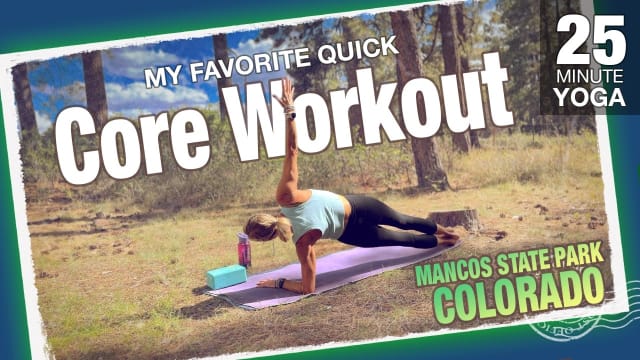
Pre-Surgery Core Yoga: A 25-Minute Floor-to-Crow Practice
Inspire

Pre-Surgery Core Yoga: A 25-Minute Floor-to-Crow Practice

A 25-minute core class from Five Parks Yoga, filmed at Mancos State Park, that builds from neutral pelvis to crow pose. Here is how each ste…

9 min read
Finding Your Spiritual Path: Ram Dass on the Many Roads to Awakening
Inspire

Finding Your Spiritual Path: Ram Dass on the Many Roads to Awakening

Discover how Ram Dass explores five distinct forms of yoga as pathways to consciousness, offering timeless wisdom for finding the spiritual …

5 min read
Kindness to Yourself: Affirmations for Self-Compassion and Inner Peace
Inspire

Kindness to Yourself: Affirmations for Self-Compassion and Inner Peace

A yoga-chill music meditation on choosing self-compassion, letting go of pain, and recognizing inner worth through intentional affirmations …

5 min read
Light in Shining Armour: A Goddess Myth Set to Mantra Pop
Inspire

Light in Shining Armour: A Goddess Myth Set to Mantra Pop

A four-and-a-half-minute video turns an ancient goddess story into a sung prayer about slowing down, guarding your energy, and remembering y…

10 min read

Continue d’explorer

Poursuis ton chemin

Plus de sagesse et de rassemblements dans tout l’annuaire BrightStar.

Plus d’articles

Parcours toute la bibliothèque d’enseignements, d’entretiens et de guides.

Retour à tous les articles →

Enseignants et artistes

Découvre les lignées, les musiciens et les guides du monde conscient.

Explorer les artistes →

Trouver un événement

Kirtan, retraites, bains sonores, breathwork, festivals — bientôt près de chez toi.

Parcourir les événements →