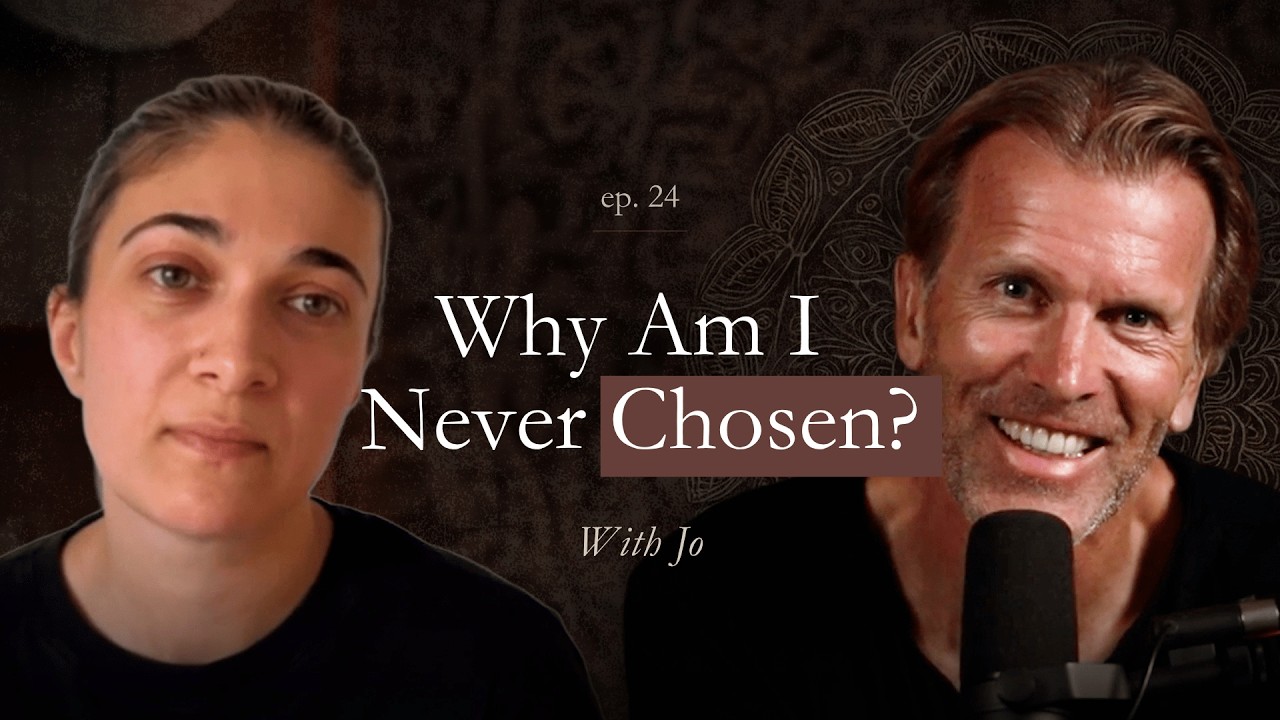
Trying to get rid of anger or force forgiveness creates a cycle of judgment that compounds pain. Anger is a survival mechanism protecting deeper hurt—the feeling of not being held, seen, or safe. True healing requires creating a safe enough space to feel and express the hurt underneath, not trying to overcome or eliminate the anger itself. When you can access the vulnerable human who is scared and hurt, you step out of the pain cycle and into genuine recovery.
Why Trying to "Get Rid Of" Anger Makes It Worse
A questioner begins by asking how to eliminate anger toward a parent who didn't provide safety. Crone immediately identifies the trap: the moment you try to get rid of anger, you create frustration—which is itself a form of anger. This is the vicious cycle. The person has likely read books, listened to podcasts, and concluded that forgiveness is the answer. But in pursuing forgiveness intellectually, they layer a new judgment on top of the old one: judgment of themselves for having anger in the first place.
"You're creating more judgment now of you having anger, right? Which is creating anger, right? Which is like the parent" (0:30–0:36). The irony is sharp—in attempting to rise above the anger through a spiritual or psychological framework, the person mimics the very dynamic they're trying to heal: judging themselves the way the unsafe parent once judged them. The frustration and resistance themselves become more anger, not less.
What Actually Lies Beneath Anger?
Crone's core assertion is this: underneath anger is hurt. And underneath hurt is a human being asking to be held and seen. He illustrates this with a straightforward animal metaphor: "You beat a dog one too many times, it's going to start and growl and bark and even bite. It's not a bad dog. It's just going on the evidence that you can't trust the hand that comes near you" (0:49–0:58).
Anger is a protection mechanism. It's what arises when a vulnerable person decides it's safer to push away than to remain open to more harm. The person with unresolved anger toward a parent is not a broken or spiritually deficient person—they are someone whose nervous system learned long ago that trust was dangerous.
The complication, however, is that the person is now also trying not to allow themselves to feel the hurt. So the emotional architecture becomes: hurt → anger (to protect the hurt) → judgment of the anger (to be "better") → more pain. Crone describes it plainly: "there's somebody who's hurt who's desperately trying to put it on somebody else and yet make themsel wrong for putting it on somebody else. And you're in this vicious cycle of a lot of pain" (0:73–0:80).
The Role of Safety in Feeling Hurt
The parent who was unsafe couldn't provide the holding, witnessing, and protection that a child needs. But Crone makes a direct assertion: whatever the care provider couldn't provide, the adult can now offer to themselves. And crucially, a group or community can offer it too. "Because whilst you have this intellectual coping mechanism which is superimposing judgment on somebody else, what's actually really at play is you're just wanting a safe enough space to feel hurt" (0:92–0:103).
This is not sentimental language. The nervous system requires safety to relax its protective mechanisms. Without that safety—actual felt safety, not just intellectual permission—the body will not release its grip on anger. Crone is suggesting that the real work is not analyzing anger or forgiving the parent, but rather creating conditions where the hurt can finally be felt.
The Two Primordial Emotions
Crone reduces the landscape of human emotion to two roots: hurt and fear. Usually both. "Everything that we feel comes down to two primordial emotions. We're either hurt or we're scared. usually both" (0:107–0:114). This is not meant to oversimplify but to clarify: beneath the anger, the resentment, the bitterness, and the avoidance are these two core states. A person who didn't feel safe with a parent is hurt (because their need for safety was not met) and scared (because they learned the world is unreliable).
The invitation, then, is radical in its simplicity: "Can I be a big enough human being to just feel hurt right now?" (0:125–0:127). Not overcome it, not transcend it, not blame the parent—just feel it. Crone suggests that most people avoid this because it feels unbearable. But the cost of that avoidance is high: "And I don't know how many years that's been there, but this is how people get sick" (0:131–0:134).
How Unprocessed Pain Drives Compulsive Behavior
Crone notes that the reason people turn to medication, street drugs, food, TV, sex, weed, and cigarettes is precisely because they are running from unprocessed hurt and fear. These are not moral failures; they are survival strategies. Someone whose body is flooded with pain will seek relief however they can find it. The diagnosis is not addiction or weakness—it is the pain itself, looking for an exit.
"This is why people are on all sorts of medication. Street prescribed food, TV, sex, weed, cigarettes" (0:154–0:162). The implication is that if the underlying hurt is processed—felt, witnessed, held—the compulsive reaching for these exits naturally diminishes. The body no longer needs to escape because it's no longer drowning.
The Courage of Feeling in Community
In the live setting, a participant works through this process in real time, moving from anger toward the parent into the rawness of the hurt itself. Crone frames this as an act of courage and as a gift to the community. "It's a real privilege to sit with somebody who has the courage to do this" (0:162–0:166). He emphasizes that this is not rare or extraordinary—"This is everyday life. We don't know what she went through, but we've all got our own version" (0:145–0:149). Everyone carries unprocessed pain from their early relationships.
What is rare is the willingness to feel it while being witnessed and held. When this happens, Crone suggests, the person "gets to step in a new world where she's just not walking around in pain" (0:150–0:154). This is not metaphorical. The nervous system literally exits the pain state when the pain itself is finally felt and held.
Where to Go From Here
If you recognize yourself in this teaching—if you have anger toward a parent or caregiver that you've been trying to manage through forgiveness, transcendence, or avoidance—consider asking: What hurt is underneath? And more importantly: Do I have a safe enough space to feel it? That space might be a therapist, a coach, a trusted friend, a support group, or a meditative practice where you can be with yourself without judgment. The work is not to eliminate anger but to go beneath it, to meet the frightened, hurt human who is still protecting themselves with it, and to offer that person what the original care provider could not: safety, witnessing, and the simple permission to feel.