BrightStar

Parcourir tous les Events

Découvre des rassemblements conscients

events

Yoga
Meditation
Breathwork
Qigong
Sacred Music
World Music
Medicine Music
Sound Healing
Ecstatic Dance
Ceremony
Destinations populaires
BaliSedonaLos AngelesCosta RicaNew YorkSan FranciscoAustin
Voir toutes les catégoriesVoir toutes les destinations

Explorer toutes les fonctionnalités

Des outils puissants pour développer tes événements

Fonctionnalités de la plateforme

Tarification dynamique intelligente
Catégories de billets
Places assignées
Récupération des paniers abandonnés
Récupération des visiteurs
Dons & Prix variables
Système d'affiliation
Scanner de billets
Codes promo
Questions personnalisées
Partage de billets
Ventes additionnelles & Options
Analyses & Rapports
Séquences d'emails
Liste d'attente / Notifier / Rappeler
Personnes & Lieux
Artists & TeachersEvent OrganizersVenues & StudiosKnowledge BaseGlossaryInspiration
Voir toutes les fonctionnalitésÀ propos
TarifsBlog
Language
Saved events
Parcourir tous les événements

events

YogaMeditationBreathworkQigongSacred MusicWorld MusicMedicine MusicSound Healing

Destinations populaires

BaliSedonaLos AngelesCosta RicaNew YorkSan Francisco

Personnes & Lieux

Artists & TeachersEvent OrganizersVenues & StudiosKnowledge BaseGlossaryInspiration

Fonctionnalités de la plateforme

Tarification dynamique intelligenteCatégories de billetsPlaces assignéesRécupération des paniers abandonnésRécupération des visiteursDons & Prix variablesSystème d'affiliationScanner de billetsCodes promoQuestions personnaliséesPartage de billetsVentes additionnelles & OptionsAnalyses & RapportsSéquences d'emailsListe d'attente / Notifier / Rappeler
Voir toutes les fonctionnalitésÀ propos
TarifsBlog
ConnexionS'inscrire
  • Parcourir tous les Événements
  • Pour les chercheurs
  • Yoga
  • Méditation
  • Breathwork
  • Qi gong
  • Musique sacrée
  • Musiques du monde
  • Musique médecine
  • Soins sonores
  • Danse extatique
  • Cérémonie
  • Retraites
  • Ateliers
  • Toutes les catégories →
  • Bali
  • Sedona
  • Los Angeles
  • Costa Rica
  • Byron Bay
  • San Francisco
  • Austin
  • New York
  • San Diego
  • Seattle
  • Toutes les villes →
  • Join the Movement
  • Why we list
  • Sell Globally
  • Pour les créateurs
  • Pour les équipes
  • Pour les écrivains
  • Pour les enseignants
  • Pour les artistes de kirtan
  • Pour les studios
  • Pour les festivals
  • Pour les centres de retraite
  • Pour les associations
  • Ambassadeur de marque
  • Billetterie gratuite
  • Elevate
  • Amplify
  • Réseau de 500K+ acheteurs
  • Récupération des paniers abandonnés
  • Tarification dynamique intelligente
  • Catégories de billets
  • Événements récurrents
  • Places assignées
  • Système d'affiliation
  • Liste d'attente / Notifier
  • Scanner de billets
  • Widget intégrable
  • Diffusion d'événements
  • Messagerie
  • Intégrations
  • Rapports
  • Toutes les fonctionnalités →
  • À propos
  • L'écosystème
  • Blog
  • Glossaire
  • Inspiration
  • Centre d'aide
  • Contact
  • Documentation API
  • Ressources de marque
  • Carrières
  • Presse
  • Conditions d'utilisation
  • Politique de confidentialité

Événements

  • Parcourir tous les Événements
  • Pour les chercheurs
  • Yoga
  • Méditation
  • Breathwork
  • Qi gong
  • Musique sacrée
  • Musiques du monde
  • Musique médecine
  • Soins sonores
  • Danse extatique
  • Cérémonie
  • Retraites
  • Ateliers
  • Toutes les catégories →

Destinations

  • Bali
  • Sedona
  • Los Angeles
  • Costa Rica
  • Byron Bay
  • San Francisco
  • Austin
  • New York
  • San Diego
  • Seattle
  • Toutes les villes →

Pour les créateurs

  • Join the Movement
  • Why we list
  • Sell Globally
  • Pour les créateurs
  • Pour les équipes
  • Pour les écrivains
  • Pour les enseignants
  • Pour les artistes de kirtan
  • Pour les studios
  • Pour les festivals
  • Pour les centres de retraite
  • Pour les associations
  • Ambassadeur de marque
  • Billetterie gratuite
  • Elevate
  • Amplify

Fonctionnalités

  • Réseau de 500K+ acheteurs
  • Récupération des paniers abandonnés
  • Tarification dynamique intelligente
  • Catégories de billets
  • Événements récurrents
  • Places assignées
  • Système d'affiliation
  • Liste d'attente / Notifier
  • Scanner de billets
  • Widget intégrable
  • Diffusion d'événements
  • Messagerie
  • Intégrations
  • Rapports
  • Toutes les fonctionnalités →

Entreprise

  • À propos
  • L'écosystème
  • Blog
  • Glossaire
  • Inspiration
  • Centre d'aide
  • Contact
  • Documentation API
  • Ressources de marque
  • Carrières
  • Presse
  • Conditions d'utilisation
  • Politique de confidentialité
BrightStar
Téléchargez l'app
Télécharger dans l'App StoreDisponible surGoogle Play
© 2026 BrightStar. Tous droits réservés.
Inspiration

Guided Meditation: Finding Peace in What Already Feels Good

Ajahn Brahm
Ajahn Brahm
Nov 2, 2026
5 min de lecture

Source : Buddhist Society of Western Australia

À regarder · 7

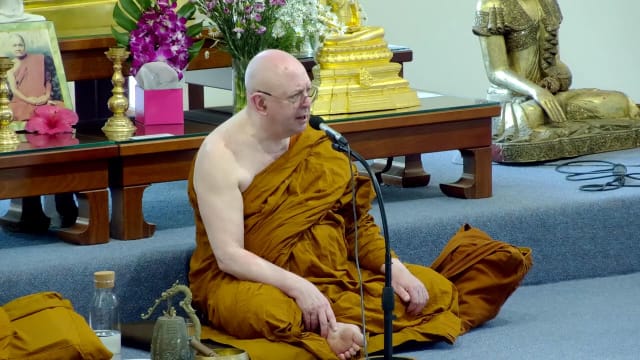
There's a radical moment early in any meditation practice when the teacher says something that flips the usual approach on its head. This video captures one: instead of fighting your mind, instead of chasing some distant state of calm, what if you started by noticing what your body already finds delightful?

Lecture · 6 sections

What Part of Your Body Feels Best Right Now?

The guided meditation opens with an unusual instruction. The teacher asks not "what hurts?" or "what's distracting?" but rather "What part of your body is the most delightful? What feels good?" It's a simple reorientation, but it moves the entire practice away from problem-solving and toward discovery.

Most people, the teacher observes, have been trained to focus on discomfort. There's a knee that aches. A shoulder that's tight. An itch. The mind naturally gravitates toward friction. In meditation practice as in life, we hunt the problem. But this approach asks you to flip the sequence: find what already feels good, celebrate it, and use that as your anchor into peace.

The teacher's own example is deliberately ordinary—the belly, warm and comfortable, even without having eaten since morning. The point isn't the specific location; it's the permission to start with joy instead of resistance.

Let Go and Enjoy What's Happening

A core teaching emerges as the meditation deepens: "I'd never do anything in meditation. I just let go and enjoy what's happening." This isn't passivity masquerading as wisdom. It's a specific skill—the art of not interfering with peace once you've found it.

The practice invites you to notice silence not as the absence of noise, but as a texture you can enjoy. Yes, there's the sound of the air conditioning. But that's only a small noise, the teacher notes. Mostly, everything is silent. The instruction is to receive that silence without commentary, without trying to improve it or deepen it artificially. Just enjoy peace.

This points to something essential in contemplative practice: the difference between reaching for a state and allowing one to settle. Striving creates tension. Enjoyment creates openness. When you start by celebrating what's already pleasant in your body and your environment, the mind naturally relaxes into receptivity.

The Essence of Meditation Is Freedom, Not Technique

Toward the end of the guided portion, the teacher offers a compass for anyone uncertain whether they're "doing it right." The essence of meditation, he says, is peace and freedom and the joy which that gives you. Not a particular posture. Not a specific breathing pattern. Not even a particular technique—especially because, the teacher notes with warmth, he never teaches the same technique in meditation twice.

What matters is results: whether you're calming down, whether you're learning to be peaceful and kind, whether beautiful happiness arrives as a by-product. For someone just beginning, that calm might feel incomplete. But the practice itself works. You're building the capacity to shift your baseline from reactivity to receptivity, from hunting problems to celebrating resources that are already yours.

Why Celebration Matters in Practice

The repeated instruction to celebrate delightful sensations isn't sentimentality. In Buddhist meditation, particularly in the cultivation of states like the jhanas (profound concentrative absorptions), the quality of joy or contentment is not incidental—it's the fuel. When you learn to genuinely enjoy your breath, the silence, the warmth in your belly, the peace of the present moment, you're training your nervous system to recognize safety and rest as real options.

This has a cascading effect. The more you practice celebrating what's already good, the more you retrain your attention away from the threat-detection mode most of us live in. You begin to see that peace isn't something you have to earn or achieve or force into being. It's already here, underneath the noise. Your job is to notice it and let it be.

The Geometry of Silence

One of the more poetic moments in the guided session is the teacher's explicit instruction not to add anything to silence. You don't improve peace by analyzing it or chasing it deeper. You just notice it. You inhabit it. This is different from the idea that meditation requires effort or progress. Sometimes the most profound work is the work of letting go of work.

The sound of air conditioning becomes, in this context, not an obstacle but simply part of the whole. The body's sensations—the delightful ones—become anchors. The silence becomes a presence you can rest in. And the teacher's own gradually decreasing speech creates space for the meditator to move from instruction into direct experience.

Where to go from here

If you're new to meditation, this session offers a practical entry point: sit comfortably, close your eyes, and genuinely ask yourself what part of your body feels good right now. Not what you think should feel good, but what actually does. Start there. Celebrate it. Let that celebration be your gateway into the larger peace that's available in silence and stillness.

If you've been practicing for a while, the session invites you to check whether you've slipped into effort. Are you trying to meditate? Are you reaching for a state? The teaching asks you to reset: let go. Enjoy. Trust that peace and freedom are not destinations you have to earn, but capacities you can activate by paying attention to what already feels delightful.
Comments

Loading the conversation…

Transcript

[0:00] And see if I can slow down time.

[0:04] Be careful. Monks do have a strange

[0:07] abilities.

[0:08] What you think is half an hour is really

[0:12] only 20 minutes.

[0:15] So let's see what happens.

[0:18] >> [snorts]

[0:19] >> So please close your eyes.

[0:21] Don't look at the clock.

[0:24] And start to feel this moment.

[0:30] I never say the same technique in

[0:33] meditation twice.

[0:36] How do you feel just right now?

[0:41] With your eyes closed, you feel much

[0:45] more about your body.

[0:48] How it feels.

[0:51] See when you are experiencing the

[0:54] feelings in the body.

[0:56] What part of your body

[0:59] is the most delightful?

[1:03] What feels good?

[1:08] So for some reason,

[1:11] the part of my body which feels the

[1:13] nicest is my tummy.

[1:15] Even though I haven't eaten anything

[1:17] since

[1:18] 11:00.

[1:21] But it still feels good.

[1:23] So I take the most delightful feeling

[1:26] first of all.

[1:29] And if it's really delightful,

[1:33] don't miss celebrating it.

[1:37] It feels good.

[1:39] A lot of times people just focus on what

[1:43] hurts. [sighs]

[1:46] They think that's what they're supposed

[1:47] to do.

[1:49] Rather than something beautiful.

[1:53] And that is something we celebrate.

[1:57] It makes you feel good.

[2:00] As you will hear in the talk later on,

[2:04] the meditation

[2:06] is delightful. That's some amazing

[2:08] things.

[2:10] So, you start now

[2:13] by learning how to enjoy this moment.

[2:23] Honest, I'll explain later. I'd never do

[2:25] anything in meditation.

[2:28] I just let go

[2:30] and enjoy what's happening.

[2:34] The peace.

[2:38] Is this moment peaceful?

[2:44] I can hear some noise. I think it's a

[2:46] noise of air conditioning.

[2:50] But, it's only a small noise.

[2:53] Mostly, everything is silent here.

[2:58] That is what I really notice.

[3:03] Can you notice the silence?

[3:09] I don't need to add to it.

[3:15] It's a nice thing of silence.

[3:19] You don't give silence any comment.

[3:23] You just enjoy peace.

[3:30] And you can do that.

[3:36] I am going to speak

[3:39] less

[3:41] and less

[3:44] and less.

[3:47] So, you, too,

[3:50] can enjoy

[3:53] the peace.

[4:10] >> Even if you think

[4:13] you haven't meditated before

[4:18] or you think you meditated another way.

[4:22] It does not matter.

[4:28] The essence

[4:29] >> [snorts]

[4:30] >> of meditation

[4:33] is peace

[4:36] and freedom

[4:40] and the joy which that gives you.

[8:10] >> Mhm.

[10:13] >> Mhm.

[12:15] >> Mhm.

[14:18] >> Mhm.

[16:21] >> Hey.

[18:23] >> Mhm.

[19:01] >> It's getting close

[19:05] to the end of the meditation.

[19:11] If it's really working well for you,

[19:16] you can feel the peace.

[19:20] Just let it be.

[19:23] Don't interfere.

[19:27] Let go.

[19:33] For many who just start the meditation,

[19:37] you find you're calming down,

[19:42] but not

[19:44] enough yet.

[19:47] Whatever,

[19:50] you find this meditation

[19:52] actually works.

[19:57] You learn how to be peaceful,

[20:00] how to be kind,

[20:03] and the beautiful happiness

[20:05] which comes with that.

[20:10] Thank you very much for joining in.

[20:15] Now, I invite you all to open your eyes

[20:18] so I can start the Dhamma talk.

[20:27] >> Hey.

Ajahn Brahm
ArtistAjahn Brahm

Ajahn Brahm is a British-American Buddhist monk and meditation teacher who leads the Dhammakaya International Society of Australia and is known for making Theravada Buddhist practi…

Voir le profilSite web
Explorer les thèmes
Guided-meditationPeaceBody-awarenessBuddhist-teachingMindfulness

Des questions ?

Questions fréquemment posées

Begin by closing your eyes and noticing what part of your body feels delightful or comfortable right now—not what hurts or what you think should feel good. Celebrate that sensation and use it as your anchor into peace. There's no perfect technique; the essence of meditation is simply learning to be peaceful, kind, and to feel the happiness that naturally comes with that.
Focusing on what feels good is more natural and sustainable than fighting your mind. When you celebrate pleasant sensations, your nervous system recognizes safety and relaxes into receptivity. This builds the capacity to shift from the threat-detection mode most people live in to genuine rest and peace.
Noise is simply part of the whole—notice it without adding commentary to it. Similarly, if you notice discomfort, that doesn't mean you're failing. The practice works by gradually shifting your baseline from reactivity to receptivity. Even in the early stages, when calm might feel incomplete, you're building the skill of peace.
The test is simple: are you calming down? Are you learning to be peaceful and kind? Does beautiful happiness arrive as a side effect? If the answer is yes to any of these, your meditation is working. The essence isn't a particular technique or achieving a special state—it's cultivating peace, freedom, and the joy that comes with them.
Letting go means stopping the effort to improve or force the moment. It's enjoying what's already happening—the silence, the sensations, the peace—without trying to deepen it or change it. You're still present and aware; you're just not interfering. This active non-interference is where real relaxation happens.
Meditation doesn't require the same technique twice. What matters is finding what works for you in the moment—whether that's focusing on breath, celebrating a pleasant body sensation, or resting in silence. The flexibility keeps the practice fresh and responsive to what your mind and body actually need.

Continuer la lecture

More from Ajahn Brahm

Voir tout
Breath Meditation: From Body Sankhara to Mind Sankhara
Inspire

Breath Meditation: From Body Sankhara to Mind Sankhara

Why does the breath become the last thing left in meditation? A Theravada teacher explains the shift from body sankhara to mind sankhara and…

8 min read
Why Happiness Makes Meditation Effortless: A Mirror Lesson
Inspire

Why Happiness Makes Meditation Effortless: A Mirror Lesson

Ajahn Brahm argues that meditation becomes effortless once the mind is happy, not forced. He traces the idea to a simple mirror practice he …

9 min read
Light in Shining Armour: A Goddess Myth Set to Mantra Pop
Inspire

Light in Shining Armour: A Goddess Myth Set to Mantra Pop

A four-and-a-half-minute video turns an ancient goddess story into a sung prayer about slowing down, guarding your energy, and remembering y…

10 min read
Palms Open: Love Without Condition in Appalachian Song
Inspire

Palms Open: Love Without Condition in Appalachian Song

Peia's "Palms Open" is a folk meditation on surrendered love, built from raw imagery of seasons, breaking hearts, and the courage to remain …

5 min read

Continue d’explorer

Poursuis ton chemin

Plus de sagesse et de rassemblements dans tout l’annuaire BrightStar.

Plus d’articles

Parcours toute la bibliothèque d’enseignements, d’entretiens et de guides.

Retour à tous les articles →

Enseignants et artistes

Découvre les lignées, les musiciens et les guides du monde conscient.

Explorer les artistes →

Trouver un événement

Kirtan, retraites, bains sonores, breathwork, festivals — bientôt près de chez toi.

Parcourir les événements →