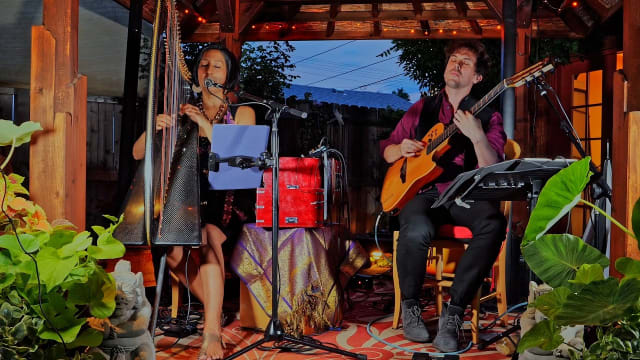
On Tuesday, October 27, 2026, a guitar line settles under the air of a Boulder radio studio, and then a harp and a bansuri start trading phrases with a voice that mostly sings no words at all. The piece is "Gaea's Ebb," an original by guitarist Elden Kelly, performed as a duo with Sheela Bringi, who plays harp and bansuri and sings. It was aired live on Kabaret, the program on KGNU Radio in Boulder, Colorado, and the video runs just over eight minutes. The piece is built on the chord changes of "Cabbage," a theme by Gregg Hill, and this session is a duo version of a composition that will appear in a fuller form on a forthcoming studio release from Elden, Sheela and an ensemble, made in collaboration with Hill. The video has no spoken introduction or commentary, so what follows draws on the session's credits and description and on what the recording itself shows, and it marks where the evidence stops.
Start with the phrase that carries the most information in the video's description. As the uploader puts it, "Gaea's Ebb" was "composed by Elden Kelly, based on the chord changes of 'Cabbage,' a theme by Gregg Hill." That sentence describes a particular way of writing that has deep roots in jazz. Chord changes are the sequence of harmonies that underpins a tune: the progression that tells the players which chord is sounding under each bar, and which notes sound right when they improvise or when a melody moves. When a composer keeps another tune's changes and writes a new melody on top, the result is sometimes called a contrafact. Jazz musicians have leaned on the technique for generations, because a familiar progression gives a band a shared map while the new melody lets the writer say something different.
What the description does not say is how closely "Gaea's Ebb" follows the original, which sections it keeps, or what Hill's theme sounds like on its own. Those are open questions the video cannot answer, and a listener who wants to hear the lineage has to go looking for Hill's own version. The credit itself, though, is a useful signal. Kelly is not presenting the piece as an invention from nothing. He is placing it inside a tune by another writer, and the description names Hill explicitly and notes that a full-ensemble version is being made "in collaboration with Gregg Hill."
The description is direct about the format: this "is a duo version of the piece," and a full ensemble version is coming. That changes how the live session should be heard. A duo has no drummer to hold the time, no horn section to carry a melody, and no second harmonic instrument filling the middle. Everything has to be carried by the two players. In a harp, bansuri, voice and guitar setting, the textures become the arrangement. The guitar supplies harmonic ground under the changes, and the harp and bansuri, which are both melodic instruments with very different attacks and sustain, pass the line back and forth. Sheela Bringi's voice then sits inside that exchange rather than above it.
A duo version is also a kind of sketch. Presenting the piece this way on the radio lets the material stand on its own before the larger arrangement is built around it. For listeners, it is an early look at the tune's bones. For the players, it is a test of what the core harmony and melody can do with four sound sources and no backline.
The description lists the musicians as "voice, harp, bansuri" for Bringi and "guitar" for Kelly. Those four sources cover very different parts of the sonic range and very different kinds of articulation. The harp is plucked and resonates; its notes bloom and decay, which means a melody on harp is always partly a melody about the space between notes. The bansuri is a bamboo transverse flute from the Indian classical tradition, and it produces a breathy, continuous line that can bend pitch and sustain a phrase. The guitar, by contrast, has a percussive attack and a harmonic clarity that anchors a chord progression. And the voice can take either role, doubling a line or stepping into a melodic space that an instrument would otherwise fill.
Put those four together over a set of jazz changes and the arrangement starts to do interesting work. The guitar can keep the progression visible while the harp and bansuri phrase against it, and the voice can smooth the join between an instrument's note and the next one. The result is less like a head arrangement with a featured soloist and more like a set of answers and responses, each instrument taking a turn to speak the same harmonic idea in its own grammar.
"Composed by Elden Kelly, based on the chord changes of 'Cabbage,' a theme by Gregg Hill." — from the YouTube description of the session
The transcript is mostly instrumental markers, but a few moments stand out, and they are worth noting precisely. The video opens on instrumental music, and the first wordless vocal arrives at about 0:27, a sung "Oh" set over the instruments. Vocal syllables recur through the piece: an "Oo" passage at about 2:08, a sung phrase that includes "my heart" at about 2:24, and near the close a short "Oh" and "Ah" at points in the middle of the instrumental flow. Around 5:16 a brief exchange, "Yeah. Mhm.", appears in the transcript, which reads like a spoken moment between players.
What these moments show is that the voice in "Gaea's Ebb" is used as an instrument as much as a vehicle for words. Sung vowels like "Oh" and "Oo" are closer to a wind or string line than to a lyric. When a phrase does carry words, such as the "my heart" at 2:24, it lands with more weight because so much of the piece is wordless. The brief "Yeah. Mhm." at 5:16 is the kind of unguarded response that tends to appear in a live session, when musicians are reacting to each other rather than performing for a page.
The description states that a full-ensemble version "will appear on a forthcoming studio release from Elden, Sheela, and ensemble, in collaboration with Gregg Hill." No release date, title, or personnel list beyond that is given, so anything more would be speculation. What the statement does establish is that this duo is one stage in a longer development of the piece, and that the composition is meant to live in a larger setting as well. A reader interested in how the tune grows should watch for that release, and should not assume the duo's exact arrangement will be carried over note for note.
The session was recorded for Kabaret, the program on KGNU Radio in Boulder, Colorado. The video credits host Joel Davis and engineer George Figgs, and states that it aired on Tuesday, October 27, 2026. The full session is available on KGNU's website, where the program presents its music posts. For a studio-based session like this, the engineer's role is decisive, since a harp, a bansuri and a voice all bring out very different demands on the microphones, and the video's sound reflects those choices.
- Listen to the full Kabaret session on KGNU at kgnu.org, where the complete broadcast lives beyond the eight-minute video.
- Look up Gregg Hill's own "Cabbage" to hear the original changes that "Gaea's Ebb" is built on. The description credits him as the theme's author, and his version is the baseline for comparing what Kelly kept and what he changed.
- Explore Sheela Bringi's and Elden Kelly's own sites, sheelabringi.com and eldenkelly.com, for further recordings and updates on the forthcoming studio release.
- Track down the ensemble version when it arrives. The duo shows the bones of the piece; the full arrangement will show how far it can stretch.