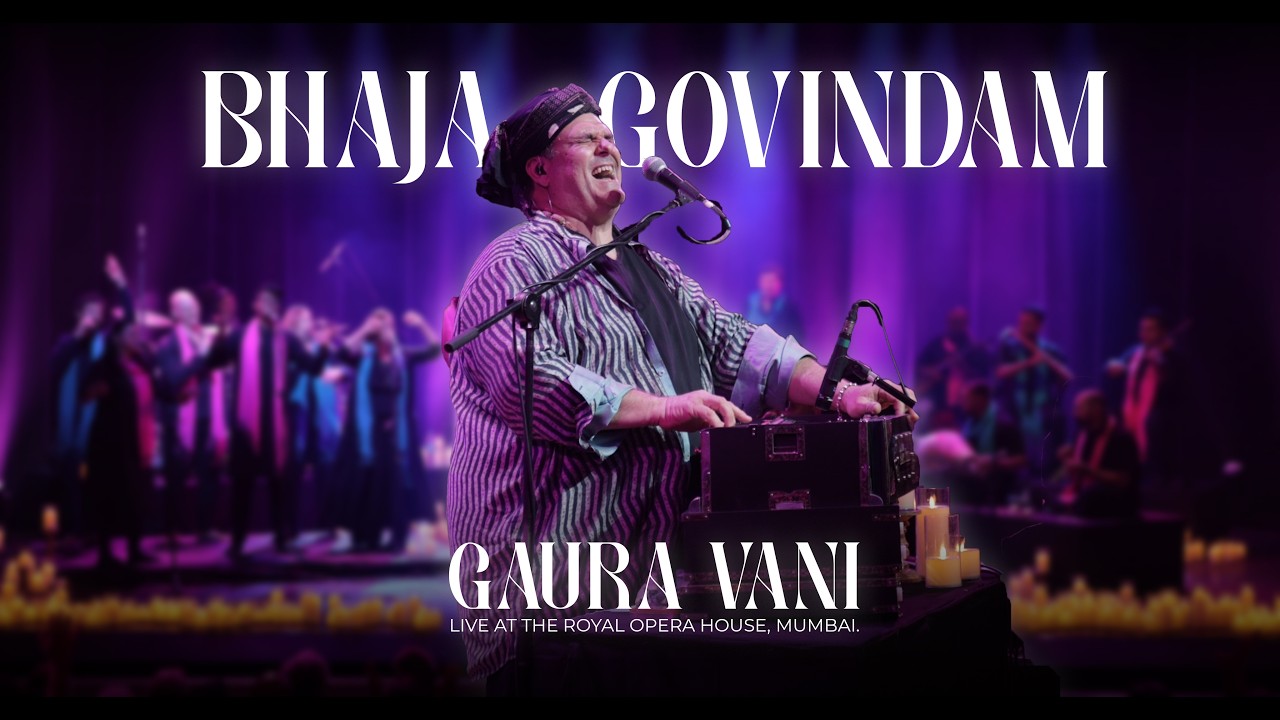
The kirtan begins with a single invocation—Ayodhya Vasi Ram—and the human voice becomes a vehicle for something older than itself. This is a performance by Gaura Vani and family, a devotional offering structured around one of Hinduism's most sacred names: Ram, the divine being born in Ayodhya. Across nine minutes, the song unfolds not as narrative but as sonic prayer, repetition as reverence, the voice circling back again and again to the same threshold.
Kirtan is the practice of call-and-response chanting, rooted in the bhakti traditions of India where singing becomes a direct path to the divine. Unlike meditation in silence or study of scripture, kirtan emphasizes the collective voice—the congregation joining in, the family singing together—as an act of spiritual practice. The name being invoked here carries weight in Hindu devotion: Ram, whose story anchors the Ramayana, is understood as an eternal presence rather than a historical figure. The title phrase, "Ayodhya Vasi Ram," means "Ram who dwells in Ayodhya"—locating the infinite in a specific sacred geography, anchoring transcendence in place.
What makes a kirtan performance meaningful to practitioners is not intellectual content but frequency, repetition, and the dissolution of the singer's boundary between voice and invocation. When Gaura Vani performs with family, the structure shifts—these are not professional singers following a score, but a household engaged in devotion. This lineage of family kirtan connects back to centuries of Hindu practice where spiritual life wasn't contained in temples alone but lived in homes, in the rhythms of daily worship, in voices raised together.
The performance carries its own logic. A mantra or divine name, chanted consistently, is understood in these traditions not merely as repetition but as a form of remembrance—smaran in Sanskrit—a continuous turning of attention toward the sacred. The voice becomes a tool, and through the tool, the singer and listener both begin to shift. Kirtan does not demand belief so much as presence: show up, add your voice to the chorus, and let the practice itself become the teaching.
This video, with 63,000 views, speaks to a hunger that exists beyond traditional Hindu contexts: the desire to sing together, to invoke something larger than individual preoccupation, to let devotion find its shape through repetition and family presence. In a fragmented world, the kirtan holds its ancient form—simple, circular, and endlessly renewable.
Repetition in kirtan is understood not as mechanical but as transformative. Each cycle of the mantra or divine name is believed to deepen the singer's connection to what is being invoked, gradually dissolving mental chatter and aligning the practitioner's consciousness with the focus of devotion.
Ayodhya is the birthplace of Lord Ram and holds sacred status in Hindu cosmology. Locating Ram in Ayodhya through the kirtan ties the infinite divine to a specific spiritual geography, making devotion both personal and universal.
Yes. Kirtan is fundamentally a call-and-response practice open to any voice. No prior training or belief system is required—participation itself, the act of singing along, constitutes the practice.
Family kirtan centers devotion in the household, making spiritual practice relational and intimate. While temple kirtan occurs in a formal setting with trained musicians, family kirtan is often more spontaneous and personal, each voice contributing to a shared spiritual rhythm.
Bhakti is the path of devotion in Hindu and related traditions, emphasizing love and surrender to the divine. Kirtan is one of bhakti's primary expressions—the voice and heart engaged together in praise, remembrance, and invocation.
While both are contemplative practices, kirtan differs from silent meditation. Rather than stilling the mind, kirtan engages it through chant, rhythm, and sound, using the voice and communal presence as the vehicle for spiritual focus.
Listening to kirtan can induce a meditative state even without active participation. The repetitive structure, combined with the devotional intent of the singers, often creates a calming effect and can serve as a gateway into deeper contemplative awareness.
If this kirtan resonates with you, the next step is often to listen more deeply to Gaura Vani's other performances and to explore the broader world of kirtan artists who carry this tradition forward. Many contemporary practitioners have built communities around regular kirtan gatherings—online and in-person—where the practice can be learned and experienced directly. The beauty of kirtan lies not in passive consumption but in joining your own voice to the circle. Find a performance, or a teacher, and add your breath to the invocation.