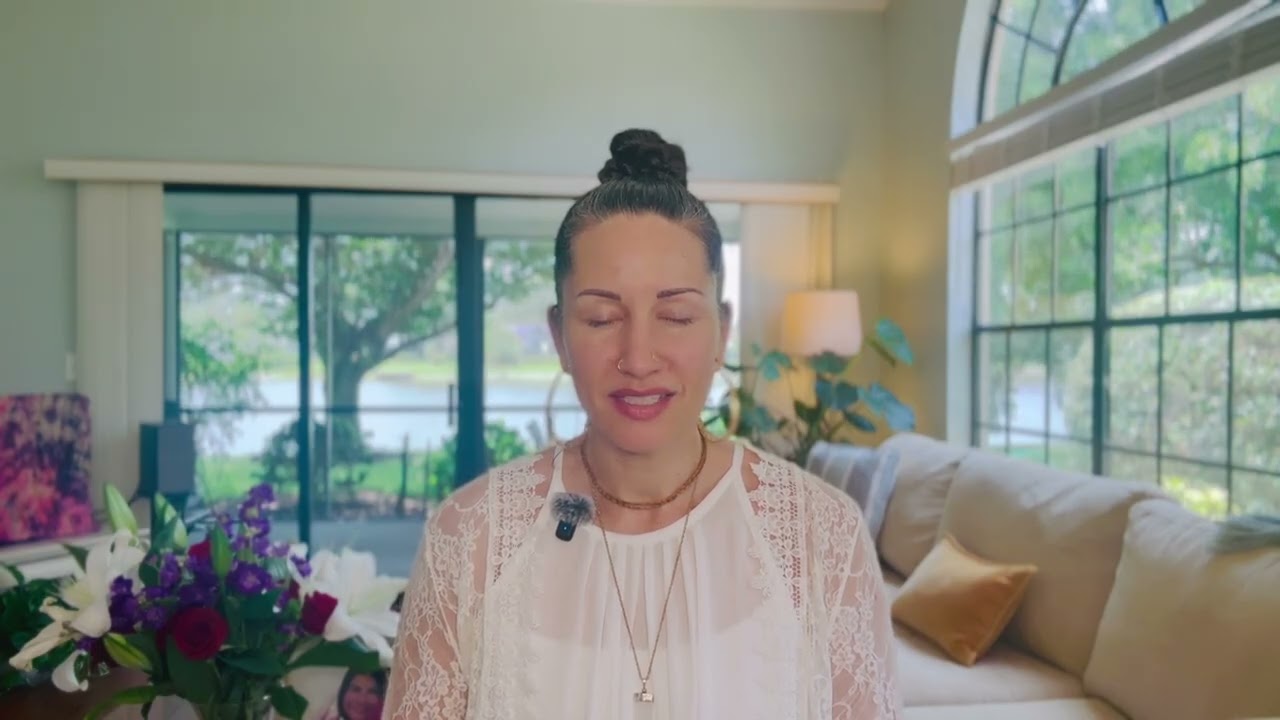
You lie down on the floor, or on a bed, with the lights low and a pair of headphones on. A voice tells you to take a breath and feel into your spine, your bones, your organs. Then, slowly, it asks you to grow. You are told to see yourself expanding past your body, past the building, past the city, out into the world and the universe and finally into other dimensions. Underneath the voice, drumming and tones rise and fall in long swells. This is the opening of a 54-minute guided meditation published by the Healing Waves channel and led by Shaman Durek, and it is built less like a relaxation track than like a map of inner territory, with checkpoints, guardians, and a required confrontation before you are allowed to walk toward the light.
Shamanic practices across many traditions share a basic structure: the practitioner leaves the ordinary room and travels through a symbolic landscape, usually to meet helpers, face obstacles, and return with something useful. This recording follows that template closely. The channel's description identifies the speaker as a sixth-generation shaman who has spent decades studying and practicing, an author, and a women's empowerment leader whose stated focus is making shamanism a lifestyle choice for what he calls evolutionary adaptation. The meditation itself does not argue a theory of shamanism. It simply takes you through the journey.
The speaker also frames the practice around objects. He describes working with crystals or "tachyon illumination rods" and suggests a short activation phrase, but he is explicit that you do not need them. "If you don't have any of that, please lay down, find a place that's comfortable and take a deep breath," he says near the start. For listeners without props, the instruction is simply to breathe and let the journey carry them. The props are optional scaffolding; the structure is the point.
After the expansion, the meditation sets you on a road with three branches. Each is marked by a statue: a figure at the first, a sword at the second, a tree at the third. The speaker asks you to choose one and to pay attention to what happens as you walk it. "Notice the sounds that you hear and how they make you feel," he says as you travel, and then, "notice the feelings that are coming up in you." The path you pick is said to connect directly to the statue you passed, which means the choice is a kind of self-report. Whatever you select tells you something about where you are right now, and the walk that follows deepens that information rather than correcting it.
This is a useful design principle for anyone trying a guided meditation for the first time. Choice does more than add drama. A listener who consciously decides to go toward the sword or the tree has already begun to notice their own inclinations, which is the actual work of the exercise.
At the end of the path, the journey opens into a ring, and there are three to choose from: the Ring of Fire, the ring of electricity, and the ring of water. You step in, sit at the center, and listen to the sound moving through the environment toward your body. The speaker tells you that the ring you have chosen will "pull up" feelings and energies that have been trapped in the body, along with thoughts trapped in the mind. "Whatever ring you are in," he says, "the spirits of that ring will begin to pull up your feelings."
The section runs for about ten minutes, and in the recording it is mostly sustained sound and long stretches of music, with only occasional spoken cues. That silence is itself a feature. Many people who try guided meditation find the first few minutes of stillness easy and the next few uncomfortable, when old feelings start to surface. The ring section gives those feelings room, and the speaker's instruction is simply to keep breathing: inhale, exhale, center yourself. A reader who wants to take the practice seriously might keep a note of which ring they chose and what came up. The choice of fire, electricity, or water is, like the choice of path, a piece of self-information.
Once the healing in the ring has settled, you return to the path and reach a stone temple. Waiting in front of it is a person from your life, specifically someone you are told you chose before this life to be a guide. "A friend or family member," the speaker says, "who chose to be one of your guides." He asks you to notice who it is, to smile at them, and to recall that this person was appointed "to give you wisdom, to give you clarity and vision."
Inside the temple, a second figure waits in a circular clearing, and this one is framed differently. The speaker describes "a friend or family member who has come to be your challenge and to bring challenge into your life so that you can grow and expand." He adds that you made an agreement with this person before arriving: that they would strengthen you by teaching you to overcome obstacles, even when their behavior was uncomfortable or unbearable. You are asked to look at that face and smile.
This is the most theologically specific part of the recording. It presents the guides and challengers as people you chose in advance, which is a framework rooted in the speaker's own cosmology rather than something a listener can check. Whether or not you share that belief, the exercise asks a concrete question: who in your life has offered you counsel, and who has pushed you hardest? A listener can hold both answers in mind without accepting the metaphysics attached to them.
The most demanding section comes at the back of the temple. There is a circle with a triangle in its center and a chair. In the chair, you find yourself. The speaker names this figure outright: "this part of yourself is your shadow. It's the part that holds on to all the things you have not shown up for, love and taking responsibility for." The shadow welcomes you, you sit in the chair, and you stare at your own image while a sound comes through the temple walls. That sound, he says, generates "a telepathic communication between you and yourself."
For ten minutes you are asked to listen. The shadow, the speaker explains, "has a lot to tell you," and the information may arrive through feelings, words, thoughts, or imagery. This is a version of a practice that therapists and contemplative teachers have long used in different forms: turning toward the parts of yourself you have avoided rather than pushing them away. The meditation's language is cosmological, but the instruction is recognizable. Sit with what you have not handled. Notice what it says. Do not rush to answer it.
After ten minutes, the shadow moves its arms to the left, and a door appears. Beyond it is light "brighter than the twenty thousand suns," and inside there is only white. The sound moving through the environment is, in the speaker's words, meant to "bring waves of peace" and "lift you above the Maya," bringing peace and unconditional love to every cell. The closing sequence is a breathing and infusion phase, and it is where the journey resolves rather than confronts.
The last segment shifts from visualization to physical action. The speaker asks you to take a piece of paper and write down the fears you have been holding, and then to fold it. He describes keeping the folded paper with you, and he says that anything that brings courage is worth keeping, while what you no longer need can be let go. The auto-generated captions for this section are rough, so the exact wording of the closing instructions is hard to reconstruct in full, but the direction is clear: move from imagery back into the body and into a concrete act, so the experience has something to hold onto after the headphones come off.
That shift matters. Many guided meditations end in a pleasant glow and leave the listener with nothing to do. Writing a fear, folding it, and keeping it gives the practice a tangible ending.
The channel's description makes strong claims about the music: that it is tuned to 432Hz, paired with theta-range binaural beats, and that it helps "detox" the mind and heart and "balance" the physical and emotional body. The description also acknowledges that there is no written scientific proof for these effects, and it points instead to tuning as a pattern found in nature and in the golden ratio. Those are the channel's framing, and they should be read as such. Listeners who want the sound for its meditative texture can enjoy it on those terms. Listeners who want a clinical outcome should look elsewhere, and should not treat a guided journey as a substitute for medical or mental health care.
If the recording appeals to you, start small. Do the first ten minutes, choose a path and a ring, and stop when you have a clear sense of what came up. Next time, try the temple, and write down the names of your guides and challengers before you listen, so you can compare what the meditation says with what you already know about the people in your life. Save the shadow conversation for a day when you have time to sit with whatever surfaces afterward. Then, if the practice feels useful, you can explore the wider shamanic literature and the ritual traditions the speaker draws on. The recording offers a structure; what you bring to it determines what it becomes.