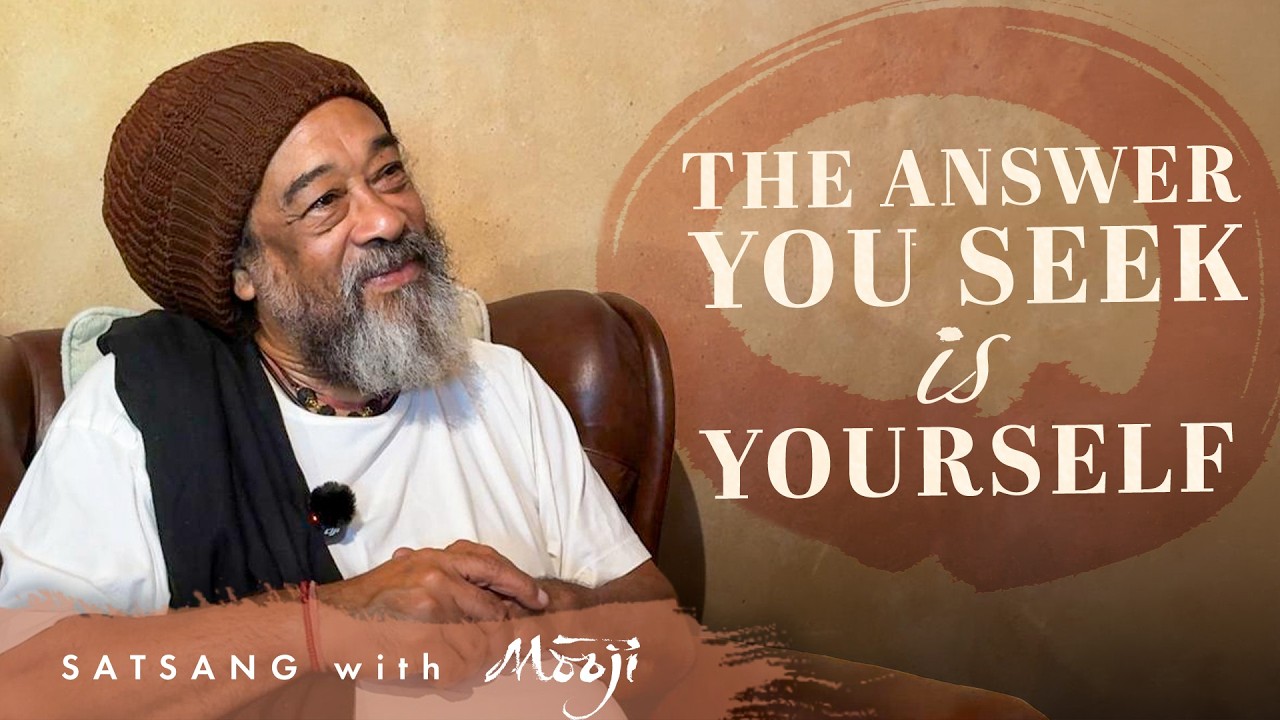
The first thing you hear is a room. Before the chorus lands, there is a soft wash of instruments and a voice repeating two syllables, "ma" and "no more," over and over, the way a crowd finds its footing before a song begins to move. Then a groove settles in, the handclaps and the bounce arrive, and by the time the first verse opens you understand that this is not a studio performance meant for a playlist alone. It was made to be sung back. The video, published on the Mooji Mala Music channel in October 2026, carries a short description that does the essential work: Sutara and Omkara wrote this "groovy, heartful song together" and shared it "for a room full of joyous sangha" during the June 2026 Guest Stay Retreat in Monte Sahaja. Three minutes and forty-nine seconds later, the recording ends in applause. That is the whole frame, and it is enough to understand what kind of object this is.
"Namo Namo," with its refrain of "Moojibaba," belongs to a tradition that is older than any single recording: the devotional song sung in company, where the words are simple enough to memorize in one pass and deep enough to keep working on you for years. It is worth taking seriously as a piece of craft and as a piece of teaching at once, because it does both on purpose.
Read the lyrics as they appear in the video's auto-generated captions and a clear arc emerges, even where the transcription garbles a word. The singer begins in doubt. "I wasn't sure if my heart was pure," the captions render at about 0:33, and then, "Everywhere I turned, yes, it was a closed door." That opening is not decoration. It names the condition most seekers know: the sense that you have tried every door, and that the trouble is not the lack of doors but the feeling that you are not allowed through.
The turn comes with the teacher. The song moves from closed door to a figure who takes the singer's hand and "lead[s] me out of darkness to the promised land." Here the devotional logic becomes explicit. The guide is not the destination; the guide shows the way out of a self-made darkness. That is the old relationship between a student and a teacher, put into a verse anyone can sing.
Then the song gets specific about what the teacher gave. Around 1:33, the lyric is "You showed me how to look inside and find the truth." That line is the hinge of the whole piece. Self-inquiry, the practice of turning attention back toward the one who is seeking, is the teaching the song keeps returning to. Nobody in the verse is asked to believe something new. They are asked to look.
The refrain is the part most people will remember, and it is the most instructive. "Rest inside. Rest inside." It appears at roughly 1:55 and again near 2:05, and the captions show it sung in alternation with a call-and-response pattern. The phrase is an instruction, but it is also an invitation to stop doing the very thing the verses describe, which is searching.
Satsang traditions tend to point at this paradox: the seeker is looking for something that is already the looking. To "rest inside" is to let attention settle into the awareness that notices thoughts, rather than chasing the next one. The song does not explain this. It lets the listener do it for the length of a chorus, which is a better teacher than explanation, because a chorus is sung with the body. You cannot sing "rest inside" while frantically trying to get somewhere.
The verse that follows deepens the point. "Your love from above is the presence of God," the captions give us around 2:00. In the devotional idiom, grace and presence are not rewards for effort. They are what is there when effort stops. The song's joy, the reason it bounces, comes from that reversal.
Consider the structure, because the structure is where the teaching lives. The song has a short, repeated phrase (the "ma / no more" opening, the "rest inside" refrain), a verse that tells a story in plain words, and a return to the refrain that gives the room something to hold. This is the shape of kirtan and bhajan singing across many traditions: a phrase short enough to be sung by a whole room, repeated until the repetition stops being repetitive and starts to feel like breath.
Repetition does a specific job. A spoken teaching asks the mind to understand. A repeated sung phrase asks the mind to get out of the way, because there is nothing left to figure out after the fifth time through. The "heartful" quality the description names is largely a product of this. The room is not performing the song; it is being carried by it. The applause at the end is the room thanking the singers, and by extension the teacher, for the ride.
The groove matters too. Music that stays on the beat and keeps a steady pulse gives the body a reason to stay in the room. The description's word "groovy" is not a throwaway. A devotional song that could not be danced to would ask the listener to hold still and feel guilty about the thoughts that wander in. This one lets them move.
The Mooji Mala Music description says the project "emanates from Heart Satsangs with Mooji" and calls itself "true soul music that uplifts the spirit and fills the heart with love and joy." That is a claim about purpose more than a claim about history, and the material gives no further backstory on how the collaboration started or how many songs the channel holds. What the material does establish is the context: a retreat in June 2026, a sangha room, and two songwriters offering a piece of music to people who were already gathered around a shared practice.
That context answers a question a first-time listener might have. Why release a song at all, when the teaching is already in satsang? The answer the song itself suggests is that a teaching sung in a group leaves a different residue than one heard in a talk. The lines about the teacher are sung by people who then carry them out of the room. The refrain becomes something you hum in the car. For a practice built on remembering what you already are, a melody you can recall without effort is a surprisingly practical tool.
One caution, in fairness to the source. The transcript is auto-generated and garbles several lines, including the place where the teacher is named (rendered as "po baba" in the captions) and a phrase about "marinate in the eye." The lyrics quoted here are the ones the captions render clearly enough to trust. For the exact words, the song is best heard in full, or read from the official lyric sources the channel points to.
- Devotional music is a teaching in its own right, and its repetition is doing deliberate work: it moves understanding from the head into the body.
- "Look inside and find the truth" is the song's central instruction, a restatement of self-inquiry in the simplest words available.
- "Rest inside" is the paradox at the heart of the piece: the thing you seek is the awareness that is already seeking, so the practice is to stop chasing.
- Grace, in this idiom, is not earned. It is "your love from above," present when the effort quiets.
- Sung in company, a teaching travels differently. The room carries it out with them.
Three minutes is a short song. It is also a complete one: a doubt, a teacher, a lesson, a refrain to rest in, and a room that answers with applause. That economy is the craft, and it is why the song is worth more than a single listen.
If the song has stayed with you, the channel's own pages are the best next step. The Mooji Mala Music official page lives at mooji.org/music, and the same recordings are available on Spotify and Apple Music. For the teachings behind the songs, mooji.org carries information on satsang. Listen to the refrain a few times, slowly, and notice what happens when you stop trying to understand it and simply let it sing itself. That is the practice the song is pointing to.