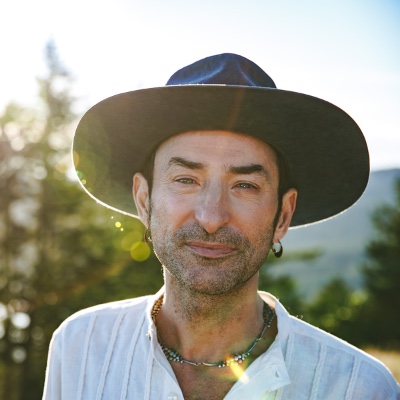
In this live concert reel, Rafe Pearlman performs a series of devotional folk songs that weave together intimate spiritual yearning with vivid natural imagery drawn from the American landscape. Through layered vocals, acoustic instrumentation, and themes of trust, love, and sacred geography, Pearlman creates a sonic prayer—calling out for human connection and divine presence while invoking the red rocks and redwoods of California as spiritual touchstones.
Rafe Pearlman's live concert reel sits at the intersection of folk tradition and devotional practice. Unlike purely secular folk or commercial country music, devotional folk centers the song as an act of calling—a reaching toward something beyond the self. In this performance, Pearlman's voice becomes both vulnerable and resolute, working with acoustic instrumentation to create space for prayer and witness. The form itself—acoustic guitar, intimate vocal phrasing, repeated refrains—harks back to centuries of spiritual folk tradition across cultures, where simple melodies and repeated words create a kind of musical mantra.
The distinction matters: this is not entertainment primarily, though it is beautiful. It is a ceremony of sound, structured to move both performer and listener toward a state of openness and receptivity. Pearlman's approach honors the folk idiom's power to express what cannot be said in prose alone.
A recurring motif in Pearlman's performance is the invocation: "I need someone to love / I need someone I can trust." This is not a romantic ballad in the contemporary sense. Rather, it is a articulation of fundamental human vulnerability and the spiritual truth that isolation is unsustainable. The repetition of this phrase—its return again and again—functions as both prayer and affirmation. By singing it, Pearlman acknowledges the human condition while also affirming that such need is valid, even sacred.
In the context of spiritual practice, love and trust are not sentimental luxuries but structural requirements for the journey inward. To trust is to release the illusion of control. To love is to open beyond the contracted self. Pearlman's song makes this transparent: these aren't things to overcome or transcend, but to meet directly and sing toward.
The second section of the performance shifts to geographical specificity: "Child, through the golden hills of California, red rock to redwood, we make our way back home." This is not mere scenic description. The landscape becomes a spiritual map. The "golden hills" evoke both literal geography and the warmth of divine presence. Red rock—exposed, ancient, holding the weight of geological time—suggests stability and enduring truth. Redwoods, the tallest living beings on Earth, point toward the vertical transcendence toward which spiritual seekers orient themselves.
The phrase "make our way back home" reframes the journey. Home is not a destination to arrive at but a direction of return. This echoes the spiritual principle that the sacred is not elsewhere but here, always accessible as a homecoming. Pearlman's invocation of specific California topography grounds this abstraction in the particular—suggesting that wherever you are, the landscape around you can become a teacher and a threshold.
The word "hallelujah" appears repeatedly in the performance's closing moments. This Hebrew word—meaning "praise the Lord"—carries centuries of liturgical weight while remaining open to secular reinterpretation as pure affirmation. When Pearlman repeats it, the effect is incantatory. It is not cerebral affirmation but embodied vocalization, a statement made not primarily to convince the mind but to move through the body and into the nervous system of both singer and listener.
The repetition itself is the practice. Like a mantra or kirtan, the repeated word creates a groove—a sonic pathway that gradually dissolves the boundary between performer and listener, between isolated self and field of shared resonance. By the end, "hallelujah" becomes less a word with a specific meaning and more a pure gesture of openness and release.
Though the full instrumentation is not detailed in this excerpt, the intimate scale evident in Pearlman's vocal delivery suggests acoustic-primary arrangement. This choice is significant. Electric instruments can carry spiritual content, but acoustic instruments—particularly when played live—carry the vibration of human touch directly through the air. The listener hears not just melody and lyrics but the physical reality of fingers on strings, breath through a resonating chamber. This embodied presence creates a different contract with the audience: not "be entertained" but "witness this act of making music as an act of prayer."
The spaces between notes matter as much as the notes themselves. In devotional music, silence is not emptiness but presence—a clearing where grace can enter.
Near the midpoint, Pearlman acknowledges "this mess we're in." This phrase—with its colloquial directness—refuses both false transcendence and spiritual bypassing. The performance does not pretend that suffering does not exist or that a beautiful song erases difficulty. Instead, it names the mess while simultaneously singing through it. This is the paradox of authentic devotional music: it does not deny the world's confusion and pain, but it places these within a larger field of meaning, calling toward something that can hold the whole truth.
This is different from toxic positivity or denial. Pearlman is saying: yes, it is a mess. And yes, we sing. Both are true. The song itself becomes a way of metabolizing what cannot be fixed through the force of will alone.
That this is a "live in concert" performance matters. The audience—present in the room, audible through applause at 41 seconds—forms part of the field. Spiritual performance is not a broadcast from stage to passive viewers, but a co-creation. The performer generates an intention and opens a space; the listeners' presence and receptivity complete the circuit. The applause itself, heard on the recording, marks moments of recognition—audience members feeling touched by what they have witnessed.
In this sense, a live concert reel is not entertainment documentation but a record of a shared ceremony. Those who listen to it now, long after the original performance, can still enter that field if they approach it with openness.
If Rafe Pearlman's work resonates, consider exploring other artists in the devotional folk tradition: contemporary kirtan artists, folk spiritualists, and singer-songwriters who use the folk form as a vehicle for prayer rather than narrative alone. Listen to how repetition functions in your own spiritual practice—whether through mantra, prayer, song, or breath. Notice how a specific place (California, your own hometown) can become a teacher and a threshold to presence. And consider: what would it feel like to sing "hallelujah" not as a word but as a pure gesture of yes, said to life as it actually is?


