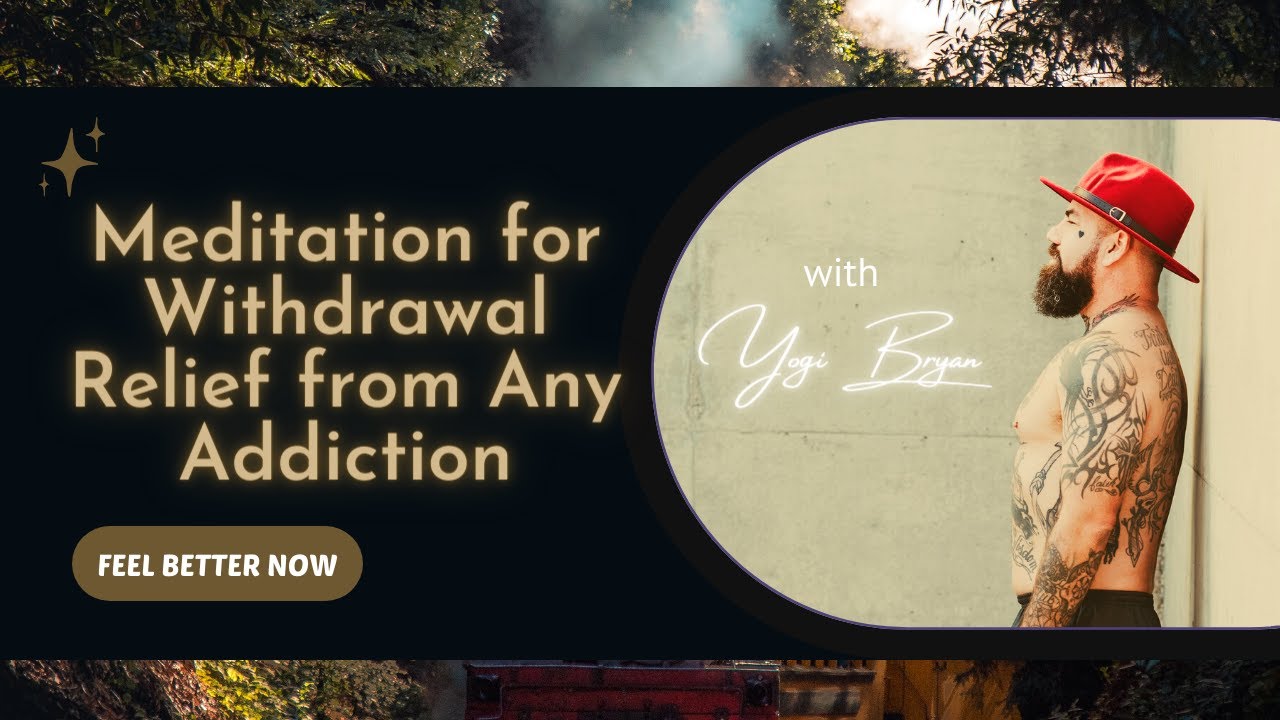
A man sits on a cushion, eyes closed, and before the first minute is up he has told you to stop overthinking, called your breath "natural" in a way that makes the word sound like a dare, and dropped a swear word just to see what happens. That is the opening move of a 13-minute guided meditation published by the YouAligned channel in October 2021, in which teacher Yogi Bryan builds a sitting practice around deliberate profanity. The premise is that his cursing jolts the listener's subconscious into attention and makes relaxation easier to reach. Whatever you make of that claim, the practice underneath it is a recognizable, carefully sequenced meditation: breath observation, a whole-body scan, witnessing thoughts, and a series of releasing breaths that bring you back to the room.
The swearing is not an accident of a casual teacher. Bryan states the logic in the first half-minute. "This is Yogi Bryan, welcome to Centered Not Censored," he says, before naming the frame: "we're going to be utilizing NLP." He glosses the acronym as neuro-linguistic programming and makes a claim about habit: "we are all a set of habits, a set of programs." If the mind runs on programs, the teacher's job is to interrupt them.
From there he makes the central promise explicit. "In this meditation using NLP I will be saying some bad words," he tells the listener, "and what that does is it shocks your subconscious mind." In his telling, each swear word is a pattern interrupt: "anytime I drop an f-bomb I get more attention out of you." The attention, he argues, creates "more opportunity for you to change" and "more opportunity for you to relax." (Yogi Bryan, YouAligned guided meditation, published October 28, 2021; the opening segment runs from roughly 0:12 to 0:47.)
It is worth being precise about what the video does and does not establish. It presents NLP and the shock-of-profanity idea as the teacher's framing. It does not cite studies, and nothing in the material provided tests whether swearing changes how a listener relaxes. What can be judged is the practice itself: whether the instructions are clear, whether the sequence makes sense, and whether the tone helps or gets in the way. On those counts the answer is more interesting than the gimmick.
Bryan's posture instructions are unusually loose, and the looseness is part of the design. He offers a cushion as his preference, but allows a chair, legs stretched out, or lying flat. Hands can rest palms-down, palms-up, or in the lap, one over the other. "Whatever is comfortable for you," he says, and then the signature line: "don't overthink it." Around the 1:12 mark, after a quick instruction to get settled, he tells the listener to quit overthinking, and the swear word lands as a deliberate comic beat.
That tone matters. Many beginners arrive at meditation certain they are doing it wrong. A guide who lowers the stakes on posture, and who laughs at himself while doing it, removes one of the most common barriers before the practice has started. The swearing works as a kind of permission slip: nothing here has to be solemn.
The breath section, beginning around 1:49, is the anchor of the whole meditation. Bryan asks the listener to breathe through the nose or the mouth, whichever feels natural, and reminds them that they have "been breathing all your life," so there is nothing to learn. The job is observation, not control: "nothing to do or control, all you have to do is observe your breath, noticing the inhale and the exhale."
He then frames arrival as a small act of permission. "Allowing yourself to arrive, giving yourself permission to relax," he says, and asks the listener to notice the breath "starting to smooth out on its own." This is a classic move in contemplative teaching: the breath is used as the one thing that is always present, a home base to return to when attention wanders. Notice that Bryan repeats the phrase "nothing to do or control" several times. The repetition is doing the work. It keeps the practice from becoming another performance.
At about 4:23, the meditation shifts to the body. Bryan asks the listener to bring awareness to "the tips of the toes" and "the crown of your head," then to take "a scan of the entire body." The instruction is specific in a useful way: notice any tension, pinpoint where it sits, and bring your attention to that spot.
Then comes the most vivid instruction in the practice. Bryan asks the listener to ask themselves why they are holding that tension there. "Why the [censored] am I holding this tension here," he prompts, and he anticipates the reaction: "might start to giggle a little bit, that's okay." The question is not a therapy session. It is a light inquiry that turns attention from the tension itself to the fact of holding it. Then he gives the release image: the tension "dissolving into the ground, melting into the ground, slowly fading away."
Body scans are one of the oldest tools in contemplative practice, and the sequence here is practical. Start at the extremities, move through the whole frame, locate the tight spots, and let the body soften while the breath keeps doing its quiet work. Bryan adds a counting principle that makes the relaxation cumulative: "each and every breath you take you relax even more and more."
Around the 6:49 mark the practice moves to thought, and the metaphor is cinematic. "Just watch the thoughts, let the thoughts roll in and roll out," Bryan says. "Be the observer of your thoughts, just like you're watching a movie." He uses the language of witness: "be the observer, be the witness, nothing to do or control with your thoughts."
The goal here is not an empty mind. Bryan asks for something subtler: a relationship to thought in which you are watching a story rather than being swept into it. When a thought begins "spiraling you out of the present moment," he gives a simple remedy: "just come back to your breath." Worries, in mind or heart, get the same treatment. Let them go, he says, and notice the body respond.
"Any worries in your mind, any worries in your heart, just let that go." (Yogi Bryan, YouAligned guided meditation, published October 28, 2021; around 10:50 in the video)
This is the emotional center of the practice. The swearing is loudest here, and the instruction is quietest: let the thought pass, return to the breath, do not argue with it.
The closing third of the meditation is built around deliberate, almost physical release. Bryan asks for a deep inhale through the nose, a hold, and an exhale "side out," repeated in rounds. The purpose is to make release tangible. He names what he wants let go of, using the same profane shorthand throughout, and asks the listener to feel "that clarity, that lightness in the body."
Then he hands the body back. "Start to move the fingers, move the toes," he says, "maybe rocking the head side to side, whatever you want to do, just do it." He encourages laughter, even suggests the listener does not have to take the meditation so seriously. This transition matters. Meditation that ends in rigid stillness can leave people feeling unanchored when they stand up. Bryan's return to movement gives the nervous system a clear signal that the session is over.
The final lines are simple: bring the hands to heart center, take one last breath, and return to the day. He suggests the practice can be repeated, and the cheerful hyperbole at the end ("do it a thousand times a day if you need to") is typical of the whole video's tone. Read it as encouragement, not a prescription.
The video carries a clear warning, and it is honest. The description tells viewers that the class "contains some profanity" and "might not be for you" if that is not their thing. The swearing is not decoration; it is the teaching device. If it grates, the practice will be harder to enter. If it makes you laugh and loosens your shoulders, it may be exactly the entry point you needed.
There is also a case to be made for the underlying structure, regardless of the language. Breath observation, a body scan, witnessing thoughts, and a closing release are a complete sitting practice in thirteen minutes. The profanity is a bet that a little shock will keep attention alive. Whether or not NLP explains why it works, the bet is easy to test for yourself: sit, follow the instructions, and notice what changes.
If this video sparked curiosity, start with the practice on its own terms. Try a single session with the instructions as written: find a seat you can hold without overthinking it, breathe without controlling the breath, scan the body for tension, and watch your thoughts as if they were a film. Then ask honestly what the swearing did. Did it wake you up, distract you, or make no difference at all?
For a broader view, compare this session with a guided practice that uses calmer language. Notice which instructions carry over regardless of tone: the breath anchor, the release on the exhale, the return to movement at the end. Those are the parts most worth keeping. The profanity is a style. The structure is the practice.
To go deeper into the source, watch the video itself on the YouAligned channel, and check the teacher's own channel for other classes he has published. Meditation is a practice you learn by doing, not by reading about it. Give it thirteen minutes, and let the words be as rough or as gentle as they need to be.