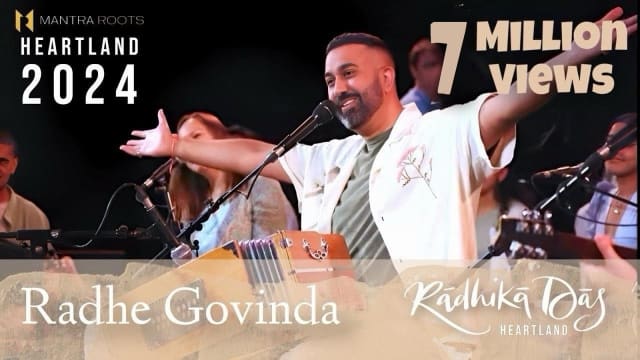
The Radhe Govinda mantra is a sacred sound formula rooted in the Sanskrit word "mantra"—meaning "that which liberates and cleanses the mind." When vibrated repeatedly through kirtan (congregational chanting), this mantra purifies the heart and mind, allowing inherent brilliance to shine into every aspect of life. Performed at Union Chapel in London, this live kirtan demonstrates how transcendental sound—channeled through various spiritual traditions across history—awakens the heart to its divine nature and brings about joy and true inner satisfaction.
A mantra is far more than a rhythmic phrase or meditation tool. The Sanskrit word "mantra" itself carries profound meaning: "that which liberates and cleanses the mind." When a sacred sound formula like Radhe Govinda is vibrated repeatedly, it functions as a process of purification—not merely psychological, but spiritual at its root. The heart and mind, through consistent repetition and intention, begin to shift their frequency and resonance.
This practice spans across cultures and spiritual traditions throughout history. Chants, prayers, hymns, and recitation of sacred texts have all served to awaken the inherent spiritual nature within human beings. The Radhe Govinda kirtan exemplifies this universal principle: transcendental sound as a vehicle for awakening consciousness. Unlike secular affirmations or self-help mantras, a mantra rooted in bhakti (devotional practice) carries the weight of centuries of spiritual lineage and the intention of countless practitioners who have resonated these sounds before.
The specific mantra "Radhe Govinda" is said to awaken the heart to its divine nature. Radha and Govinda (Krishna) represent different aspects of consciousness and devotion in the bhakti tradition—Radha embodying the soul's yearning for the divine, and Govinda representing the divine beloved. When these names are chanted together, the vibration is understood to invoke the relationship between the individual soul and the infinite source.
This awakening is not intellectual. It is felt as joy and true inner satisfaction—a shifting of the heart's orientation from external seeking to internal recognition of divinity. The repeated invocation of these names begins to work on the subtle levels of consciousness, gradually opening channels of perception that may have been obscured or dormant. In this way, the "innate brilliance within" begins to shine out into every aspect of life—relationships, work, creative expression, and presence.
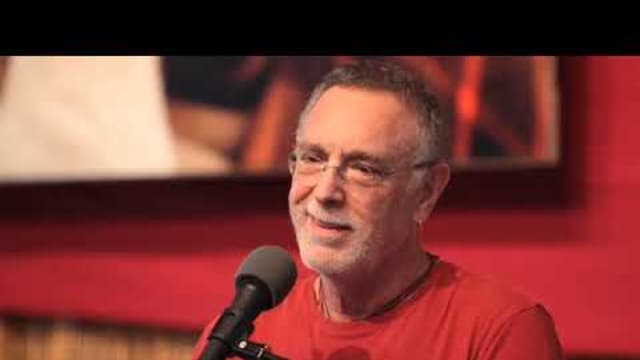
The arrangement of the Radhe Govinda kirtan performed at Union Chapel was inspired by Krishna Das, Pragjibhai Ladva, and Agnideva Das—lineage holders within the kirtan tradition. The structure itself is intentional: the entry to the kirtan consists of joyful free playing and crowd participation, creating a mood that inspires loving devotion.
This is crucial to understanding how kirtan differs from passive listening to chanting. The involvement of the assembled group—clapping hands, swaying, joining voices—creates a collective field of resonance. When individuals come together to vibrate a sacred sound, the effect is exponentially greater than solitary chanting. The momentum builds, the heart opens, and the mind becomes absorbed in the repetition. The musical arrangement, with its piano, double bass, violin, percussion, guitar, and saxophone, provides a sophisticated harmonic container that both honors the ancient tradition and makes it accessible to a contemporary Western audience.
The performance at Union Chapel brought together multiple skilled musicians and vocalists: Michael Goodey (piano), Rex Horan (double bass), Preetha Narayanan (violin), Abhay Buddhdev (percussion), Keli Woods (guitar/vocals), along with vocalists Ananda Monet, Madhvi Mulji, Nrtya Shekhar, Sai Gadhvi, Daivī-kumārī, Ekadasi, Syamali Buddhdev, and Vik (tabla), plus Tom Duggan (saxophone). Radhika Das led the kirtan as the primary vocalist and guide.
This ensemble approach reflects a fundamental truth about mantra: the power resides not in perfection, but in sincere participation and alignment. Each musician contributes their consciousness and skill to create a unified field of sound. The tabla, an ancient Indian percussion instrument, provides the rhythmic anchor; the Western strings and piano integrate the tradition into a language the London audience could feel resonantly. The result is not a performance "at" the audience, but a shared exploration of transcendental sound in which everyone becomes part of the vibrational field.
Within the kirtan itself, there are moments of teaching embedded in the chanting and the interactions with the crowd. The reference to "karma from lifetimes" and the "reaction to all action" touches on a central bhakti philosophy: that through devotional sound and surrender, one can begin to shift patterns that have accumulated over time. The mention of clapping hands—"when you clap your hands together, your karma floating away"—uses the immediate physical action of participation as a metaphor for liberation.
This is not to suggest that a single kirtan session erases all karmic patterns. Rather, it points to the direction of practice: regular, intentional engagement with transcendental sound creates a gradual softening of reactive patterns, a turning toward the heart, and an orientation toward something greater than individual conditioning. The clapping is both literal (a physical expression of joy and participation) and symbolic (a gesture of release, of offering, of surrender).
In an era of constant digital stimulation, background noise, and fragmented attention, the deliberate practice of chanting a sacred mantra stands as a counter-current. The voice is one of the most intimate and powerful instruments we possess. When that voice is aligned with a sacred intention and merged with others in collective sound, something shifts in the nervous system, the heart, and the subtle energy channels of the body.
The Radhe Govinda kirtan is not an escape from the world, but a direct engagement with the world's source. By awakening the heart to its divine nature through repeated invocation, practitioners begin to perceive life differently. The suffering they see around them becomes infused with compassion. The joy they feel becomes more abundant and less dependent on external circumstances. The innate brilliance—often buried under years of conditioning, trauma, and habitual thought patterns—begins to emerge.
The arrangement's inspiration from Krishna Das, Pragjibhai Ladva, and Agnideva Das is significant. Krishna Das is a renowned Western kirtan leader who has spent decades making traditional bhakti accessible to contemporary seekers. Pragjibhai Ladva and Agnideva Das represent other lineage holders within the broader kirtan movement. By naming these sources, Radhika Das honors the transmission—the living practice that flows from teacher to student, from heart to heart, across generations.
This is how spiritual practice survives and thrives: not through rigid preservation, but through living transmission. The Radhe Govinda mantra is ancient, but its arrangement at Union Chapel is contemporary. It bridges the traditional bhakti path with the musical sophistication and cultural context of modern London. This is not dilution or degradation; it is translation, the carrying forward of something vital into new vessels.
If the Radhe Govinda kirtan resonates with you, there are several pathways forward. First, you might engage directly with the mantra through repeated chanting, either in community kirtan settings or in your own practice space. Twenty minutes of unhurried, sincere repetition can begin to shift your internal state. Second, explore the broader bhakti tradition—study the relationships between Radha and Govinda, the philosophy behind mantra, and the teachings of the lineage. Third, seek out live kirtan in your area or participate in online kirtans; the collective field is essential to the full power of the practice. Finally, consider how the principle of transcendental sound might apply beyond kirtan—in prayer, in music, in conscious use of your voice—as a path to awakening the heart to its inherent divine nature.