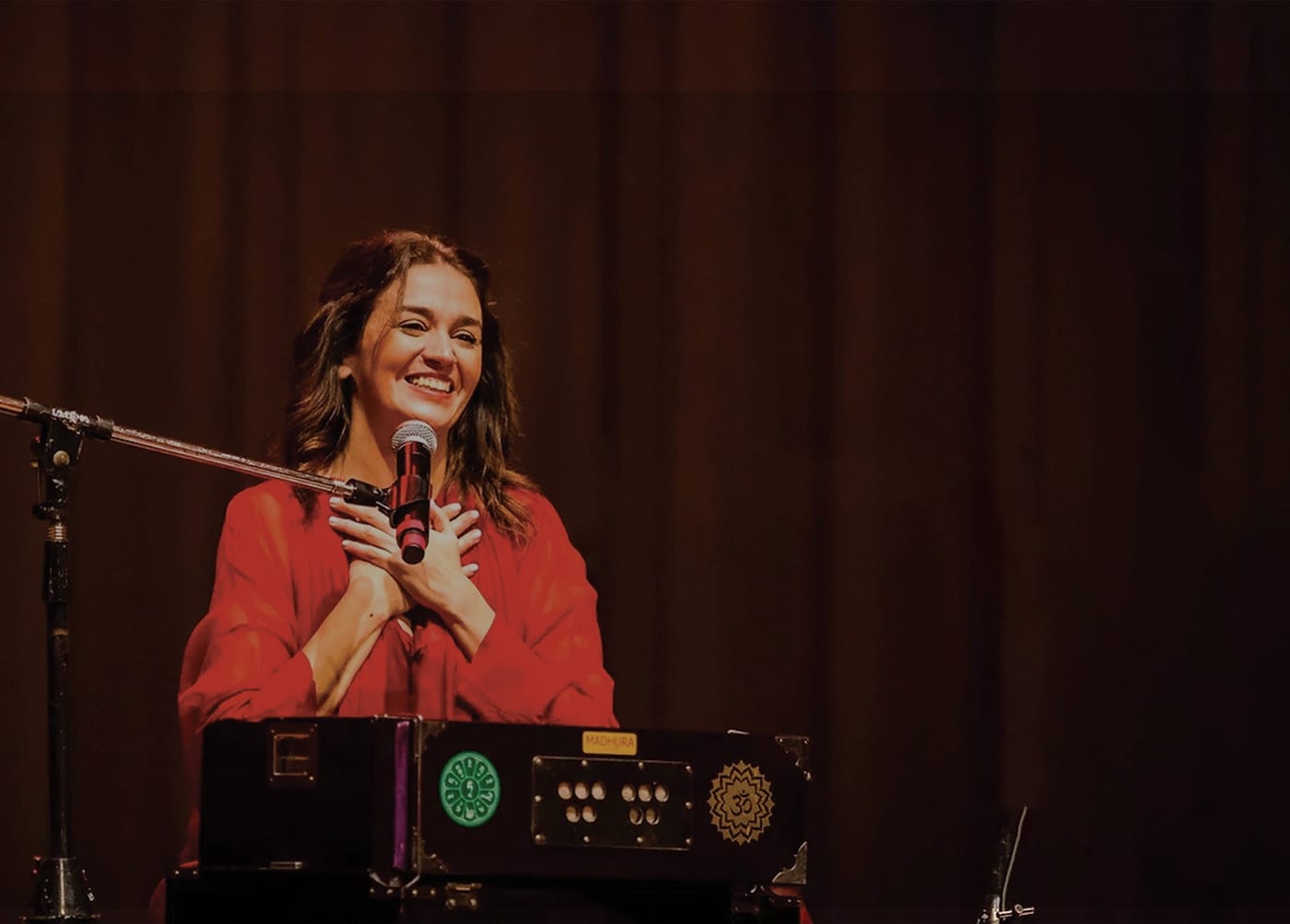

Released on December 21, 2019, Into the Heart is a nine-track album and the middle chapter of Prashanti Paz's three full-length releases, following Inner Light (2017) and preceding Beyond (2023). By the time it arrived, she had been working as a full-time devotional singer and meditation teacher for a few years, having moved from screenwriting into sacred music and teaching in 2016. If Inner Light introduced her voice and the breadth of her mantra practice, this record deepens the meditation work and shows a practice maturing. It came out just before the pandemic years, when her catalog would turn toward contemporary heart songs. It is a moment of settled, quiet focus.
The album's defining quality is restraint. Prashanti Paz sings in a clear alto that prioritizes the clarity of the Sanskrit syllables over vocal display. The bio calls her voice luminous and soothing, and that fits: it is steady and unhurried rather than showy. The primary accompaniment is harmonium, often alone, with sparse strings appearing on some tracks. There is no drum machine, no synth, no layered vocal loops.
Pacing follows the breath. There is no driving rhythm section and no urgency; pauses between phrases leave room for the mantra syllables to resonate. The mood is intimate and contemplative, something like chamber music for chanting. The production is warm but deliberately spare, so the voice and the simplicity of the mantra carry the emotional weight. This is not background music, and it rewards patience.
I can't responsibly name individual tracks from the material I have, since the track list for this album isn't included in the facts at hand. Rather than guess, I'd point you to the album's shape. Its nine tracks are built to be heard sequentially, as a complete meditation experience in a single sitting, rather than as isolated singles. Look for the places where the harmonium drops away and the voice stands alone, and the moments where a string line enters softly beneath a repeated phrase. Those are the places where the album's approach, a voice supported rather than surrounded, is clearest. Open the album on Spotify and let the running order do its work; that is how it was designed to be heard.
Prashanti Paz's foundation is explicitly Buddhist. She has trained for over two decades with teachers including H.H. the Dalai Lama, Kyabje Kalu Rinpoche, and Gyetrul Jigme Rinpoche. Yet her music is deliberately ecumenical, drawing on mantras from Hindu, Buddhist, Sikh, and shamanic traditions. That reflects her upbringing in an interfaith household, with a Jewish father and a Christian mother, where both traditions were honored.
Kirtan is the genre label most often attached to her work, and Krishna Das has said, "I love Prashanti Paz's voice!" But this album departs from the call-and-response, communal energy of group kirtan. It is closer to solo sadhana practice: a single voice, a harmonium, silence. It is an introspective cousin of kirtan, and it also sits comfortably beside meditation music, though it is more voice-forward and more articulate than ambient soundscapes.
This album suits listeners who want a personal practice rather than a communal event: meditators, yoga practitioners, and people drawn to mantra who may not identify with any single tradition. It lands hardest in a season of quiet deepening, when you are ready to move from curiosity about chanting toward sustained attention. It is a natural second step after Inner Light.
It is not for those seeking high-energy group ritual, lush production, or fast-paced meditation soundscapes. The mantras are largely in Sanskrit, and the arrangements are intentionally austere. Some openness to contemplative practice helps, though no formal background in Buddhism or Eastern philosophy is required. The repetition and tone of the chanting work independently of comprehension.
Give it a full, uninterrupted sitting, ideally in the evening, when the day's noise has settled. Headphones help, because the album's drama lives in small things: the breath before a phrase, the decay of a harmonium chord, the silence between repetitions. Sit or lie down, dim the room, and listen from the first track to the last without skipping. If you keep a meditation or altar practice, the album can frame a session as a whole.
Don't try to follow every word. Let the syllables become a focal point, return to them when your mind wanders, and allow the pauses to be part of the music. Then, if the album speaks to you, come back to it on another night. It reveals itself through repeated, patient listening rather than a single pass.