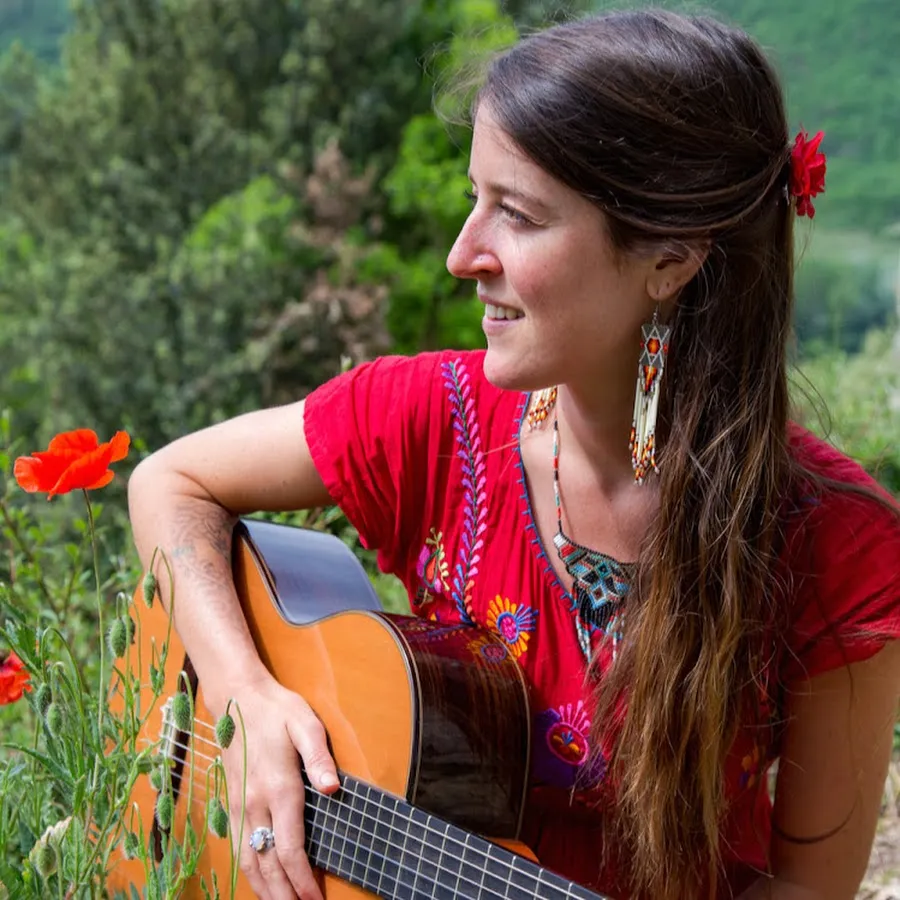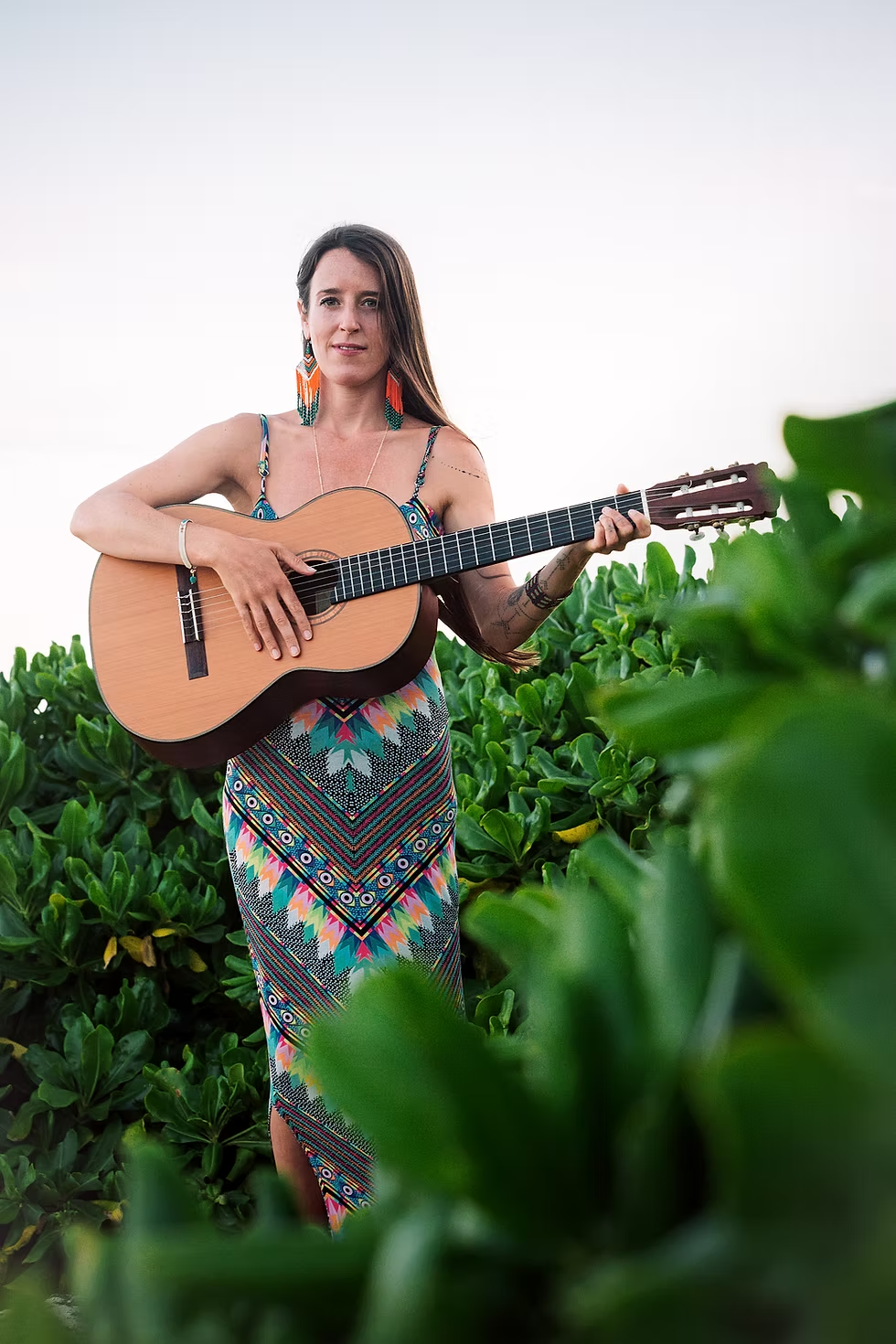

Fuerzas Sagradas arrived on 17 October 2025 as a three-track single, a compact release from an artist whose work has long been about distance traveled. Ayla Schafer is a multilingual world folk singer-songwriter and ceremonial musician who lives among the wild lands of Dartmoor, and she is a mother of two. Her story turns on 2010, when she travelled through South America. The years she spent away from home shaped her writing and taught her, through various indigenous traditions, about the healing power of song.
The Spanish title makes that history audible. Her repertoire moves between Spanish, English and Proto-Celtic, the reconstructed ancestral language of the Bronze Age, and a Spanish-titled release speaks to the South American thread in her writing. Coming after years of festival stages, ceremonial work and songwriting, a short release like this reads less as a statement of arrival than as a distilled offering: three tracks, one title, one intention.
Track-by-track credits and instrumentation are not detailed in the sources I have, so I won't claim specific instruments or players. What can be said comes from how Schafer's music is described: world folk and "medicinal song," with a poetic repertoire in which memory, remembrance and power are central. Her compositions are said to hold the beauty, shadow and rawness of human experience.
Treat the voice as the center of gravity, as in much ceremonial song. Listen for how language shapes the delivery. Spanish carries its own warmth and vowel-rich openness, and if Proto-Celtic or English surface, notice how the texture shifts. Expect the pacing and mood to serve presence rather than spectacle. Her stated invitation is to reconnect with yourself, the earth and "the quiet power of presence," which suggests music that rewards patience over immediacy.
The single runs to three tracks, but I don't have the track titles, so I won't name any. Here is how I'd approach them instead:
- The first track is your threshold. Notice how the voice enters, what language it chooses, and how much space surrounds it. In devotional and ceremonial music, the opening often sets the terms of the whole experience.
- The middle track is where a short release usually deepens. Listen for where the writing turns toward shadow or rawness, the quality Schafer's bio singles out.
- The closing track is worth hearing as an exhale. Ask whether it resolves, dissolves or leaves a question open.
With a release this small, the sequence matters as much as any individual song. Play all three in order at least once before you pick favorites.
Schafer works in a lane that overlaps several traditions without belonging neatly to one. Her bio places her in world folk and ceremonial song, informed by her exposure to indigenous approaches to healing through music during her South American years. It also reaches back to the Bronze Age through Proto-Celtic, and forward to Dartmoor, where she lives. That makes her music a kind of bridge: earth consciousness and ancestral wisdom expressed through contemporary songwriting.
If you come from kirtan or bhakti listening, treat this as an adjacent practice rather than the same one. The shared ground is song as a vehicle for presence, remembrance and reconnection. The vocabulary and languages here are different, rooted in folk songwriting and ceremony rather than call-and-response devotional forms. Ambient listeners may find kinship in the emphasis on atmosphere and stillness, though the poetic, language-forward writing keeps it closer to song than soundscape.
This release will resonate most with listeners who already use music as a companion to inner work: people in circles, ceremonies, movement or quiet practice, or anyone drawn to songs that carry ancestral memory. It suits a life moment of transition or return, such as coming back to yourself after a long stretch away, grieving, or making space for something new. Parents, particularly those who want music with depth in a busy household, may also find it meets them well, given that Schafer is herself a mother of two.
It is probably less suited to listeners who want high-energy rhythm or background music for tasks. The intent is closer to attention than distraction.
Choose an evening, when the day's noise has settled. Use headphones or a quiet room, and listen alone the first time. Dim the lights, put the phone away, and play the three tracks straight through without skipping.
On a first pass, let the languages wash over you rather than hunting for translations. On the second, look up the lyrics if they are available to you, and notice what shifts. If you practice ritual, journaling or gentle movement, this is a natural companion for it, but let the music lead rather than using it as a backdrop. Afterward, sit for a minute in the quiet. That is where this kind of song tends to do its work.