
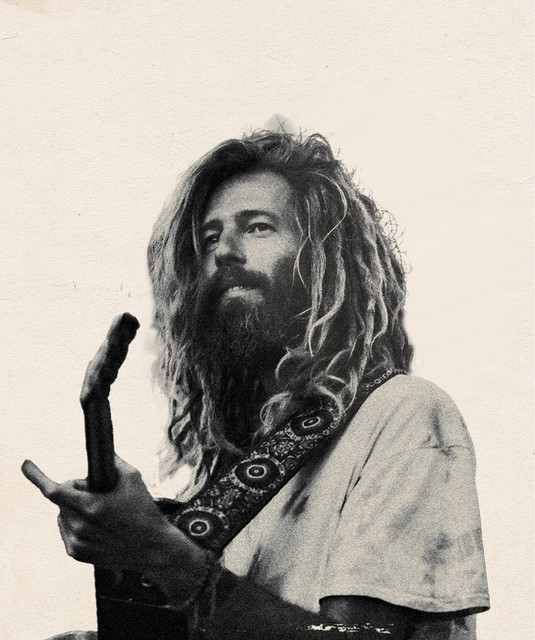
The Brighton Mystic
Sam Garrett occupies an unusual place in contemporary music: he's a folk singer whose songs double as spiritual practice, a touring musician whose performances feel more like gatherings than gigs. With nearly 680,000 followers on Spotify, he's built a devoted international audience that comes to him not just for melody, but for meaning—for music that treats the soul as seriously as it treats the song.
Born in Brighton, England, Garrett grew up in a household where creativity wasn't just encouraged but woven into daily life. The seaside city, with its bohemian spirit and eclectic cultural scene, provided fertile ground for a young artist learning to trust his voice. During his teenage years, he gravitated toward songwriting and performance, driven by what he would later describe as a quest for authenticity—a desire to use music not as entertainment, but as a vehicle for genuine human connection.
The Pilgrimage That Changed Everything
What distinguishes Garrett's story from countless other singer-songwriters is the turning point that came not from a record deal or a viral moment, but from an inward journey that took him outward. As a young adult, he began traveling extensively, absorbing musical traditions and spiritual philosophies from various corners of the world. These weren't tourist expeditions but pilgrimages of a sort—extended stays where he immersed himself in different cultural sounds and contemplative practices.
This period of wandering proved transformative. The folk and soul music he'd grown up with began to merge with mantra traditions, meditation practices, and the sacred music of cultures far from Brighton's pebbled beaches. Where other artists might have kept these interests separate—music in one box, spirituality in another—Garrett allowed them to inform and reshape each other. The result was a sound that feels both ancient and contemporary, rooted in folk tradition yet unafraid to incorporate the rhythmic patterns of kirtan or the tonal textures of world music.
A Sound That Heals
Garrett's core contribution lies in this synthesis. He's created a musical language that honors the storytelling tradition of British folk—think Nick Drake's intimacy or John Martyn's emotional depth—while incorporating elements usually found in spiritual ceremonies rather than concert halls. His songs often begin in familiar folk territory: fingerpicked guitar, warm vocals, narrative lyrics. But they evolve into something more circular, more meditative, with repeated phrases that function like mantras, inviting listeners not just to follow a story but to enter a state.
His album "The Journey" stands as perhaps his most complete artistic statement, chronicling the insights and experiences gained from his travels and spiritual practices. The title itself is telling—this is music concerned with process rather than arrival, with the transformative power of seeking rather than the certainty of finding. Each release in his discography marks a new chapter in his ongoing exploration of consciousness, personal growth, and the ways music can serve as a bridge between the material and the transcendent.
Beyond the Stage
What makes Garrett's work particularly distinctive is his understanding that the album is just one form his music can take. His live performances are designed as transformative experiences, events where the boundary between performer and audience becomes porous. These aren't simply concerts where people listen; they're gatherings where people participate, often singing along to repeated phrases, allowing the music to work on them in the way a meditation session might.
This approach has found a particular resonance in an era when many people are seeking spiritual connection outside traditional religious structures. Garrett's music offers something rare: a practice that doesn't require adherence to any particular tradition, yet honors the depth of many traditions. It's folk music that knows what mantras know, soul music that understands what meditation understands.
A Quiet Revolution
Garrett matters because he represents a growing movement of artists who refuse the old categories. He's too spiritual for the folk purists, too rooted in song craft for the mantra scene, too serious about transformation to be dismissed as New Age, yet too accessible to be academic. This in-between space is precisely where he's most effective.
His audience spans age groups and backgrounds, but what unites them is a hunger for music that offers more than escape or entertainment—music that can be a companion to inner work. In an increasingly fragmented cultural landscape, he's created a genuinely international community, one that gathers not around ideology or identity but around the simple, radical act of using sound to remember what matters.
Garrett continues to travel, write, and perform, his work deepening as he ages into his practice. He's not trying to be a guru or a pop star—just a songwriter who understood early on that the most powerful music doesn't just move the body or even the heart, but reaches toward something harder to name. In doing so quietly and without fanfare, he's carved out a legacy as a bridge-builder: between traditions, between the secular and sacred, between the personal journey and the collective song.