Music as a Way of Understanding
For Ram Dass, music has always been part of the way he understands the world.
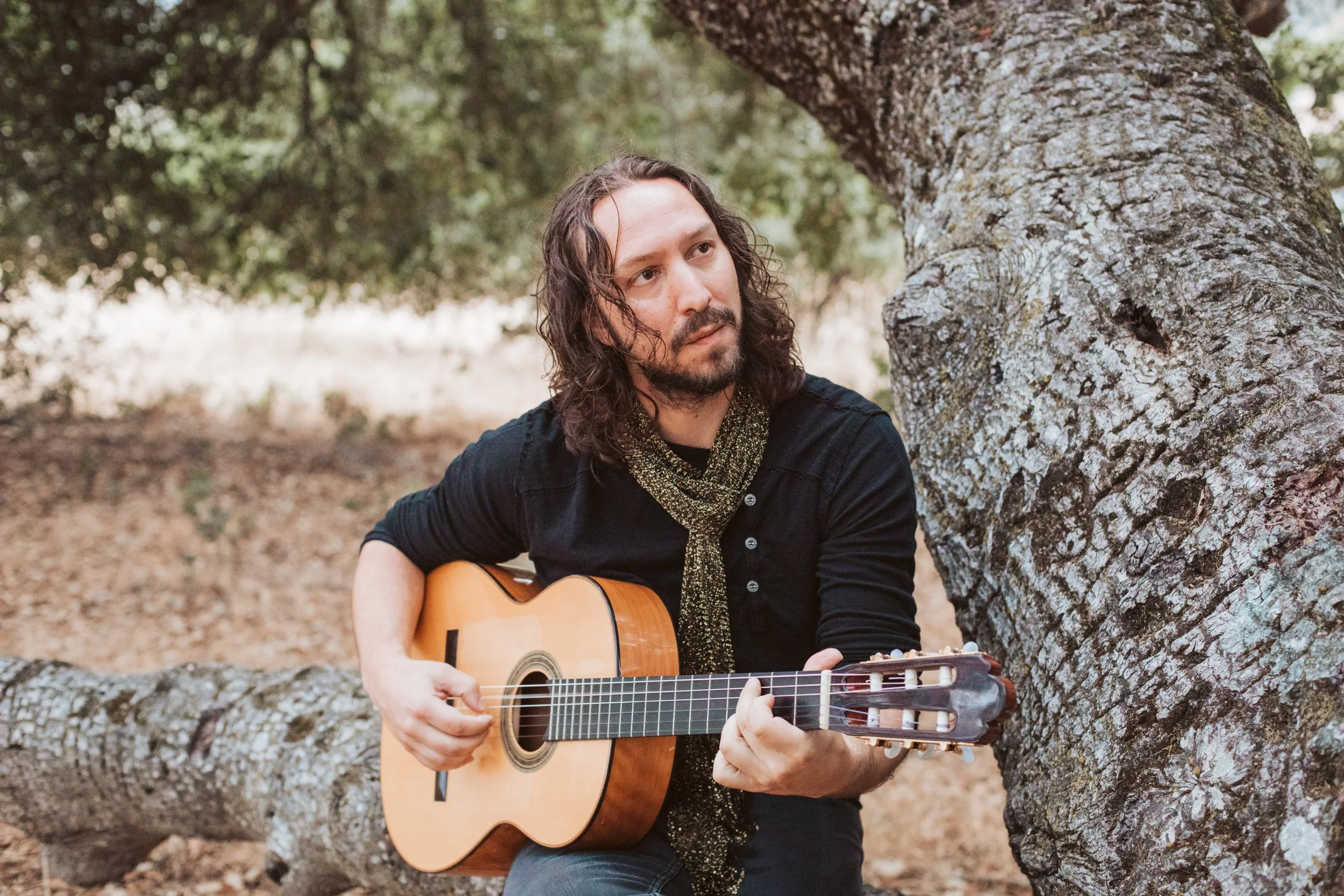
Raised by two professional musicians, he began playing at a very early age. His formal training started with piano, followed by extensive classical study on clarinet. From 2001 through 2004, he performed with the Young People’s Symphony Orchestra, based in Berkeley, California. In June 2003, he appeared with the orchestra at Carnegie Hall in a MidAmerica Productions concert featuring selections from Prokofiev’s Romeo and Juliet ballet suites.
That early training gave him a strong technical foundation, but his musical development never remained confined to one tradition. Over time, his work expanded into songwriting, improvisation, production, engineering, and multi-instrumental performance.
The through line is less a genre than a way of listening.
A Life Built Around Collaboration
Collaboration is central to Ram Dass’s work.
As a touring musician, he has spent many years performing internationally with Snatam Kaur, moving between clarinet, keyboards, guitar, bass, percussion, and vocals. He is also Kaur’s current producer and has produced recordings including Nirankaar and Heartflow.
His broader live, recording, and production work has included artists such as Ajeet, Mirabai Ceiba, Jai-Jagdeesh, Nirinjan Kaur, Simrit, Ganavya, Peter Kater, Matthew Schoening, Tina Malia, Roscoe Mitchell, Joseph Jarman, Peter Yarrow, Guster, Jahnavi Harrison, and others.
For Ram Dass, collaboration is not simply about adding musicians to a finished idea. It is often part of the composition itself. Improvisation, close listening, and allowing another musician to substantially change the direction of a piece are fundamental to the way he works.
That approach is especially clear in his music with AWARÉ.
Grief, Love, and And Now He Has Wings
In 2021, Ram Dass collaborated with AWARÉ on the EP And Now He Has Wings, created in the aftermath of the death of his newborn son.
The project includes “The Water Poem,” “Heart Takes Flight,” “To Become Born,” “Elegy for a Yellow Bird,” and the title track. Rather than trying to explain grief, the music creates space for grief, love, memory, and recovery to exist together.
“The Water Poem” and “Heart Takes Flight” have become two of the most widely heard pieces from Ram Dass’s catalog.
The project also reveals something central to his approach to music: an interest not only in what a song says, but in what music can hold when language becomes insufficient.
That thread continues in later work, including the 2022 EP The Unimaginable, where his voice and songwriting move more directly to the foreground.
The Producer Behind the Music
A significant part of Ram Dass’s career takes place on the other side of the recording process.
Credited on many projects as Ram Dass Khalsa, he works as a producer, engineer, mixer, arranger, and multi-instrumentalist. Depending on the recording, his role can include developing arrangements, playing instruments, shaping performances, recording and editing, mixing, songwriting, and helping an artist determine the larger direction of a project.
His approach to production is closely related to his approach to collaboration.
Rather than imposing the same sonic identity on every artist, he works to understand what is already distinctive about the music and build the recording around it. Production becomes an act of attention: deciding what should be emphasized, what should remain untouched, and what the song needs in order to communicate clearly.
That has allowed him to work across folk, world, devotional, ambient, singer-songwriter, and contemplative music without treating those categories as rigid boundaries.
Spirituality and Lived Experience
Spirituality has been an important part of Ram Dass’s life and has shaped the way he understands music, grief, nature, mortality, and connection.
His experience includes years within devotional and contemplative traditions, along with substantial personal experience with meditation, ceremony, and plant-medicine traditions. These influences appear in his work less as doctrine than as perspective: an openness to mystery, an attention to presence, and an interest in the ways music can hold experiences that are difficult to explain directly.
That relationship to spirituality sits alongside many other influences in his work, including classical training, improvisation, songwriting, collaboration, studio craft, and the ordinary complexity of human life.
What Music Can Do
A recurring idea throughout Ram Dass’s work is that music can have a role beyond entertainment.
It can create connection between people who may not otherwise share a language. It can give form to grief and experiences that resist explanation. It can offer solace without pretending to resolve suffering. It can become part of ceremony, memory, celebration, mourning, or simply the experience of being present with another person.
Ram Dass is part of a broader movement of musicians exploring this role for music in contemporary life.
For him, meaning does not depend on whether a piece is explicitly spiritual. It can live in a melody, an improvised phrase, a lyric, a silence, or the relationship between musicians playing together.
The question is less whether music belongs to a particular category than whether something real is being communicated.
Between the Stage and the Studio
Ram Dass’s work has developed through an unusual combination of live performance and studio practice.
As a performer, he has toured internationally for many years and appeared on stages ranging from intimate venues to Carnegie Hall and the 61st GRAMMY Awards Premiere Ceremony, where he performed with Snatam Kaur in 2019.
As a producer, much of his work happens away from the stage, through the slower process of building recordings and helping artists translate ideas into finished music.
These two sides of his career inform one another. Years spent listening to musicians in real time influence the way he produces records, while the detailed listening required in production changes how he approaches live performance.
Both depend on the same underlying skill: listening closely enough to know when to contribute and when to leave space.
The Work Continues
There is no single recording or genre that completely defines Ram Dass’s work.
His own releases include intimate collaborative music, singer-songwriter projects, and recordings shaped by contemplative and devotional traditions. His production work extends into the catalogs of numerous other artists. His live career continues alongside both.
What connects those different areas is an approach to music rooted in curiosity, collaboration, technical craft, and an interest in the deeper role music can play in human life.
Rather than turning away from difficult experience, his work often moves toward it: grief, love, uncertainty, beauty, mortality, and the complicated process of being human.
The aim is not to reduce those experiences to an explanation.
It is to make music spacious enough to hold them.