BrightStar

すべてのEventsを見る

意識ある集いに出会う

events

Yoga
Meditation
Breathwork
Qigong
Tai Chi
Sacred Music
World Music
Medicine Music
Sound Healing
Ecstatic Dance
人気の目的地
BaliSedonaLos AngelesCosta RicaNew YorkSan FranciscoAustinMiamiJoshua TreeTulum
すべてのカテゴリを見るすべての目的地を見る

すべての機能を探索

イベントを成長させる強力なツール

プラットフォーム機能

スマートダイナミックプライシング
チケットカテゴリ
座席指定
カート放棄リカバリー
訪問者リカバリー
寄付とスライディングスケール
アフィリエイトシステム
チケットスキャナー
クーポンコード
カスタム質問
チケット共有
アップセルとアドオン
分析とレポート
メールシーケンス
ウェイトリスト / 通知 / リマインダー
人と場所
Artists & TeachersEvent OrganizersVenues & StudiosKnowledge BaseGlossaryInspiration
すべての機能を見る私たちについて
料金ブログ
Language
Saved events
すべてのイベントを見る

events

YogaMeditationBreathworkQigongTai ChiSacred MusicWorld MusicMedicine Music

人気の目的地

BaliSedonaLos AngelesCosta RicaNew YorkSan Francisco

人と場所

Artists & TeachersEvent OrganizersVenues & StudiosKnowledge BaseGlossaryInspiration

プラットフォーム機能

スマートダイナミックプライシングチケットカテゴリ座席指定カート放棄リカバリー訪問者リカバリー寄付とスライディングスケールアフィリエイトシステムチケットスキャナークーポンコードカスタム質問チケット共有アップセルとアドオン分析とレポートメールシーケンスウェイトリスト / 通知 / リマインダー
すべての機能を見る私たちについて
料金ブログ
ログイン探求者クリエイター
  • すべてのイベントを見る
  • 探求者向け
  • ヨガ
  • 瞑想
  • ブレスワーク
  • 気功
  • 太極拳
  • 聖なる音楽
  • ワールドミュージック
  • メディスンミュージック
  • サウンドヒーリング
  • エクスタティックダンス
  • リトリート
  • ワークショップ
  • すべてのカテゴリ →
  • Bali
  • Sedona
  • Los Angeles
  • Costa Rica
  • Tulum
  • Byron Bay
  • San Francisco
  • Austin
  • New York
  • San Diego
  • Denver
  • Seattle
  • Portland
  • Miami
  • すべての都市 →
  • Join the Movement
  • Why we list
  • Sell Globally
  • クリエイター向け
  • チーム向け
  • ライター向け
  • 講師向け
  • キルタンアーティスト向け
  • スタジオ向け
  • フェスティバル向け
  • リトリートセンター向け
  • 非営利団体向け
  • ブランドアンバサダー
  • 無料チケット販売
  • Elevate
  • Amplify
  • 50万人以上のバイヤーネットワーク
  • カート放棄リカバリー
  • スマートダイナミックプライシング
  • チケットカテゴリ
  • 定期イベント
  • 座席指定
  • アフィリエイトシステム
  • ウェイトリスト / 通知
  • チケットスキャナー
  • 埋め込みウィジェット
  • イベント配信
  • メッセージセンター
  • インテグレーション
  • レポート
  • すべての機能 →
  • 概要
  • エコシステム
  • ブログ
  • 用語集
  • インスピレーション
  • ヘルプセンター
  • お問い合わせ
  • APIドキュメント
  • ブランドアセット
  • 採用
  • プレス
  • 利用規約
  • プライバシーポリシー

イベント

  • すべてのイベントを見る
  • 探求者向け
  • ヨガ
  • 瞑想
  • ブレスワーク
  • 気功
  • 太極拳
  • 聖なる音楽
  • ワールドミュージック
  • メディスンミュージック
  • サウンドヒーリング
  • エクスタティックダンス
  • リトリート
  • ワークショップ
  • すべてのカテゴリ →

目的地

  • Bali
  • Sedona
  • Los Angeles
  • Costa Rica
  • Tulum
  • Byron Bay
  • San Francisco
  • Austin
  • New York
  • San Diego
  • Denver
  • Seattle
  • Portland
  • Miami
  • すべての都市 →

クリエイター向け

  • Join the Movement
  • Why we list
  • Sell Globally
  • クリエイター向け
  • チーム向け
  • ライター向け
  • 講師向け
  • キルタンアーティスト向け
  • スタジオ向け
  • フェスティバル向け
  • リトリートセンター向け
  • 非営利団体向け
  • ブランドアンバサダー
  • 無料チケット販売
  • Elevate
  • Amplify

機能

  • 50万人以上のバイヤーネットワーク
  • カート放棄リカバリー
  • スマートダイナミックプライシング
  • チケットカテゴリ
  • 定期イベント
  • 座席指定
  • アフィリエイトシステム
  • ウェイトリスト / 通知
  • チケットスキャナー
  • 埋め込みウィジェット
  • イベント配信
  • メッセージセンター
  • インテグレーション
  • レポート
  • すべての機能 →

会社

  • 概要
  • エコシステム
  • ブログ
  • 用語集
  • インスピレーション
  • ヘルプセンター
  • お問い合わせ
  • APIドキュメント
  • ブランドアセット
  • 採用
  • プレス
  • 利用規約
  • プライバシーポリシー
BrightStar
アプリを入手
App StoreからApp StoreGoogle Playで手に入れようGoogle Play
© 2026 BrightStar. 全著作権所有.
Watch

Smile at Fear: Living from Genuine Strength

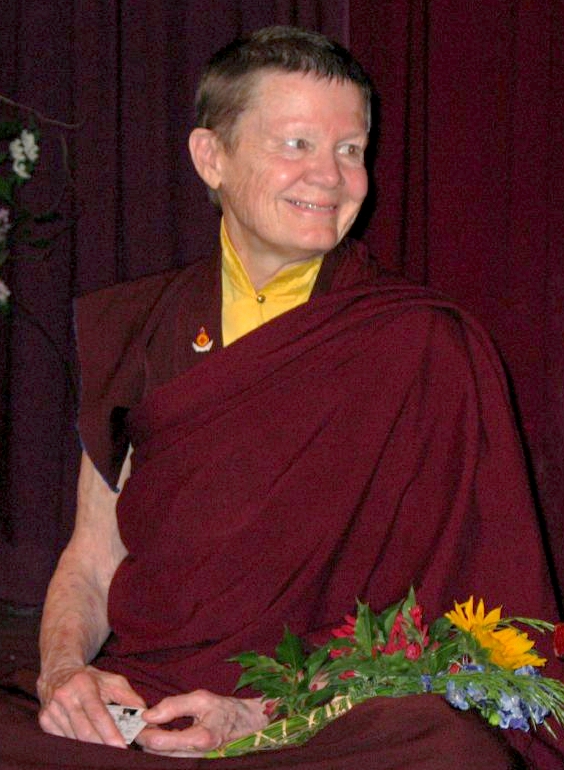
Pema Chodron
Pema Chodron
Apr 2, 2020
読了 約8分
視聴 · 6

In this talk from her 2009 "Smile at Fear" retreat at Omega Institute, Pema Chodron grounds fearlessness not in the absence of anxiety but in cultivating unconditional friendship with yourself—a practice rooted in Shambhala teachings about human potential. She presents genuineness as the life force animating the path of courage, explains why facing your weaknesses actually builds strength, and introduces meditation and a particular way of viewing your life as the two major tools for learning to stay with yourself when fear and aversion arise.

読む · 8セクション

What does the Shambhala view of human potential offer?

At the heart of Pema Chodron's teaching in this talk is a radically trusting view of what humans are capable of. Rather than beginning from a premise of human flaws or damage, the Shambhala teachings—particularly those transmitted by Chögyam Trungpa Rinpoche, whom Chodron studied under—start with the conviction that each of us contains real capacity for awakening. "We could live in a way as individuals and as a society where we called on our potential... our ability to open up our hearts and minds our ability to be kind our ability to care about each other our ability to love our ability to be generous our ability to have a sense of humor" (0:00). This is not positive thinking or denial of real suffering; it is a foundational trust in latent human qualities that can be developed through practice.

What makes this view practical, Chodron explains, is the decision to stop interpreting ourselves and others primarily through the lens of flaw. "Rather than seeing each other as flawed or seeing ourselves as flawed we see ourselves as full of potential to keep our hearts and minds open no matter what is happening in the outer circumstances" (0:70). This doesn't mean ignoring problems or pretending difficulty doesn't exist. Instead, it means holding a different frame: that our basic nature includes the capacity to remain open-hearted and mentally flexible regardless of external pressures. This foundational view then shapes how we relate to our own fear and weakness.

Why is genuineness the foundation of fearlessness?

Chodron identifies genuineness as the primary ground for developing true courage. "Genuineness becomes kind of the basis of the path of cultivating courage the path of fearlessness begins and continues and ends it's like the breath that you breathe into this path it's the it's the life force of the path of fearlessness is genuineness" (0:90). This is a precise teaching: fearlessness is not built on bravado or the suppression of doubt. It is built on a willingness to be authentic with yourself.

Genuineness, in this context, means two things. First, it means not being afraid of your own inner landscape: "not be afraid of ourselves and to be able to have an - to practice and cultivate so that our friendship with ourselves becomes more and more uncondition" (0:116). Second, it means refusing to perform a false version of yourself for others. "Our ability to not feel we have to fake it to make people think we're more together than we are but just being able to be honest with ourselves allows us to be open to our world if to the degree that we're open to ourselves we can be open to other people and to the world" (0:134).

The logic here is interconnected: to the extent you can be authentic internally—acknowledging your real thoughts and emotions rather than defending against them—you become capable of genuine openness to others. Faking coherence requires constant vigilance and creates an inward closure. Authenticity, by contrast, frees attention outward.

What is unconditional friendship with yourself?

A cornerstone practice Chodron introduces is cultivating "unconditional friendship" with your own experience. "Unconditional friendship is the ongoing exploration and the ongoing practice of cultivating an unconditional friendship" (0:170). This phrase might sound abstract, but the question Chodron poses clarifies it: "How do I stick with myself when I actually have an aversion or deep fear or a sense of it's tremendous feeling of anxiety?" (0:196). In other words: how do I remain present and kind toward myself precisely when my impulse is to reject, judge, or run from what I'm feeling?

Unconditional friendship means you stop abandoning yourself in the presence of your own difficulty. Most of us have been trained to abandon ourselves as soon as something uncomfortable arises: we numb, distract, judge ourselves harshly, or contract. Chodron is teaching a radically different move: to stay present to yourself with kindness and curiosity, even when—especially when—your weaknesses, fears, or uncomfortable sensations emerge.

How does facing your weaknesses reveal strength?

One of Chodron's most striking teachings in this talk concerns the relationship between weakness and strength. She introduces the teaching of Chögyam Trungpa Rinpoche on this point: "When you when you face yourself when you're to the degree that you're willing to face yourself and face your fear and come to know your fear so intimately you sort of know it's smell it's taste its color its texture and you particularly begin to be very wise about knowing what it triggers in you and all the different ways that you try to run away from the feeling the emotion the sensation of fear" (0:278).

This teaching suggests that real strength does not come from denying or transcending your vulnerabilities. Instead, it comes from intimate familiarity with them. When you truly know your fear—not intellectually but sensorially and emotionally—you become wise about its movements. You recognize the specific patterns it triggers in you. You see clearly the strategies you employ to escape it. This self-knowledge is the ground of genuine strength because it means you are no longer unconsciously reactive.

The ultimate instruction is equally striking: "When you turn toward your fear when you move closer to it you don't right away discover courage he said instead what you discover is a kind of shaky tender vulnerability" (0:361). Chodron and Trungpa are saying that approaching your fear directly does not immediately deliver the experience of being brave. What you discover first is vulnerability—a trembling openness. But this vulnerability, this willingness to be affected and exposed, is the actual substance of real strength. It is the discovery of strength not as armor or invulnerability, but as the capacity to stay present to the full texture of your life.

What is the genuine heart of sadness?

The YouTube description mentions "the genuine heart of sadness" as a basis for nonviolent warriorship. Though Chodron's teaching in this excerpt does not elaborate extensively on this phrase, it connects to the overall arc: that authentic strength emerges not from hardness or triumph over difficulty, but from openness to the full range of human experience, including grief, tenderness, and sorrow. The "genuine heart of sadness" is perhaps the recognition that to be open to others and to care about the world is to be touched by its pain. This tenderness is not weakness; it is the ground of genuine compassion and the willingness to act ethically.

What role does meditation play?

Chodron identifies meditation as one of the two major practical tools (the other being a particular way of viewing your life). "Meditation itself meditation it just presents a way of being with yourself in a genuine way and not faking it and being able to look deeply more and more deeply as the years go on at one's emotions at one's thoughts at one's habits and patterns" (0:230).

In this teaching, meditation is not presented as a technique for achieving bliss or emptying the mind. Rather, it is a laboratory for practicing unconditional friendship with yourself. On the cushion, you encounter the same patterns, fears, and resistances that arise in daily life, but in a contained, intentional setting. Over time, this repeated practice of noticing without judgment, staying present without faking, creates the capacity to do the same off the cushion. Meditation trains the mind to remain open to your own experience.

How does this teaching apply to nonviolent action?

The description references "nonviolent warriorship." Chodron's teaching clarifies what this means: strength that is rooted in genuineness, vulnerability, and openness rather than in domination, hardness, or the need to prove yourself. A nonviolent warrior is someone who can stand in difficulty without contracting into defensiveness. Someone who can face opposition, injustice, or fear without abandoning their own heart. Someone whose strength comes from refusing to shut down, even when shutting down would be easier.

This is profoundly different from passive acceptance. It requires tremendous activity: the activity of staying present, remaining kind to yourself, continuing to trust human potential even when that trust is tested. The warrior in this context is the person who refuses the small death of numbing or hardening, and who instead keeps practicing genuine connection and openness.

Where to go from here

This talk offers a foundation for several deeper explorations. Readers drawn to Chodron's work might study her books such as When Things Fall Apart or Pema Chodron's How to Meditate for more detailed guidance on meditation practice and the application of these teachings. The concept of tonglen (sending and taking) practice, central to Tibetan Buddhism and often taught alongside these principles, offers a concrete method for developing unconditional friendship with others through compassion. Those interested in the broader Shambhala vision of human society might explore Chögyam Trungpa Rinpoche's Shambhala: The Sacred Path of the Warrior to understand the cultural and philosophical context of these teachings. Finally, the teaching on the relationship between vulnerability and strength deserves continued contemplation: what happens when you stop fleeing your own difficulty and instead turn toward it with curiosity?

Comments

Loading the conversation…

Transcript

[0:00] the Shambhala teachings that trumpery

[0:03] mache spent was so impatient about

[0:07] teaching are based on the notion that we

[0:14] could live in a way as individuals and

[0:17] as a society where we called on our

[0:21] potential our are the potential that we

[0:25] all have our ability to open up our

[0:29] hearts and minds our ability to be kind

[0:33] our ability to care about each other our

[0:36] ability to love our ability to be

[0:39] generous our ability to have a sense of

[0:42] humor that we could live our own lives

[0:47] in such a way and as a society to bring

[0:52] out that quality to nurture that quality

[0:55] to trust that for me to trust that I

[0:59] have that quality in each of us to trust

[1:01] that we have it and that the all the

[1:03] others have it as well and so rather

[1:06] than seeing each other as flawed or

[1:10] seeing ourselves as flawed we see

[1:13] ourselves as full of potential to keep

[1:19] our hearts and minds open no matter what

[1:22] is happening in the outer circumstances

[1:25] no matter what is happening in the outer

[1:27] circumstances to keep our minds and

[1:30] hearts open so genuineness becomes kind

[1:35] of the basis of the path of cultivating

[1:40] courage the path of fearlessness begins

[1:43] and continues and ends it's like the

[1:49] breath that you breathe into this path

[1:52] it's the it's the life force of the path

[1:56] of fearlessness is genuineness which is

[1:59] to say not be afraid of ourselves and to

[2:03] be able to have an - to practice and

[2:08] cultivate so that our friendship with

[2:11] ourselves becomes more and more

[2:13] uncondition

[2:14] and therefore our our ability to not

[2:18] feel we have to fake it to make people

[2:24] think we're more together than we are

[2:27] but just being able to be honest with

[2:32] ourselves allows us to be open to our

[2:36] world if to the degree that we're open

[2:38] to ourselves we can be open to other

[2:42] people and to the world

[2:44] so genuineness is kind of key and

[2:50] unconditional friendship is the ongoing

[2:55] exploration and the ongoing practice of

[2:58] cultivating an unconditional friendship

[3:00] so then the question really becomes you

[3:03] know well how do I stick with myself how

[3:07] do I stick with myself and since the

[3:11] subject is fear you know it's

[3:12] particularly how do I stick with myself

[3:16] when I actually have an aversion or deep

[3:19] fear or a sense of it's tremendous

[3:22] feeling of anxiety when I really start

[3:24] to look and see stay the strengths but

[3:28] it's the weaknesses that we call the

[3:30] weaknesses that brings up this fear of

[3:33] ourselves how do I do that and partly

[3:38] it's this via the view that I'll be

[3:40] presenting in the talks of the way of

[3:42] looking at our life is part of the part

[3:46] of how we do it and the other major tool

[3:50] is meditation itself meditation it just

[3:54] presents a way of being with yourself in

[3:58] a genuine way and not faking it and

[4:01] being able to look deeply more and more

[4:04] deeply as the years go on at one's

[4:08] emotions at one's thoughts at one's

[4:11] habits and patterns so what is said is

[4:18] that I when I was saying the terms that

[4:22] I wanted to

[4:24] in this talk and I talked about

[4:27] genuineness I also talked about

[4:30] vulnerability and strength and their

[4:32] connection so so chill um Trump uh says

[4:38] in this book he said when you when you

[4:43] face yourself when you're to the degree

[4:46] that you're willing to face yourself and

[4:51] face your fear and come to know your

[4:56] fear so intimately you sort of know it's

[4:59] smell it's taste its color its texture

[5:03] and you particularly begin to be very

[5:06] wise about knowing what it triggers in

[5:09] you and all the different ways that you

[5:12] try to run away from the feeling the

[5:14] emotion the sensation of fear and he

[5:21] said when you to the degree that you

[5:23] begin to make friends with yourself to

[5:26] the degree that you begin to face

[5:28] yourself to the degree that you begin to

[5:36] be kind to yourself and to the degree

[5:39] that you begin to trust the potential

[5:48] that you and all other beings have to

[5:52] open up to be wakeful to be kind to the

[5:57] degree that you have that he said when

[6:01] you turn toward your fear when you move

[6:05] closer to it you don't right away

[6:11] discover courage he said instead what

[6:17] you discover is a kind of shaky tender

[6:22] vulnerability

Pema Chodron
ArtistPema Chodron

American Tibetan Buddhist nun (Vajrayana, Shambhala lineage), longtime resident teacher at Gampo Abbey, Nova Scotia. Student of Chögyam Trungpa Rinpoche. Her teachings on staying p…

プロフィールを見るウェブサイト
トピックを見る
FearlessnessGenuinenessVulnerabilityMeditationCompassion

ご質問はありますか?

よくある質問

Chodron teaches that meditation is the primary tool: sitting regularly to observe your emotions, thoughts, and patterns without judgment or distraction trains you to remain present. She also emphasizes cultivating unconditional friendship with yourself—deliberately staying kind and curious toward yourself even when anxiety or weakness arises, rather than judging or abandoning yourself.
According to Chodron, real strength emerges from turning toward your fear and discovering the vulnerable, tender openness beneath it—not from trying to overcome or banish fear. Genuine strength is the capacity to stay present and openhearted even when shaky, whereas forced courage is an attempt to perform bravery or armor yourself against difficulty.
Chodron explains that to the degree you are open and honest with your own inner experience rather than faking coherence, you free up the capacity to be genuinely open to others. When you stop managing a false image of yourself, you have more presence and authenticity available for real connection.
The ability to remain open to the world and care about others naturally includes the capacity to be touched by pain and loss. True strength, in Chodron's teaching, is not invulnerability but the willingness to feel deeply and still act with kindness—what she calls the genuine heart of sadness.
It means practicing staying with yourself with kindness and curiosity when difficult emotions, fears, or weaknesses emerge, rather than the usual habit of judging yourself or distracting yourself away. Meditation is the primary practice for developing this capacity over time.
Rather than seeing yourself as fundamentally flawed, Shambhala teachings invite you to see yourself as full of latent positive potential—capacity for kindness, wisdom, and openness—that can be developed through practice. This shift in perspective is itself transformative because it changes what you believe is possible.
Neither, exactly. Chodron teaches that genuine change comes through first accepting and getting to know yourself as you are—your fear, your patterns, your weaknesses—without judgment. From that authentic foundation, real development becomes possible. It's about honest self-awareness as the ground for growth.

読みつづける

More from Pema

すべて表示
How Present Moment Awareness Creates Your Future
Inspire

How Present Moment Awareness Creates Your Future

How we relate to the present moment sows seeds for how we'll relate to future moments. This shapes whether we open to change or strengthen e…

1 min read
Bodhicitta: The Longing for Freedom and Awakened Culture
Inspire

Bodhicitta: The Longing for Freedom and Awakened Culture

Bodhicitta is not merely compassion—it's a longing to be free from habitual patterns and fears so you can help ease suffering in the world. …

1 min read
Omega and the Town That Never Existed
Inspire

Omega and the Town That Never Existed

The land under America's largest holistic retreat center spent 56 years as Camp Boiberik — a Yiddish summer camp named for Sholem Aleichem's…

1 min read
Speak Up or Stay Silent? A Guru Nanak Guide to Impact
Inspire

Speak Up or Stay Silent? A Guru Nanak Guide to Impact

Should you speak up or stay silent? SathPaal Singh's Guru Nanak-rooted test asks where impact lies, not who is right, from workplace clashes…

1 min read

探索を続ける

旅をつづける

BrightStarのディレクトリから、さらなる智慧と集いを。

もっと記事を読む

教え、インタビュー、ガイドのライブラリ全体をご覧ください。

すべての記事に戻る →

講師とアーティスト

コンシャスな世界の系譜、音楽家、導き手を探しましょう。

アーティストを探す →

イベントを見つける

キルタン、リトリート、サウンドバス、ブレスワーク、フェスティバル — まもなく開かれます。

イベントを見る →