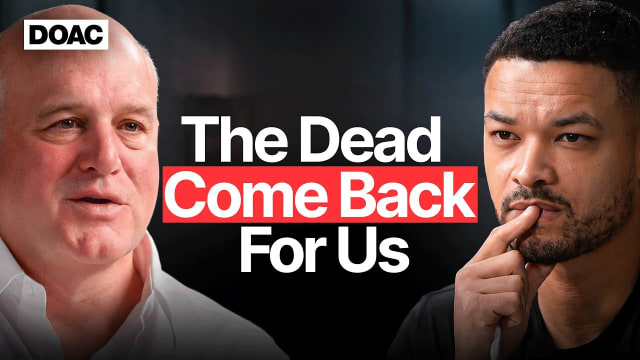
Dr Christopher Kerr has spent almost 30 years caring for people in their final days, and his research has focused on a question medicine has historically overlooked: what do people actually experience as they approach death? In a short conversation with The Diary of a CEO, he described a finding that cuts against most of what we assume about the end of life. Nearly 90 percent of the dying patients in his work report intense dreams or visions, and those experiences do not look like confusion. They feel real, and the people having them tend to describe them as comforting rather than frightening. Kerr also argues that the fear surrounding death is built largely on a vacuum of information, and that the myths filling that vacuum, especially about pain and regret, are mostly wrong.
The clip opens with the figure that anchors his work. The published description puts it at 88 percent of patients dreaming of loved ones who have already died; in the conversation itself, Kerr says "nearly 90% of people start to have very intense dreams or visions as they get closer to death and it's unlike anything they've ever experienced." That detail matters for anyone who has sat at a bedside. These are not the drifting, half-coherent dreams we associate with fever or sedation.
Kerr's team also tested that difference directly. As he put it, "these events don't resemble delirium. When we ask them to scale it 0 to 10 on the degree of realism, it's always a 10. So it feels like this actually happened." A patient who rates an experience a 10 out of 10 for realism is describing something with the weight of an ordinary memory, not a hallucination they can dismiss. The clip cuts away before he details the content of those visions, but the realism rating is the piece of evidence that makes the claim hard to wave away.
"These events don't resemble delirium. When we ask them to scale it 0 to 10 on the degree of realism, it's always a 10. So it feels like this actually happened."
Kerr's diagnosis is blunt. "After doing this for 30 years, what I've come to understand is we've lost our way with dying. There's such a lack of information and that void is overwhelmingly felt with fear and mistruths compounded by the fact that doctors don't have these discussions." The problem he names is not only that people are frightened of death. It is that they are frightened without knowing what is typical, which leaves the imagination to fill the gap with the worst possibilities.
That is why the specifics he chooses to address are so pointed. Most of us carry a handful of stock assumptions about how a death will go, and two of them come up directly in the clip.
Kerr identifies pain as one of the "big myths," the belief that suffering is simply expected at the end. His answer is unambiguous: "It's less painful than people think." He puts the gap in strong terms, saying it is "by a mile" less painful than people assume. What he finds troubling is the silence around it. "It's damning how little conversations there are to address that issue," he said. When a fear goes unspoken, families carry it into the room without any evidence to test it against.
The second myth is regret. Kerr says he does not see patients dwelling on it: "First, I don't see people bringing up regret towards the end of their life." When the interviewer pressed whether they are thinking about what they regret, he answered without hesitation: "No. Yeah, hell no. No, it's gone."
His explanation is the most philosophically rich idea in the clip. "Death is this unbelievably truthful place. You're stripped to the bare bones of who you are. And if you think of the best version of yourself, it was never achieving something. It was being a son, it was being a brother, it was being a friend." The measure of a life, as the patients he has listened to seem to frame it, is relational rather than résumé-based. Titles and accomplishments fall away, and what remains is the quality of one's attachments.
"Death is this unbelievably truthful place. You're stripped to the bare bones of who you are."
Kerr brought six handwritten cards listing lessons he has taken from caring for the dying, and the host said the full list would come later in the conversation. The clip ends before those lessons are read out, so this article cannot report what they say. Anyone looking for that list will need the full episode.
The closing question asks Kerr whether, given everything he has witnessed, he thinks there is life after death. He answers, "This is probably the most remarkable thing of all, so I think" and the clip stops there. His reply is not in the material, so it would be wrong to guess at it. What the clip does establish is that he approaches the question from decades of bedside observation rather than from doctrine, and that he is candid about how much remains unknown.
This is a 90-second excerpt, so treat it as an introduction. The strongest threads to pull are the realism rating, the gap between the myths and what patients report, and the idea that a life is measured by relationships rather than achievement. The full conversation covers children's experience of dying, what matters most to people in their final days, and his work with grieving families, which the video description says spans 750 families. If you are facing the loss of someone close, the most useful takeaway may be the simplest one Kerr offers: many of the fears we bring to death are inherited from silence, and speaking openly with a doctor or hospice team can replace some of that guesswork with actual information.