BrightStar

すべてのEventsを見る

意識ある集いに出会う

events

Yoga
Meditation
Breathwork
Qigong
Tai Chi
Sacred Music
World Music
Medicine Music
Sound Healing
Ecstatic Dance
人気の目的地
BaliSedonaLos AngelesCosta RicaNew YorkSan FranciscoAustinMiamiJoshua TreeTulum
すべてのカテゴリを見るすべての目的地を見る

すべての機能を探索

イベントを成長させる強力なツール

プラットフォーム機能

スマートダイナミックプライシング
チケットカテゴリ
座席指定
カート放棄リカバリー
訪問者リカバリー
寄付とスライディングスケール
アフィリエイトシステム
チケットスキャナー
クーポンコード
カスタム質問
チケット共有
アップセルとアドオン
分析とレポート
メールシーケンス
ウェイトリスト / 通知 / リマインダー
人と場所
Artists & TeachersEvent OrganizersVenues & StudiosKnowledge BaseGlossaryInspiration
すべての機能を見る私たちについて
料金ブログ
Language
Saved events
すべてのイベントを見る

events

YogaMeditationBreathworkQigongTai ChiSacred MusicWorld MusicMedicine Music

人気の目的地

BaliSedonaLos AngelesCosta RicaNew YorkSan Francisco

人と場所

Artists & TeachersEvent OrganizersVenues & StudiosKnowledge BaseGlossaryInspiration

プラットフォーム機能

スマートダイナミックプライシングチケットカテゴリ座席指定カート放棄リカバリー訪問者リカバリー寄付とスライディングスケールアフィリエイトシステムチケットスキャナークーポンコードカスタム質問チケット共有アップセルとアドオン分析とレポートメールシーケンスウェイトリスト / 通知 / リマインダー
すべての機能を見る私たちについて
料金ブログ
ログイン探求者クリエイター
  • すべてのイベントを見る
  • 探求者向け
  • ヨガ
  • 瞑想
  • ブレスワーク
  • 気功
  • 太極拳
  • 聖なる音楽
  • ワールドミュージック
  • メディスンミュージック
  • サウンドヒーリング
  • エクスタティックダンス
  • リトリート
  • ワークショップ
  • すべてのカテゴリ →
  • Bali
  • Sedona
  • Los Angeles
  • Costa Rica
  • Tulum
  • Byron Bay
  • San Francisco
  • Austin
  • New York
  • San Diego
  • Denver
  • Seattle
  • Portland
  • Miami
  • すべての都市 →
  • Join the Movement
  • Why we list
  • Sell Globally
  • クリエイター向け
  • チーム向け
  • ライター向け
  • 講師向け
  • キルタンアーティスト向け
  • スタジオ向け
  • フェスティバル向け
  • リトリートセンター向け
  • 非営利団体向け
  • ブランドアンバサダー
  • 無料チケット販売
  • Elevate
  • Amplify
  • 50万人以上のバイヤーネットワーク
  • カート放棄リカバリー
  • スマートダイナミックプライシング
  • チケットカテゴリ
  • 定期イベント
  • 座席指定
  • アフィリエイトシステム
  • ウェイトリスト / 通知
  • チケットスキャナー
  • 埋め込みウィジェット
  • イベント配信
  • メッセージセンター
  • インテグレーション
  • レポート
  • すべての機能 →
  • 概要
  • エコシステム
  • ブログ
  • 用語集
  • インスピレーション
  • ヘルプセンター
  • お問い合わせ
  • APIドキュメント
  • ブランドアセット
  • 採用
  • プレス
  • 利用規約
  • プライバシーポリシー

イベント

  • すべてのイベントを見る
  • 探求者向け
  • ヨガ
  • 瞑想
  • ブレスワーク
  • 気功
  • 太極拳
  • 聖なる音楽
  • ワールドミュージック
  • メディスンミュージック
  • サウンドヒーリング
  • エクスタティックダンス
  • リトリート
  • ワークショップ
  • すべてのカテゴリ →

目的地

  • Bali
  • Sedona
  • Los Angeles
  • Costa Rica
  • Tulum
  • Byron Bay
  • San Francisco
  • Austin
  • New York
  • San Diego
  • Denver
  • Seattle
  • Portland
  • Miami
  • すべての都市 →

クリエイター向け

  • Join the Movement
  • Why we list
  • Sell Globally
  • クリエイター向け
  • チーム向け
  • ライター向け
  • 講師向け
  • キルタンアーティスト向け
  • スタジオ向け
  • フェスティバル向け
  • リトリートセンター向け
  • 非営利団体向け
  • ブランドアンバサダー
  • 無料チケット販売
  • Elevate
  • Amplify

機能

  • 50万人以上のバイヤーネットワーク
  • カート放棄リカバリー
  • スマートダイナミックプライシング
  • チケットカテゴリ
  • 定期イベント
  • 座席指定
  • アフィリエイトシステム
  • ウェイトリスト / 通知
  • チケットスキャナー
  • 埋め込みウィジェット
  • イベント配信
  • メッセージセンター
  • インテグレーション
  • レポート
  • すべての機能 →

会社

  • 概要
  • エコシステム
  • ブログ
  • 用語集
  • インスピレーション
  • ヘルプセンター
  • お問い合わせ
  • APIドキュメント
  • ブランドアセット
  • 採用
  • プレス
  • 利用規約
  • プライバシーポリシー
BrightStar
アプリを入手
App StoreからApp StoreGoogle Playで手に入れようGoogle Play
© 2026 BrightStar. 全著作権所有.
Inspiration

Tenemos Todo: A Kirtan on Wholeness and Spiritual Abundance

Paloma Devi
Paloma Devi
Jul 8, 2014
読了 約7分
視聴 · 5
読む · 9セクション

What is "Tenemos Todo" and Why Does It Matter?

"Tenemos Todo" (We Have Everything) is a devotional kirtan by Paloma Devi that explores the spiritual principle of inherent wholeness and abundance. Performed as a meditative chant, the piece teaches that the fulfillment sought externally already exists within the self. The kirtan uses repetition, call-and-response, and rhythmic invocation to anchor this teaching into direct experience rather than intellectual understanding alone. Recorded during a 2014 shoot in Tulum, Mexico, the song appears on Devi's album Let It Be So (Spirit Voyage Records) and exemplifies how Sanskrit and Spanish devotional traditions can merge to explore contemporary spiritual inquiry.

What Does the Title "Tenemos Todo" Mean?

The title translates from Spanish as "We Have Everything." This is not a metaphor about material abundance or wishful thinking. In devotional practice, "Tenemos Todo" points to a non-dual recognition: that the wholeness, peace, and fulfillment most spiritual seekers pursue externally—through practices, experiences, or acquisitions—already exists as the ground of being. The word "tenemos" (we have) is plural, inclusive; it addresses not just the individual singer but all beings. This reflects the kirtan tradition's democratic approach to spiritual realization: the recognition of wholeness is not reserved for the enlightened few but is the birthright of all consciousness.

What Is the Role of Kirtan in Spiritual Practice?

Kirtan is a Sanskrit term for devotional chanting, typically performed in a call-and-response format. Unlike meditation done in silence, kirtan uses the voice, rhythm, and repetition to invoke shifts in consciousness. The practice operates on several levels simultaneously:

  • Vibrational: The repetition of sacred syllables and affirmations creates a resonance within the nervous system that can quiet mental chatter and activate parasympathetic rest.
  • Emotional: Singing together, whether alone or in group, opens the heart and accesses felt states that pure intellectual understanding cannot reach.
  • Linguistic: The mantra or affirmation becomes internalized through repetition, reshaping habitual thought patterns. If you sing "we have everything" enough times, the mind begins to reorganize around that principle.
  • Communal: Even when practiced individually, kirtan carries the energy of lineage and collective consciousness, reminding the practitioner they are not isolated in their spiritual inquiry.

In "Tenemos Todo," Paloma Devi uses the kirtan form to move the listener from intellectual assent to embodied knowing. The teaching—that we already possess wholeness—is not delivered as a sermon but as an invocation. The listener/singer participates in the realization rather than merely receiving information about it.

How Do Spanish and Sanskrit Traditions Merge in This Piece?

The use of Spanish alongside Sanskrit reflects a growing reality in contemporary devotional music: spiritual traditions are not geographically or linguistically bound. Paloma Devi, based in Spain, brings a European sensibility and language to practices rooted in Hinduism and yoga philosophy. By singing "Tenemos Todo" rather than a Sanskrit equivalent like "Purna" or "Atman," she makes the teaching accessible to Spanish-speaking practitioners while maintaining the energetic integrity of kirtan practice.

This linguistic choice is not mere translation; it is localization. When a spiritual teaching is sung in one's native tongue, the barrier between the concept and the felt sense dissolves more readily. The words penetrate at a deeper level because they do not require the mind to decode an unfamiliar language first. The listener can focus entirely on the meaning and the vibrational quality of the chant.

What Spiritual Principle Underlies the Message "We Have Everything"?

The statement "we have everything" rests on the Advaita Vedanta principle of non-duality—the recognition that separation is illusory. In this framework, what we seek outside ourselves (peace, love, wholeness, security) is actually our own essential nature. The seeking itself is the obstacle. We have "everything" not because we accumulate or achieve, but because we remove the mental veils that obscure our already-whole nature.

This is radical for the conditioned mind. Most spiritual practice begins with a sense of lack: "I am not whole; I must practice to become whole." But non-dual teaching inverts this: "You are already whole; practice to see it." The shift from "becoming" to "seeing" is the shift from effort to grace. Kirtan like "Tenemos Todo" works to accelerate this recognition by bypassing the reasoning mind and speaking directly to the heart's knowing.

Why Is the Visual Production Important to the Spiritual Message?

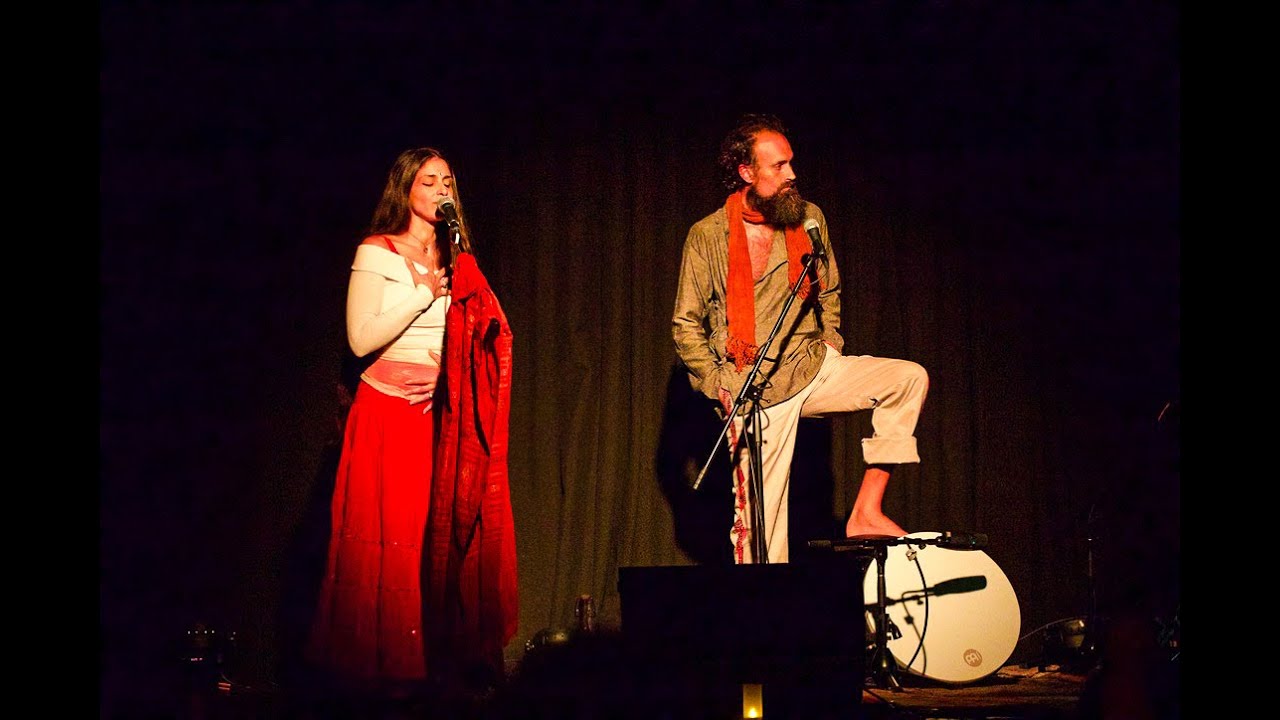
The video was filmed in Tulum, Mexico, at sacred locations including Retiro Maya, Zamas Beach, and Cenote Azul. The choice of landscape is intentional. Water—particularly cenotes and ocean bays—symbolizes flow, receptivity, and the dissolution of boundaries. By situating the kirtan in these natural settings, director Lucas Sileoni and the creative team root the spiritual message in the body of the earth itself. The video is not simply a performance recording; it is an invocation of place as a spiritual participant.

The presence of two figures (Paloma Devi and Alberto Amador) singing together also embodies the principle of "tenemos todo"—not "I have everything" in solitary realization, but "we have everything" as a shared recognition. This subtle visual teaching reinforces the non-dual principle: separation is the illusion; unity and wholeness are what we discover when we sing together.

How Does Repetition Function as a Teaching Tool?

The kirtan form relies heavily on repetition. Phrases return again and again, creating a hypnotic state. This is not aesthetic repetition for its own sake; it serves a clear function. Each repetition is an opportunity for the conscious mind to relax its grip and for deeper layers of being to surface. On the first hearing, the listener may engage intellectually: "Yes, I understand that we have everything." On the fifth or tenth repetition, the mind exhausts its analytical function and opens into a more direct knowing. The chant becomes less about meaning and more about presence.

Repetition also mirrors the cyclical nature of spiritual practice itself. One does not "complete" non-dual realization in a single sitting. Rather, the recognition deepens and clarifies with each encounter, each meditation, each performance. "Tenemos Todo" performed once is a song; performed consistently, it becomes a practice—a gradual reorganization of consciousness around the truth of wholeness.

What Makes This Piece Part of a Broader Spiritual Conversation?

Released in 2014 on the album Let It Be So through Spirit Voyage Records, "Tenemos Todo" is part of a growing movement of contemporary kirtan artists working to bridge East and West, traditional and modern. The title of the album itself—Let It Be So—echoes the principle of surrender and acceptance. Together, these songs form a collection exploring how to live from a place of trust in one's own completeness, rather than from a place of grasping or lack.

This is particularly relevant in the contemporary spiritual marketplace, which often sells the idea that you need more practices, more experiences, more teacher-lineages to become enlightened. Paloma Devi's work, and specifically "Tenemos Todo," quietly subverts this: the real teaching is that you already have what you seek. The practice is not to become something other than what you are, but to recognize what you already are.

Where to Go From Here

If "Tenemos Todo" resonates with you, consider working with it as a daily practice. Sing it for five minutes each morning, or whenever you feel the familiar pull of seeking, striving, or lack. Notice how the simple affirmation "we have everything" begins to shift your perception over time. You might also explore other work by Paloma Devi, particularly the full album Let It Be So, to deepen your engagement with these themes. For a deeper theoretical understanding of the non-dual principle underlying the kirtan, investigate Advaita Vedanta teachers such as Ramakrishna Paramahamsa or contemporary teachers like Rupert Spira. Finally, if you have access to a kirtan circle or community, attend a session in person. The collective energy of group chanting amplifies the transmission far beyond what an individual practice can achieve.

Comments

Loading the conversation…

Transcript

[0:01] [Music]

[0:16] thee

[0:18] [Music]

[0:20] spee

[0:24] [Music]

[0:29] for

[0:31] [Music]

[0:37] [Music]

[0:48] uned

[0:50] [Music]

[0:55] the that to

[0:59] you

[1:01] [Music]

[1:05] I want I st I want

[1:22] I

[1:26] I not I

[1:29] have

[1:34] [Music]

[1:55] I'm

[1:57] more

[1:59] is d for the

[2:01] [Music]

[2:06] [Music]

[2:29] most

[2:30] [Music]

[2:48] [Music]

[2:53] IE sing

[2:58] more I want

[3:01] [Music]

[3:12] [Music]

[3:14] [Applause]

[3:16] [Music]

[3:29] I'm

[3:35] [Music]

[3:48] [Music]

[3:59] for

[4:01] [Music]

[4:06] oh

[4:08] [Music]

[4:20] [Music]

[4:28] oh oh

[4:31] [Music]

[4:36] the was

[4:42] the

[4:54] [Music]

[4:59] I'm

Paloma Devi
ArtistPaloma Devi

Kirtan artist dedicated to sharing the transformative power of devotional chanting through performances and teachings rooted in the Bhakti lineage.

プロフィールを見るウェブサイト
トピックを見る
KirtanDevotional-chantSpiritual-abundanceNon-dualityWholeness

ご質問はありますか?

よくある質問

Tenemos todo' means 'we have everything' in Spanish. Spiritually, it expresses the non-dual principle that wholeness and fulfillment already exist within us—we don't need to acquire or become something other than what we are. This teaching inverts the typical spiritual seeker's narrative from 'I must become whole' to 'I am already whole; I need only see it.'
Kirtan uses repetitive chanting, call-and-response, and rhythm to shift consciousness beyond the rational mind. The vibrational quality of the mantra, combined with repetition, quiets mental noise and opens the heart to direct experience. Unlike intellectual understanding, kirtan anchors spiritual truth into the nervous system and emotional body.
Using Spanish makes the teaching accessible to native Spanish speakers and allows the spiritual principle to penetrate more directly without the mind having to decode an unfamiliar language. It also reflects how contemporary spiritual practice localizes ancient traditions—bringing non-dual teachings into the modern lived context of diverse practitioners.
Singing 'we have everything' instead of 'I have everything' embodies non-duality—the recognition that separation is illusory. It shifts the focus from individual attainment to universal wholeness. This also explains why kirtan is often done in groups: the collective singing reinforces that spiritual realization is not isolated but shared among all consciousness.
Repetition exhausts the analytical mind's need to understand, allowing deeper layers of being to surface. Each iteration of the chant is an opportunity for consciousness to relax its grasping and open to direct knowing. Over time, the affirmation rewires habitual thought patterns and reorganizes one's experience around the principle being invoked.
The song draws from Advaita Vedanta non-duality, which teaches that what we seek externally (peace, love, wholeness) is our own essential nature. Spiritual practice, then, is not about becoming something new but recognizing what already is. The teaching subverts the common marketplace idea that you need endless practices to become enlightened.

読みつづける

More from Paloma

すべて表示
Dance of Transformation: Om Namah Shivaya Through Movement
Inspire

Dance of Transformation: Om Namah Shivaya Through Movement

A meditative kirtan and movement experience exploring the sacred mantra Om Namah Shivaya through devotional chanting and embodied practice w…

1 min read
I Am Infinite Love: Kirtan and Handpan Music for Awakening
Inspire

I Am Infinite Love: Kirtan and Handpan Music for Awakening

Paloma Devi and Joel Karabo Elliott perform "I Am Infinite Love," a kirtan-style meditation blending handpan and devotional song to invoke a…

1 min read
Does Suffering Mean Spiritual Seeking Hasn't Ended?
Inspire

Does Suffering Mean Spiritual Seeking Hasn't Ended?

Rupert Spira argues that suffering is itself a form of seeking, and that the honest response is to ask where to look. His answer is to inves…

1 min read
Why Emotional Suffering Means You Are Still Seeking
Inspire

Why Emotional Suffering Means You Are Still Seeking

Rupert Spira separates physical pain from emotional suffering, arguing suffering is itself seeking. Here is how investigating the self behin…

1 min read

探索を続ける

旅をつづける

BrightStarのディレクトリから、さらなる智慧と集いを。

もっと記事を読む

教え、インタビュー、ガイドのライブラリ全体をご覧ください。

すべての記事に戻る →

講師とアーティスト

コンシャスな世界の系譜、音楽家、導き手を探しましょう。

アーティストを探す →

イベントを見つける

キルタン、リトリート、サウンドバス、ブレスワーク、フェスティバル — まもなく開かれます。

イベントを見る →