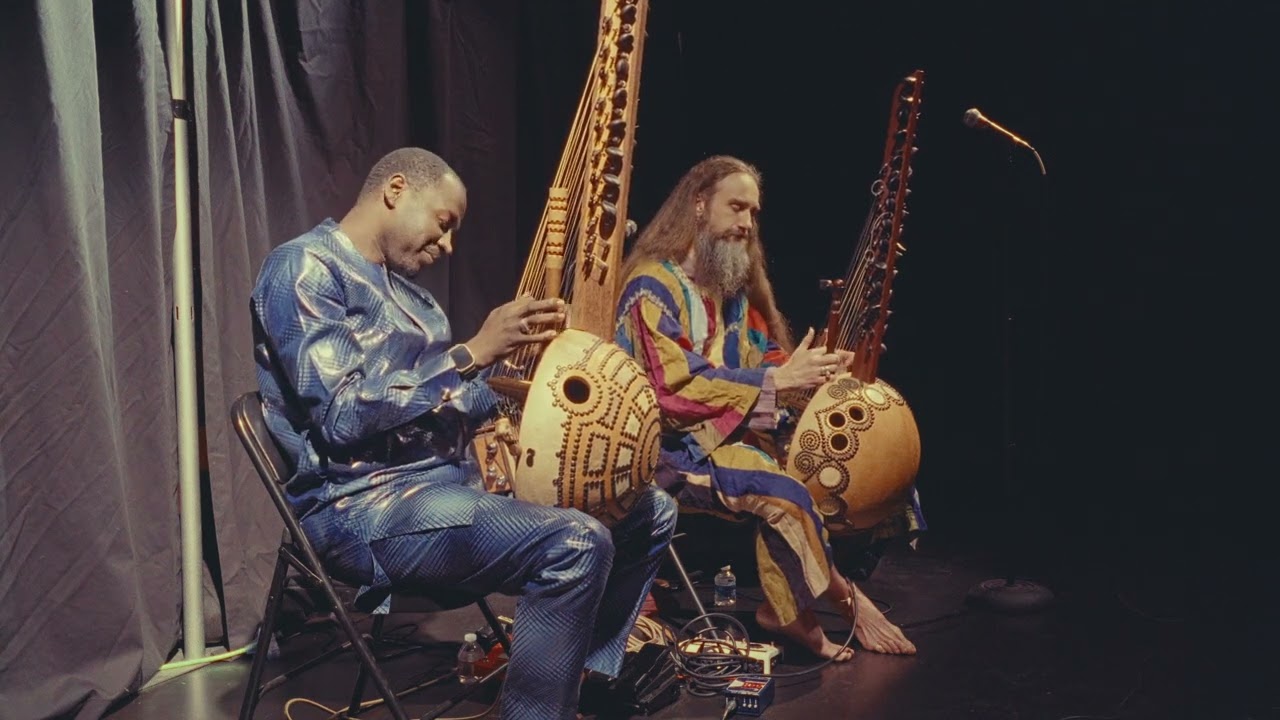

Salif Bamakora's story begins in Mali, a nation whose musical traditions have shaped West African culture for centuries. Born into a family embedded in the Manding people's ancient customs, Bamakora grew up surrounded by the distinctive sound of the kora—the twenty-one-stringed bridge harp that has carried stories, histories, and prayers across generations. His father, himself a respected musician, recognized early the spark in his son and became his first teacher, introducing him not merely to technique but to the deeper philosophy underlying Malian musical practice.
This wasn't simply childhood exposure to an instrument. It was an initiation into a worldview where music serves as spiritual conduit, community binding force, and historical archive all at once. The rhythms and melodies that filled Bamakora's formative years would become the foundation of everything that followed—a sonic vocabulary he would spend his life expanding, preserving, and sharing.
Bamakora's work is inseparable from the griot tradition, the West African practice of oral history and storytelling maintained by specific family lineages across generations. This isn't background context; it's the essential framework through which his entire musical identity takes shape. The griots have long been more than entertainers—they are historians, diplomats, genealogists, and spiritual guides, their music a technology for preserving collective memory in societies where the written word came late or not at all.
Drawing inspiration from legendary kora masters like Toumani Diabaté and Ballaké Sissoko, Bamakora positions himself within this continuum while carving out his own voice. His connection to his ancestors isn't nostalgic; it's active and living, informing every note he plays and every student he teaches. This lineage consciousness gives his work a gravitas that purely technical virtuosity could never achieve.
As a kora player, Bamakora has built a reputation for exceptional technique married to deep cultural knowledge. His playing is characterized by intricate melodic lines and rhythmic complexity that reveal the kora's full expressive range—from meditative, gossamer-like passages to driving, percussive attacks. Yet technical excellence is never the endpoint for Bamakora; it's the means through which he accesses and transmits something larger.
His recordings showcase a musician comfortable navigating between the traditional and the contemporary. Rather than treating these as opposing poles, Bamakora understands them as a continuum, exploring how ancient Malian musical forms can speak to modern ears without dilution or compromise. This contemporary-traditional fusion doesn't chase Western audiences through superficial "world music" aesthetics; instead, it deepens the tradition by demonstrating its continued vitality and relevance.
Perhaps equally significant as his performing career is Bamakora's work as an educator. He has conducted workshops and masterclasses internationally, bringing the kora and its cultural context to students far beyond Mali's borders. His pedagogical approach reflects his broader artistic philosophy: music as spiritual expression, as heritage preservation, as community creation.
In these educational settings, Bamakora emphasizes connection—to cultural roots, to ancestral knowledge, to the spiritual dimensions of musical practice. He encourages students not simply to master technique but to understand the kora's role within its original cultural matrix. At the same time, he invites creative exploration, recognizing that living traditions must breathe and evolve. This balance between preservation and innovation, between respect for lineage and encouragement of individual voice, defines his teaching method.
What distinguishes Bamakora's approach is his insistence on music's spiritual dimension. In his understanding, the kora is not merely an instrument but a vehicle for devotion, meditation, and transcendence. This perspective aligns with traditional Malian beliefs about music's power to heal, to connect the visible and invisible worlds, to facilitate communion with ancestors and the divine.
This spiritual orientation infuses both his performances and his teaching. Music becomes a form of satsang—a gathering in truth—where performer and listener, teacher and student, enter into shared sacred space. The emphasis shifts from entertainment or even art-making in the Western sense toward something more akin to ceremony or contemplative practice.
In an era when globalization threatens to homogenize cultural expression, musicians like Bamakora play a crucial role. He serves as both guardian and ambassador, maintaining the integrity of Malian musical traditions while making them accessible to global audiences. For diaspora communities, his work offers connection to heritage; for students of diverse backgrounds, it provides entry into one of Africa's richest musical traditions.
Bamakora matters because he embodies a rare combination: deep rootedness in tradition coupled with openness to dialogue and exchange. He demonstrates that cultural preservation needn't mean museum-like stasis, that honoring ancestors and embracing contemporary expression can coexist. In his hands, the kora remains what it has always been—a voice for stories that must not be forgotten, for spiritual truths that transcend language, for the continuing vitality of West African musical genius.
His legacy is still being written, measured not in commercial metrics but in students taught, traditions transmitted, and audiences moved by the ancient, ever-new voice of the kora.