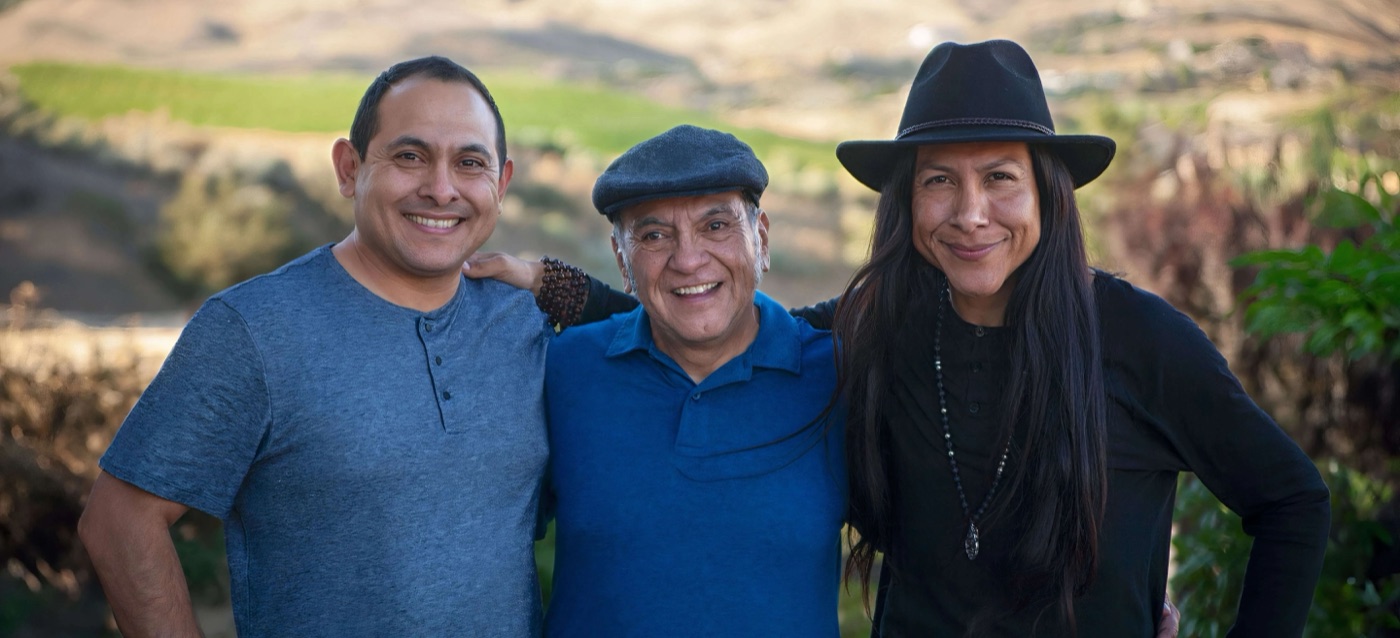

don Miguel Ruiz teaches from two places at once: a family inheritance of Toltec practice and the habits of a trained neurosurgeon. The bio says he was born from a lineage of shamans, that his mother, Sarita Vasquez, tutored him in the Toltec tradition, and that he left medicine in 1986 partly because, as a scientist, he wanted answers to his own questions about the human mind. Those two sources explain most of what is distinctive about how he teaches.
The public record describes his teaching as grounded in place and sustained practice more than in stage performance. He has led spiritual journeys to the pyramids of Teotihuacan and to sacred sites around the world, and his current calendar is anchored there: events on October 22 and December 28, 2026, at venues including The Dreaming House and the Teotihuacan Archaeological Site. Later listings include Whispering Hills in Boone, USA, on November 13, 2026, and the Paradise Island Ashram in Nassau, Bahamas, on February 21, 2027. The range suggests a format that moves between an ancient site and more intimate settings.
Someone expecting a conventional lecture may be surprised. The emphasis falls on experiential work at sacred places and on testing ideas in daily life. Session length and pricing are not in the profile data, so anyone considering attendance should check the event listings.
The deeper structure is repetition over time. His Toltec Dreaming course, begun in 2000 for select apprentices, ran monthly workshops for over a decade and still informs his lectures, online classes, and writing. The method favors returning to the same ideas until they change habits, not collecting a single transformative weekend.
The most persistent theme is quieting the mind. In his early years of teaching he created tools to help students do this, and that work became The Four Agreements, published in 1997. Closely tied to it is freedom from inherited belief, which runs through the Toltec Wisdom Series. Love is central to The Mastery of Love and returns in the relational questions of The Fifth Agreement, which he wrote with his son, don Jose Ruiz. Dreaming, both as the name of his course and as a frame for perception, connects to the idea that the mind builds the reality it experiences.
He also treats change as slow. The bio describes the Four Agreements as steps toward long-term personal transformation, and that framing is deliberate: no instant awakening is promised.
The biographical material does not record specific exercises or prompts, so what follows is inferred from his themes and the shape of his books. The questions appear to be diagnostic ones. Which beliefs did I inherit without choosing them? What is my mind doing when it is not quiet? How much of what I experience is perception I have constructed? Where do my relationships run on agreements I never examined? The approach is that of someone who frames problems about the mind as things to observe and test, which fits his stated wish as a scientist for answers.
The style is restrained. He explains the agreements in plain language and asks students to try them. The books are compact and built around named principles rather than extended doctrine, and listeners should expect a direct speaking style, not an academic one. The profile data does not document humor, silence, story, or scripture in his sessions, and those should not be assumed. What can be said is that the register is practical and analytic, with less emotional intensity than many in the field, and that authority comes from lineage and decades of workshops rather than from citation or ritual display.
It suits readers who want practical principles for changing habits of mind and who are comfortable with a teacher whose authority rests on family lineage. Readers from scientific backgrounds may find the plain, structured language congenial. No formal background is needed for the books or public talks, though later titles assume familiarity with the agreements.
Several kinds of reader will be disappointed. Those wanting a rigorous history of the Toltec civilization will not find it; the teaching is a living lineage practice, not an archaeological account. Those seeking detailed meditation technique, ritual instruction, or chant-based devotion will likely find the books lighter than expected. Readers drawn to satsang in the Hindu sense should know the Toltec framework is a different tradition, even though his catalog carries that tag. Skeptics of any teacher's authority may struggle to evaluate the agreements without committing to practice over time, and readers wanting footnoted scholarship will be frustrated by books written for general audiences.
His work belongs to the Toltec tradition, which he received from his mother. Here Toltec refers to a spiritual lineage with shamanic roots, not a strict historical account of one ancient civilization. The bio names no other teacher or lineage, and none should be supplied. The tradition continues within his family: he teaches alongside family Toltec teachers, including his son don Jose Ruiz, and his eldest son, don Miguel Ruiz Jr., is listed as an author and Toltec master. Janet Mills, founder of Amber-Allen Publishing, is a longtime co-author, and Barbara Emrys is a longtime apprentice and co-author.
Taken together, the picture is of a teacher whose appeal is method more than mysticism: short principles, repeated practice, and a scientist's interest in how attention shapes experience. The limits are real. The teaching asks for sustained commitment, and it offers little to those who want technique, scholarship, or spectacle.