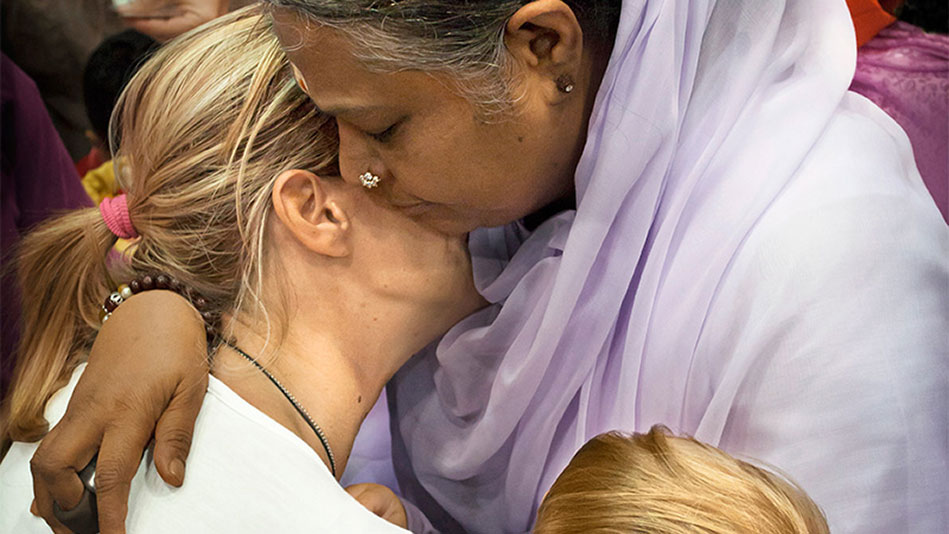
The Essence of Unconditional Love
Amma's profound assertion that "pure love is unconditional. It is given without expectation" invites us to explore the depths of love that transcends transactional relationships. This concept challenges the often conditional nature of human affection, urging us to cultivate a love that is freely offered, without the strings of expectation. In a world where relationships frequently hinge on reciprocity, Amma's words remind us of a higher calling—to love simply for the sake of love itself.
Delving deeper, we recognize that unconditional love is not merely an ideal but a transformative practice that can reshape our interactions and inner lives. It asks us to confront our own needs for validation and recognition, pushing us toward a more expansive understanding of connection. This love, as Amma suggests, is a gift that flows from the heart, unencumbered by the desire for return, and it invites us to engage with others in a way that honors their inherent worth.
The image / the metaphor
The imagery in Amma's quote evokes a sense of purity and clarity, suggesting that true love is akin to a clear stream, flowing freely and without obstruction. The verbs "is given" and "without expectation" emphasize the active nature of love as a gift, highlighting the selfless act of offering oneself to another. This portrayal of love as an unadulterated force invites us to envision a state of being where our affections are not tainted by ulterior motives or desires for reciprocation.
In the speaker's tradition
Amma's teachings are deeply rooted in the bhakti tradition, which emphasizes devotion and love for the divine as the highest expression of spirituality. In this context, the concept of unconditional love aligns closely with the idea of *bhakti*, where the devotee surrenders their ego and desires to experience a profound connection with the divine. This surrender, or *kenosis*, allows for a love that is not only selfless but also transformative, leading to a deeper understanding of one's own nature and the nature of existence.
In the *Bhagavad Gita*, a foundational text in the bhakti tradition, Lord Krishna speaks of selfless action and devotion, urging Arjuna to act without attachment to the fruits of his labor. This echoes Amma's sentiment, as both teachings advocate for a love and service that is free from expectation. The essence of such love is captured in the concept of *sunyata*, or emptiness, where one finds liberation in the act of giving without the burden of desire or expectation.
Living the teaching
Consider a modern scenario where unconditional love can manifest: a parent caring for a child. In this relationship, the parent often provides support, guidance, and affection without expecting anything in return. This dynamic exemplifies the essence of Amma's teaching, as the parent’s love is given freely, nurturing the child's growth and well-being. Such an example illustrates how pure love can create a safe space for another to flourish, reinforcing the idea that love is most powerful when it is offered without conditions.
Another application of this teaching can be found in friendships, particularly during difficult moments. Imagine a friend going through a challenging time, where your presence and support are needed. By offering your love and understanding without the expectation of reciprocation, you embody the spirit of unconditional love. This practice not only strengthens the bond between you but also fosters a sense of community and connection that transcends individual struggles, reminding us that love is a powerful force for healing and transformation.
A reflection
As we contemplate Amma's profound words, we are invited to reflect on our own capacity for unconditional love. How often do we find ourselves holding back our affections, waiting for validation or reciprocation? In what ways can we practice giving love freely, without the constraints of expectation? This contemplation can serve as a guiding question, encouraging us to explore the depths of our hearts and the ways we can embody pure love in our daily lives.