




What is Somatic Yoga?
Somatic yoga is an umbrella term for yoga practice that treats the body as it is experienced from the inside (the soma) rather than as an object to be shaped into poses. Its movements are slow and exploratory, and attention stays on sensation, effort, and the quality of movement. The aim is to change habitual patterns of muscular holding and to refine internal body awareness. Achieving a particular posture is not the aim. People asking “what is somatic yoga” or about the somatic yoga meaning will find two overlapping uses of the phrase. The narrower use refers to yoga informed by Thomas Hanna’s somatic education, which uses slow, repeated contraction and release to reduce chronic muscle tension. The broader use refers to any yoga class that borrows from somatic disciplines such as the Feldenkrais Method, body-scan practice, or trauma-informed movement. There is no single governing body, curriculum, or canonical text.
Origins & lineage
The word “somatics” was introduced in its current sense by the American philosopher and movement educator Thomas Hanna (1928–1990). It appears in his book Bodies in Revolt (1970), and he developed it through the 1970s. Hanna trained in the Feldenkrais Method, created by the Israeli engineer and judoka Moshe Feldenkrais (1904–1984). In 1976 Hanna founded the journal Somatics and later directed the Novato Institute for Somatic Research and Training in California. He defined somatics as the study of the body as perceived from within by first-person perception.
Hanna’s later method, Hanna Somatic Education, is built on “pandiculation,” a voluntary version of the stretch-and-yawn reflex. His student and later wife, Eleanor Criswell Hanna, a psychologist, wrote How Yoga Works (1987), which presents yoga as an approach to somatic education. Their framing links the postures of hatha yoga to ideas about the nervous system and learned muscular habits.
The yoga side of the lineage is older and separate. Modern postural yoga took its current shape in the early twentieth century, notably through Tirumalai Krishnamacharya (1888–1989) and his students. Patanjali’s Yoga Sutras are often cited as a precedent for inward attention. Scholars disagree about whether they describe anything like somatic practice, since the text says little about postures beyond the instruction that asana be “steady and comfortable” (sthira-sukham asanam, 2.46). Somatic yoga is therefore best seen as a late twentieth-century convergence of Western somatics and postural yoga, not as an ancient tradition.
How it’s practiced
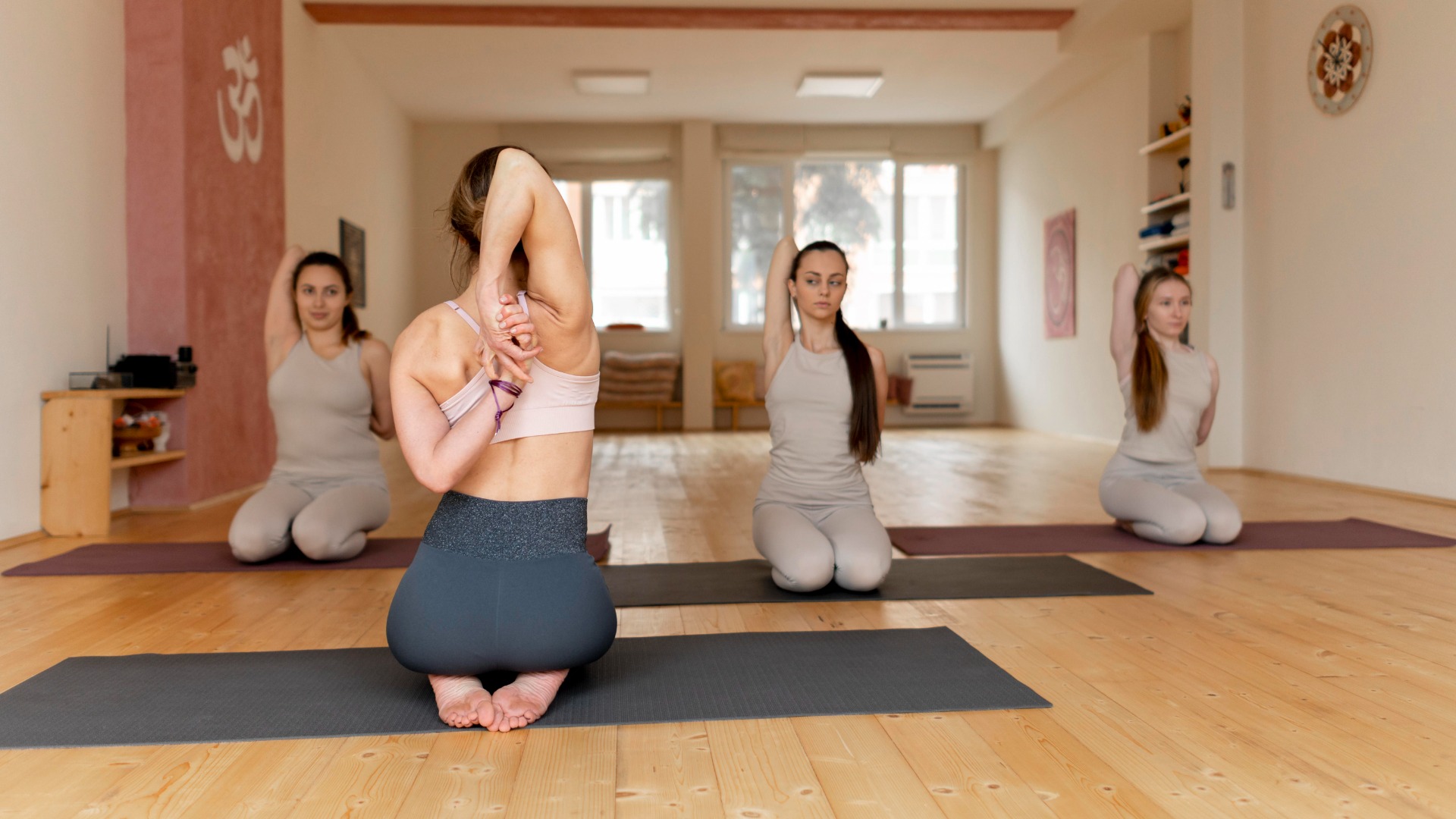
A typical session moves slowly, often on the floor. A teacher may ask students to make a small movement, such as lifting a shoulder or rolling a pelvis, and to notice where effort begins and where it spreads. Movements are repeated at low intensity with pauses, so the nervous system can register the difference between holding and release. Verbal cues emphasize noticing (“what do you feel in the ribs?”) over correcting. Breath is observed more than controlled. Many classes end with rest and a short body scan. Poses from hatha yoga such as cat-cow, bridge, or child’s pose may appear, but they are treated as environments for exploring sensation. A visible, finished shape is not the goal.
Somatic Yoga today
Somatic yoga is now widely taught in studios, in online video libraries, and in teacher-training programs. Some programs have an explicit Hanna Somatic Education connection, and others use the label loosely. Some retreats pair it with trauma-informed practice, and some physical therapists and bodyworkers use similar methods with clients who have chronic pain. Its growth has coincided with wider public interest in the nervous system, interoception, and trauma-sensitive movement. Research on somatic yoga as a distinct method is limited. Studies of related practices, such as mindful movement and yoga for back pain, exist, but they should not be read as proof of claims specific to somatic yoga.
Common misconceptions
- It is not a single standardized style. Unlike Iyengar or Ashtanga yoga, it has no fixed sequence or certifying authority. Quality and content vary by teacher.
- It is not the same as Somatic Experiencing. That is a trauma-therapy model developed by Peter Levine. Some teachers draw on it, but it is a separate discipline.
- It is not therapy. A yoga class is not psychotherapy or medical treatment, and claims of curing pain or trauma should be treated cautiously.
- It is not necessarily easy. The movements are gentle, but sustained attention to sensation can be demanding, and some people with trauma histories find interoceptive focus unsettling.
- It is not ancient. The term and method date to the twentieth century, even where teachers cite classical yoga.
How to begin
Those new to the practice can start with a beginner-level somatic yoga class, which may be advertised as “somatic movement,” “gentle floor yoga,” or “Hanna Somatics.” Eleanor Criswell Hanna’s How Yoga Works and Thomas Hanna’s Somatics (1988) give the conceptual background. Look for teachers who describe their training and who offer options and rest instead of pushing intensity. Anyone with injuries, chronic pain, or a trauma history should consult a health professional and tell the teacher beforehand. Two or three short sessions a week, done with attention to sensation, are enough to learn whether the approach suits you.