BrightStar

Sfoglia tutti i Events

Scopri incontri consapevoli

events

Yoga
Meditation
Breathwork
Qigong
Tai Chi
Sacred Music
World Music
Medicine Music
Sound Healing
Ecstatic Dance
Destinazioni popolari
BaliSedonaLos AngelesCosta RicaNew YorkSan FranciscoAustinMiamiJoshua TreeTulum
Vedi tutte le categorieVedi tutte le destinazioni

Esplora tutte le funzionalità

Strumenti potenti per far crescere i tuoi eventi

Funzionalità della piattaforma

Prezzi dinamici intelligenti
Categorie di biglietti
Posti assegnati
Recupero carrelli abbandonati
Recupero visitatori
Donazioni e prezzi variabili
Sistema affiliati
Scanner biglietti
Codici sconto
Domande personalizzate
Condivisione biglietti
Upsell e componenti aggiuntivi
Analisi e report
Sequenze email
Lista d'attesa / Notifica / Promemoria
Persone e Luoghi
Artists & TeachersEvent OrganizersVenues & StudiosKnowledge BaseGlossaryInspiration
Vedi tutte le funzionalitàChi siamo
PrezziBlog
Language
Saved events
Sfoglia tutti gli eventi

events

YogaMeditationBreathworkQigongTai ChiSacred MusicWorld MusicMedicine Music

Destinazioni popolari

BaliSedonaLos AngelesCosta RicaNew YorkSan Francisco

Persone e Luoghi

Artists & TeachersEvent OrganizersVenues & StudiosKnowledge BaseGlossaryInspiration

Funzionalità della piattaforma

Prezzi dinamici intelligentiCategorie di bigliettiPosti assegnatiRecupero carrelli abbandonatiRecupero visitatoriDonazioni e prezzi variabiliSistema affiliatiScanner bigliettiCodici scontoDomande personalizzateCondivisione bigliettiUpsell e componenti aggiuntiviAnalisi e reportSequenze emailLista d'attesa / Notifica / Promemoria
Vedi tutte le funzionalitàChi siamo
PrezziBlog
AccediRicercatoriCreatori
  • Sfoglia tutti i Eventi
  • Per i ricercatori
  • Yoga
  • Meditazione
  • Breathwork
  • Qigong
  • Tai chi
  • Musica sacra
  • World music
  • Musica medicina
  • Sound healing
  • Danza estatica
  • Ritiri
  • Workshop
  • Tutte le categorie →
  • Bali
  • Sedona
  • Los Angeles
  • Costa Rica
  • Tulum
  • Byron Bay
  • San Francisco
  • Austin
  • New York
  • San Diego
  • Denver
  • Seattle
  • Portland
  • Miami
  • Tutte le città →
  • Join the Movement
  • Why we list
  • Sell Globally
  • Per i creatori
  • Per team
  • Per gli scrittori
  • Per gli insegnanti
  • Per gli artisti kirtan
  • Per gli studi
  • Per i festival
  • Per i centri ritiro
  • Per le no-profit
  • Ambasciatore del brand
  • Biglietteria gratuita
  • Elevate
  • Amplify
  • Rete di 500K+ acquirenti
  • Recupero carrelli abbandonati
  • Prezzi dinamici intelligenti
  • Categorie di biglietti
  • Eventi ricorrenti
  • Posti assegnati
  • Sistema affiliati
  • Lista d'attesa / Notifica
  • Scanner biglietti
  • Widget incorporabile
  • Distribuzione eventi
  • Centro messaggi
  • Integrazioni
  • Report
  • Tutte le funzionalità →
  • Chi siamo
  • L’ecosistema
  • Blog
  • Glossario
  • Ispirazione
  • Centro assistenza
  • Contatti
  • Documentazione API
  • Risorse del brand
  • Carriere
  • Stampa
  • Termini di servizio
  • Informativa sulla privacy

Eventi

  • Sfoglia tutti i Eventi
  • Per i ricercatori
  • Yoga
  • Meditazione
  • Breathwork
  • Qigong
  • Tai chi
  • Musica sacra
  • World music
  • Musica medicina
  • Sound healing
  • Danza estatica
  • Ritiri
  • Workshop
  • Tutte le categorie →

Destinazioni

  • Bali
  • Sedona
  • Los Angeles
  • Costa Rica
  • Tulum
  • Byron Bay
  • San Francisco
  • Austin
  • New York
  • San Diego
  • Denver
  • Seattle
  • Portland
  • Miami
  • Tutte le città →

Per i creatori

  • Join the Movement
  • Why we list
  • Sell Globally
  • Per i creatori
  • Per team
  • Per gli scrittori
  • Per gli insegnanti
  • Per gli artisti kirtan
  • Per gli studi
  • Per i festival
  • Per i centri ritiro
  • Per le no-profit
  • Ambasciatore del brand
  • Biglietteria gratuita
  • Elevate
  • Amplify

Funzionalità

  • Rete di 500K+ acquirenti
  • Recupero carrelli abbandonati
  • Prezzi dinamici intelligenti
  • Categorie di biglietti
  • Eventi ricorrenti
  • Posti assegnati
  • Sistema affiliati
  • Lista d'attesa / Notifica
  • Scanner biglietti
  • Widget incorporabile
  • Distribuzione eventi
  • Centro messaggi
  • Integrazioni
  • Report
  • Tutte le funzionalità →

Azienda

  • Chi siamo
  • L’ecosistema
  • Blog
  • Glossario
  • Ispirazione
  • Centro assistenza
  • Contatti
  • Documentazione API
  • Risorse del brand
  • Carriere
  • Stampa
  • Termini di servizio
  • Informativa sulla privacy
BrightStar
Scarica l'app
Scarica suApp StoreDisponibile suGoogle Play
© 2026 BrightStar. Tutti i diritti riservati.
Inspire

Shivoham Live in Germany: A Chant Built on Repetition

Manish Vyas
Manish Vyas
May 21, 2026
7 min di lettura
Guarda · 6

In a clip of just under five minutes recorded at the Yoga Vidya Music Festival in Horn Bad Meinberg, Germany, on 16 May 2026, Manish Vyas sings "Shivoham," a track from his album Sattva, with a three-person band behind him. The performance is built on a small vocabulary of sacred words, mostly the name Shiva, the word ananda (bliss), and a longer phrase that the captions render as "nijananda svarupa," stated, returned to, and turned over until the repetition itself becomes the subject. There is no spoken teaching in the clip and no direct address to the audience, so everything here comes from listening closely to the music and to the way the captions mark it. What follows is an attempt to explain what is happening in that music, and why a chant this simple can hold a listener for the length of a whole song.

Lettura · 6 sezioni

What does a live chant sound like at a festival like this?

The clip opens with a caption tagged as praise, a short burst of acclaim before any singing has started. Then the sound settles in. Around the half-minute mark a bell is marked in the captions, and the first sung words appear: a phrase that resolves into "paripurna," a Sanskrit word meaning complete or full. That is a small, clear signal of how the piece begins. It does not open with a melody that builds toward a hook. It opens with a claim, that something is whole, and then the rest of the song keeps circling back to that claim.

The bell matters more than its brevity suggests. In a live setting, a single metallic strike is a marker of time and of attention. It tells the room that the song has begun in earnest, and it sets a register of stillness that the voices then move through. Listeners who have sat through long kirtan or devotional programs will recognize the function: the bell is a threshold, not a decoration.

Why does repeating one word carry an entire song?

Most of the captions in the clip are single words, often the same word several times in a row: "Shiva," "Shivo," "Shivoham," "Shivoham" again, then "Shiva" again with a different ending. The captions also show brief sections marked only as music, where the words drop away and the band carries the line. This is the central fact of the form. Once a word is repeated enough, the meaning stops being a sentence and becomes a pulse. The listener no longer follows an argument. They follow the breath that shapes each return.

The name Shiva and the word Shivoham (roughly, "I am Shiva") sit at the center of the performance. Because the same sounds come back again and again, small changes in vowel length, in stress, or in how a phrase ends become noticeable in a way they would not be in a verse-and-chorus song. Around the two-minute mark the captions show the phrase "Shiva Shivoham" arriving in clusters, with the endings shifting from "Shivoham" to "Shivohaha" and back. For a listener, these shifts are the drama. The chorus does not change; the way it is pronounced does.

This is why a performance like this rewards patience. A chant of this kind asks the audience to stop waiting for the next section and to hear the current one instead. When it works, the repetition feels less like a loop and more like a room being slowly lit from different angles.

What does the longer phrase add to the chant?

Around the one-minute mark, the captions show a line that breaks the single-word pattern: "nijananda svarupa," which can be read as "the form of true bliss." It is the longest sung phrase in the clip, and its arrival is a turn. After a run of short, hammering words, a fuller line gives the ear a place to rest and a meaning to hold. The sequence is worth noticing because it shows how the song is structured. The short words create momentum and the longer phrase gives the momentum a direction.

The word ananda appears again and again in the middle section, around the one-minute-forty mark, and is sung in a run of three and four repetitions. Where "Shiva" names a presence, ananda names a quality, the bliss the presence is said to be made of. The song therefore moves from identity to experience: first, the claim that this is Shiva, then the description of what that state feels like. A listener who knows the words will hear the logic. A listener who does not will still feel the shift in mood.

How does a three-person band hold a chant for almost five minutes?

The video description names the band as Priyanti Shanmugarajah, Keval Joshi, and Dattatreya Mutalik Desai, alongside Manish Vyas. It does not say who plays which instrument, and the captions do not identify instruments, so it would be guesswork to assign them roles. What the captions do show is the structure of the performance: long passages marked only as music, interspersed with sung words, and then a steady return to the chant. That alternation is how a band keeps a repetitive song from going stale. The voice sets the phrase, the instruments hold the space around it, and the return to words reminds the room what the music is for.

In the clip's later stretch, from around two minutes twenty-five seconds, the captions show the singing becoming dense and rapid, with "Shiva" repeated in quick succession, then slowing again. This push and release is one of the oldest tools in devotional music. It keeps the energy from flattening, and it gives the audience moments to join in, which is often the real point of a festival chant.

The clip ends with a music marker at about four minutes thirty-four seconds, and the captions give no closing words. That silence in the transcript is consistent with a song that is meant to be felt rather than summed up.

What should a listener take away from a clip like this?

The clearest lesson of "Shivoham" in live form is that a short sacred text does not need elaboration to sustain attention. Once the words are chosen, the work becomes a matter of repetition, breath, pacing, and the small variations that a good singer and band can introduce. The music does the teaching that a lecture might attempt, by letting the listener stay inside a single idea long enough to feel what it is.

The clip is also a useful reminder of how much of this music lives in performance. The captions here are partial and auto-generated, and a recording cannot reproduce the room, the bell in the air, or the energy of a festival crowd. For a reader who wants to hear the studio version, the album Sattva is available through the artist's site at manishvyas.com/sattva, as listed in the video's description.

Where to go from here

If this clip is your first encounter with Manish Vyas, start with the full studio recording of "Shivoham" on Sattva to compare the arrangement against this live version. Then listen to the live clip a second time with attention to the bell, the moments where the words fall away, and the return of "nijananda svarupa" near the one-minute mark. The contrast between the recorded and live versions is where the performance tells you the most about what the song is built to do. For more context, the artist's own site at manishvyas.com/sattva is the best place to find the album and any further information the artist has published about the record.

Comments

Loading the conversation…

Transcript

[0:02] [ಪ್ರಶಂಸೆ]

[0:07] [ಪ್ರಶಂಸೆ]

[0:11] [ಪ್ರಶಂಸೆ]

[0:15] [ಸಂಗೀತ]

[0:22] [ಸಂಗೀತ]

[0:27] [ಸಂಗೀತ]

[0:32] [ಗಂಟೆ] ಸಜಾನ

[0:35] ಪರಿಪೂರ್ಣ [ಸಂಗೀತ]

[0:37] ಶಿವ

[0:40] ಶಿವೋ

[0:42] [ಸಂಗೀತ]

[0:48] [ಸಂಗೀತ] ಶಿವ

[0:50] ಶಿವ [ಹಾಡಲಾಗುತ್ತಿದೆ]

[0:54] [ಗಂಟೆ]

[0:55] [ಸಂಗೀತ]

[0:58] ಶಿವ

[1:01] ಶಿವ [ಸಂಗೀತ]

[1:04] ನಿಜಾನಂದ

[1:06] ಸ್ವರೂಪ

[1:07] >> [ಹಾಡಲಾಗುತ್ತಿದೆ]

[1:09] >> ಶಿವ

[1:11] ಶಿವಾಯ

[1:15] [ಸಂಗೀತ]

[1:23] [ಸಂಗೀತ]

[1:34] [ಸಂಗೀತ]

[1:40] ಆನಂದ

[1:43] [ಸಂಗೀತ]

[1:45] ಆನಂದ

[1:48] ಆನಂದ [ಹಾಡಲಾಗುತ್ತಿದೆ]

[1:51] ಆನಂದ

[1:53] ಆನಂದ

[1:56] [ಸಂಗೀತ]

[2:02] >> [ಸಂಗೀತ]

[2:10] [ಸಂಗೀತ]

[2:19] [ಸಂಗೀತ]

[2:25] >> ಶಿವ

[2:28] ಶಿವೋಂ

[2:30] ಶಿವೋಂ [ಸಂಗೀತ]

[2:33] ಶಿವೋಂ

[2:35] [ಸಂಗೀತ] ಶಿವೋಂ

[2:38] ಶಿವೋಹ

[2:40] ಶಿವ

[2:43] ಶಿವ [ಸಂಗೀತ][ಹಾಡಲಾಗುತ್ತಿದೆ]

[2:45] ಶಿವ

[2:48] ಶಿವ [ಸಂಗೀತ]

[2:50] ಶಿವ

[2:53] ಶಿವೋ

[2:55] ಶಿವೋ [ಸಂಗೀತ][ಹಾಡಲಾಗುತ್ತಿದೆ]

[2:58] ಶಿವೋ

[3:00] ಶಿವೋ

[3:03] ಶಿವೋ [ಸಂಗೀತ]

[3:05] ಶಿವೋ

[3:08] ಶಿವೋಂ

[3:10] >> [ಸಂಗೀತ]

[3:10] >> ಶಿವ

[3:12] ಶಿವ

[3:15] ಶಿವ [ಹಾಡಲಾಗುತ್ತಿದೆ]

[3:17] ಶಿವ

[3:20] [ಸಂಗೀತ] ಶಿವ

[3:22] ಶಿವ

[3:24] [ಸಂಗೀತ] ಶಿವ

[3:27] ಶಿವ [ಹಾಡಲಾಗುತ್ತಿದೆ]

[3:29] ಶಿವ [ಸಂಗೀತ]

[3:32] ಶಿವ

[3:34] ಶಿವ

[3:37] ಶಿವ [ಸಂಗೀತ] ಶಿವಾ [ಹಾಡಲಾಗುತ್ತಿದೆ]

[3:39] ಶಿವ

[3:41] [ಸಂಗೀತ] ಶಿವ

[3:44] ಶಿವ

[3:46] [ಸಂಗೀತ] ಶಿವ

[3:48] ಶಿವ

[3:51] ಶಿವ

[3:53] ಶಿವ [ಸಂಗೀತ]

[3:54] [ಹಾಡಲಾಗುತ್ತಿದೆ]

[3:55] ಶಿವ

[3:58] ಶಿವೋಂ [ಸಂಗೀತ]

[4:00] ಶಿವೋಂ

[4:02] ಶಿವ [ಸಂಗೀತ]

[4:05] ಶಿವೋಂ

[4:07] ಶಿವ

[4:09] ಶಿವ

[4:12] [ಸಂಗೀತ] ಶಿವ

[4:14] ಶಿವ

[4:16] ಶಿವ [ಸಂಗೀತ]

[4:19] ಶಿವ

[4:26] [ಸಂಗೀತ]

[4:34] >> [ಸಂಗೀತ]

Manish Vyas
ArtistManish Vyas

Gujarat-born musician, composer, singer and multi-instrumentalist who devotes his work to sacred Indian music, mantra, kirtan and the intrinsic power of sound known as naad yoga.

Vedi il profiloSito web
Esplora i temi
ShivohamKirtanChant-and-repetitionManish-vyasSattva-album

Hai domande?

Domande frequenti

Shivoham is commonly translated as "I am Shiva," and the word appears repeatedly throughout this live performance. The clip's captions show it alongside the name Shiva and the word ananda (bliss), so the chant moves from naming a presence to describing an experience.
The video description identifies Manish Vyas as the singer and credits "Shivoham" to his album Sattva. The description lists the band as Priyanti Shanmugarajah, Keval Joshi, and Dattatreya Mutalik Desai, and points to manishvyas.com/sattva for the album.
The clip was recorded at the Yoga Vidya Music Festival in Horn Bad Meinberg, Germany, on 16 May 2026, according to the video description. It was published on YouTube on 21 May 2026.
Repetition lets a short sacred phrase stop being a sentence and become a steady pulse the listener can settle into. In this performance, small shifts in how a word like Shivoham is pronounced or ended become the main movement of the song.
No. The clip contains no spoken explanation or direct address to the audience, and the captions mark only sung words and music. Its meaning comes from the chant itself rather than from commentary.
The video description links to the album Sattva at manishvyas.com/sattva. Comparing the studio recording with this live version is a good way to hear how the band changes the arrangement in performance.

Continua a leggere

More from Manish

Vedi Tutto
True World of Mantra: What the Sound-Science Film Claims
Inspire

True World of Mantra: What the Sound-Science Film Claims

A four-minute trailer for the documentary True World of Mantra argues that sound, used correctly, shapes body, mind and consciousness. Here …

1 min read
Karpur Gauram in London: Inside a Live Shiva Chant
Inspire

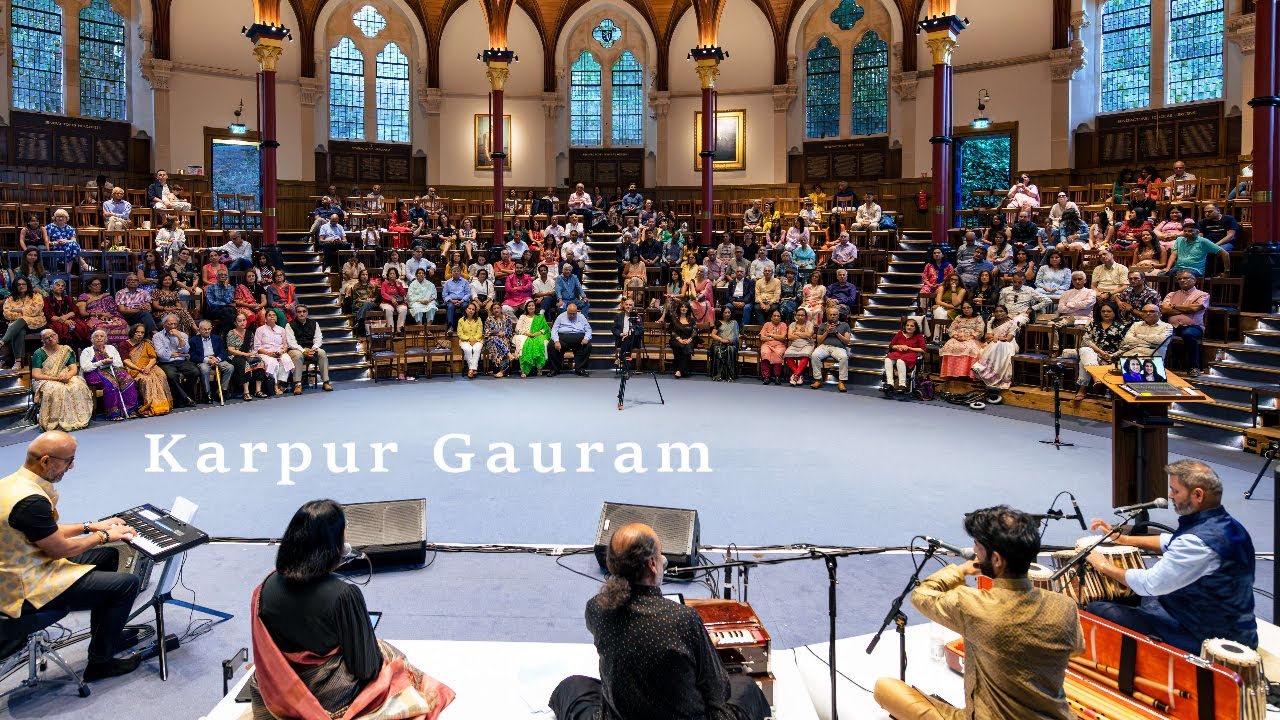
Karpur Gauram in London: Inside a Live Shiva Chant

A six-minute live recording of "Karpur Gauram" by Manish Vyas and his band, performed in a London school library. Here is how the verse, its…

1 min read
Opening a Lighthouse: Gratitude, Seva and Song in Mumbai
Inspire

Opening a Lighthouse: Gratitude, Seva and Song in Mumbai

A three-hour live ceremony in Borivali West reopens a Brahma Kumaris service center. Here is how gratitude, seva and devotional song shape t…

1 min read
Namo Namo: The Devotional Song Sung Back to a Teacher
Inspire

Namo Namo: The Devotional Song Sung Back to a Teacher

A three-minute devotional song, written by Sutara and Omkara and shared with a sangha room in June 2026, turns a teacher's teaching into a c…

1 min read

Continua a esplorare

Continua il tuo viaggio

Altra saggezza e altri incontri da tutta la directory BrightStar.

Altri articoli

Sfoglia l’intera raccolta di insegnamenti, interviste e guide.

Torna a tutti gli articoli →

Insegnanti e artisti

Esplora i lignaggi, i musicisti e le guide del mondo consapevole.

Esplora gli artisti →

Trova un evento

Kirtan, ritiri, sound bath, breathwork, festival: in arrivo presto.

Sfoglia gli eventi →
