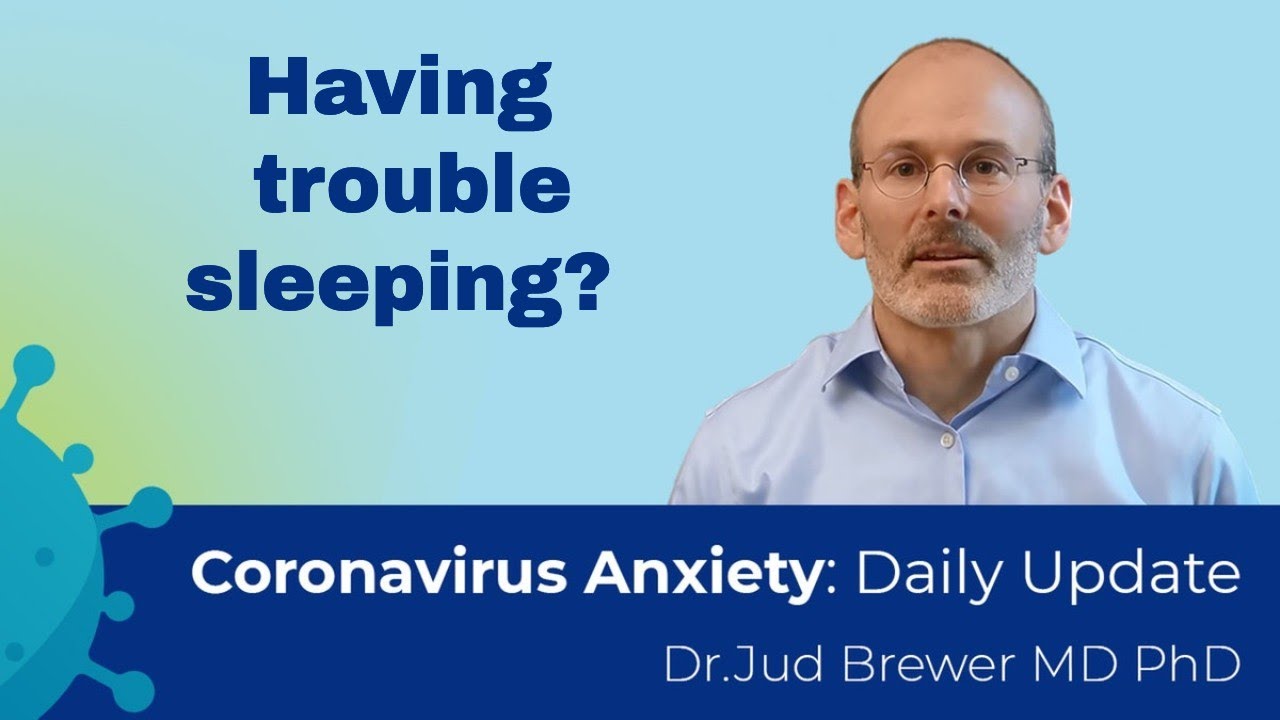
Picture the moment after a conference call ends. Someone said something important three minutes ago, and it has already slipped away, crowded out by a looping worry about the deadline behind it. Most of us have been there, and most of us have been advised to take a few slow breaths. In a short April 2020 video, Jud Brewer, MD, PhD, an addiction psychiatrist and neuroscientist who works on anxiety and habit change, argues that breath work alone often fails at exactly the moment we need it, because the mind is already full. His alternative is a five-finger breathing exercise in which you trace the edges of your own fingers while you breathe. Brewer frames it as a way to "reboot" the brain's working memory. The logic is practical and worth taking seriously: instead of trying to out-focus anxiety with a single sense, you occupy the mind with several at once, leaving less room for the worry to run.
Brewer's video builds on earlier advice from his channel: when stress starts to climb, bring your attention to your feet, which keeps you anchored in the present. But he points out a problem with that suggestion. Feet are not where most people hold anxiety. In his words, anxiety "show[s] up in our chest our shoulders our jaw and even in the muscles around our eyes," so a body scan that starts at the soles can feel like it's happening in the wrong room. Even paying attention to your feet, he says, "can feel a bit challenging" when you're really stressed.
The reason is not a lack of willpower. It is a question of mental bandwidth. Brewer's explanation starts with a region of the prefrontal cortex, the thinking and planning part of the brain, known as the dorsolateral prefrontal cortex, or DLPFC. Located toward the front and side of the brain, it is central to working memory, the short-term system that holds information in mind while you use it. When you repeat a phone number to yourself long enough to dial it, the DLPFC is doing the holding. So is the mental list of groceries you're trying to remember for the next few minutes.
The key limitation is capacity. Brewer compares the DLPFC to the random access memory, or RAM, in a computer:
"You can think of your DLPFC as being analogous to the random access memory or RAM of your computer. If your computer has a lot of RAM you run a bunch of programs at the same time. If it doesn't have that much RAM it gets slower each time you use a new app."
That slowdown is what worry does to the mind. Brewer's point is that when you are anxious, worried thinking takes up that same limited space. The grocery list vanishes, and so does what a colleague said on a call an hour earlier. A mindfulness instruction such as "notice your breath" then asks a computer that is already running hot to take on one more program, and the result can feel forced, as though it isn't doing enough to settle either the mind or the body.
Brewer's answer is to give the brain a richer task. Five-finger breathing asks you to coordinate several streams of attention simultaneously. You watch and feel your fingers, you track breath, and you do it across two locations, one finger on each hand, plus the breath. In his description, this is "not only multi-sensory seeing and feeling but it requires awareness of multiple locations as well."
The principle is that working memory has a ceiling, and a demanding sensory task can push worried thoughts out of the way. Breath alone, he suggests, is not always enough to dislodge a worry that has already claimed the space. Brewer puts it this way: "This takes a lot of your brain's RAM to do, perhaps enough that it crowds out those worried thoughts." If you forget what you were worried about for a moment, that gap is the point.
There is a second mechanism, and it concerns the body. Brewer says that as you practice for a minute or so, you also calm your physiology. The emotional charge that makes thoughts feel urgent drops. When the worry returns, it "aren't as convincing because they don't have the same emotional tone," he says. Without that arousal behind them, thoughts "have less weight" and are easier to let go of, or simply see as thoughts rather than instructions to act right now. That distinction matters. A thought that feels like a fire alarm demands a response. A thought that feels like weather can be noticed and allowed to pass.
Brewer's instructions are simple enough to do anywhere, including at your desk or during a call's silence. Here is the sequence as he describes it:
- Place the index finger of one hand on the outside edge of the pinky of your other hand.
- As you breathe in, trace up the outside of the pinky.
- As you breathe out, trace down the inside of the pinky.
- Repeat the same pattern on the ring finger, then the middle finger, and continue across the whole hand.
- When you reach the end, reverse direction and trace from the thumb toward the pinky.
He notes that you don't have to complete the entire hand to benefit. Even a few fingers, practiced for a minute, can help. The movement is slow, the tracing is tactile, and the breath is paced to the finger movement, which is what makes the attention multi-location and multi-sensory rather than a single point of focus.
Brewer's exercise rests on a broader view of anxiety that he has developed across his videos. In an earlier episode, he argued that worrying is the brain's way of doing "at least something when we can't really do anything about a situation." That framing matters because it reframes the problem. Worry is not a malfunction to be eliminated; it is an attempt at control that has nowhere to go. Five-finger breathing gives the mind a different job, one with a clear beginning, middle, and end, so the impulse to worry has less room to take over.
This is also why Brewer's approach is not about forcing thoughts to stop. The aim is to lower the intensity of the thinking, so you can see it more clearly and respond from a steadier place. That is a modest goal, and it is a realistic one.
Brewer's favorite part of the exercise may be that it works for children. He says he "love[s] this" partly because you can use the excuse of teaching it to your kids while practicing it with them, and he is clear that it works at any age. His suggested routine is to practice it as a family at natural transition points: before each meal, before naps, at bedtime, or at other discrete breaks in the day.
He also describes a more personal use. If you notice you're getting worked up during the day, name it out loud to your kids, something like "I'm feeling a little stressed right now," and then ask for their help. In his example, the request is: "can you help me calm down by leading me in a five finger breathing exercise." The move does two things at once. It models emotional honesty, and it gives children a sense of agency, helping them feel in control rather than simply told what to do. If you don't have kids, Brewer suggests letting your "inner kid" lead the exercise.
He closes the video with a page from the children's book The Boy, the Mole, the Fox and the Horse, reading the question "What is the bravest thing you've ever said?" and the advice to ask the boy for help and to send the horse. His takeaway is simple: ask for help when you need it, whether from your kids or from yourself, and see whether five-finger breathing helps you reset your physiology so your working memory can keep working.
Five-finger breathing is a small tool, but the reasoning behind it is useful for anyone whose breathing practice stalls under pressure. Try it the next time you notice a worry crowding out the task in front of you. Start with a few fingers, a minute of breath, and no expectation of a perfect outcome. Notice whether the thought loses some of its urgency, and if it doesn't, try again later in the day.
For more, Brewer's video description points to several free resources. You can subscribe to his channel for daily updates and join a free weekly anxiety "office hours" Q&A on Mondays at noon Eastern. The free Breathe by Dr. Jud app, available on Apple and Android, offers mindfulness practices, and more anxiety resources are at drjud.com. The description also lists weekly online mindfulness classes from the University of Oxford Mindfulness Centre and a library of free talks and practice sessions from the Free Mindfulness Project. Brewer's own background is in addiction psychiatry and neuroscience, and he directs research and innovation at Brown University's Mindfulness Center, so the exercise sits at the intersection of clinical work and brain science. Use it as a starting point, and let your own experience tell you where it helps.