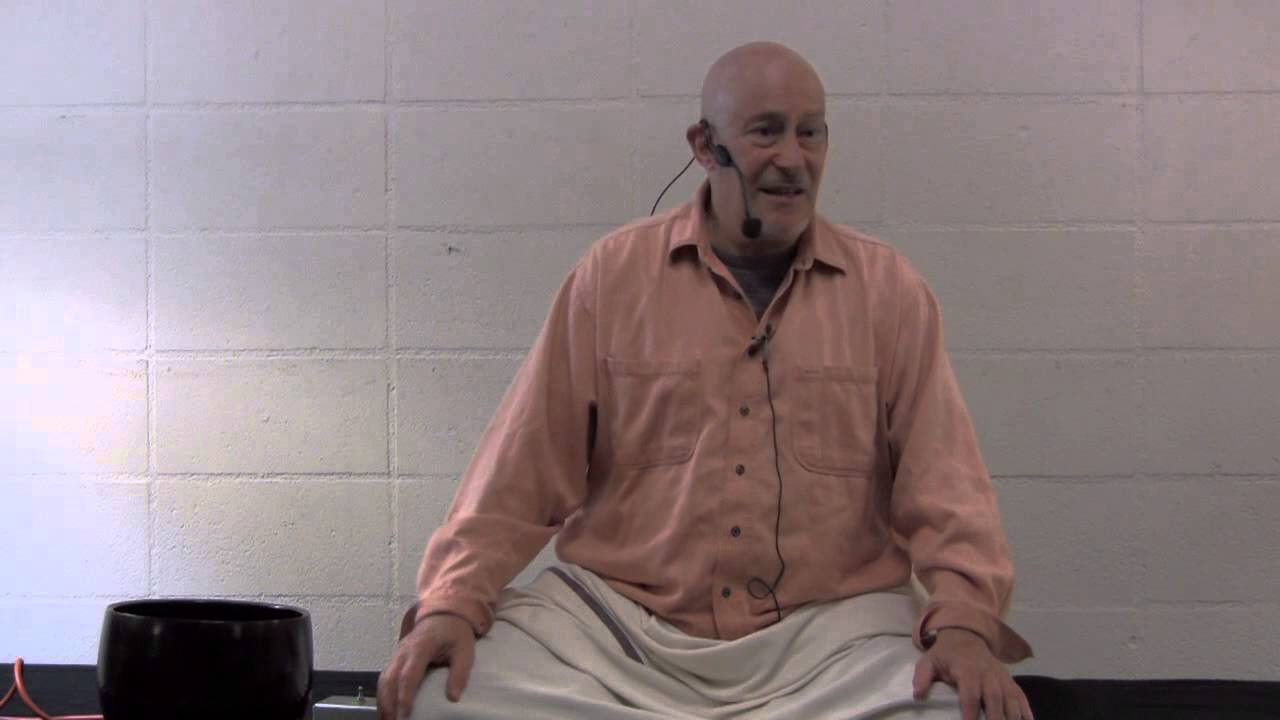
Somewhere in the middle of a sit, the noting has gone ragged. The labels are coming too fast, or too slow, or the meditator is choosing which sensation to label next and noticing that the choosing itself has become the practice. In a talk filmed at a group process in January 2010 at the Mary and Joseph Retreat Center in Rancho Palos Verdes, California, Shinzen Young takes up this moment and offers a deliberate antidote. The technique he calls "Do Nothing" is a meditation with no techniques to apply, no labels to assign, and no decisions to make about where attention goes. Its entire instruction runs to two sentences, and the teaching around those sentences is a careful study of what it means to stop controlling the mind without falling asleep inside it. What follows explains the ideas in that talk, from the logic of the practice to the subtleties he flags, so that a reader who has never sat with it can understand what is being asked and why it is framed the way it is.
Young begins by naming the problem his other techniques create. "A lot of the techniques that I give you — the noting techniques and so forth — they require a certain amount of effort," he says (0:05). The practice is not wrong to require effort, but he adds that "it's good to be able to drop effort also" (0:17). Noting involves judgment as well. If more than one phenomenon is present, the practitioner has to choose which to work with, and must choose which approach to pursue (0:31 to 0:37).
The Do Nothing practice is meant to remove that layer of decision-making entirely. Young says "it's also good to have a practice that involves no choices whatsoever, not even a choice as to directing what's happening in attention" (0:46). He is careful to note that this approach travels under many names. "Some people call this 'choiceless awareness,' some people call it 'just sitting,' some people call it the 'Great Perfection,' in Tibetan Dzogchen, or the 'grand symbol,' in Sanskrit Mahamudra" (1:05). He names it his own way: "I like to call it 'Do Nothing.' That's just my name for it" (1:26). The naming matters because the phrase is a paradox. As he puts it, because "do" and "nothing" don't go together, the instruction needs subtleties that a plain reading would miss.
The most important two words in the talk may be the ones Young repeats most insistently. "The Do Nothing technique is designed with time," he says (1:59). "I cannot overemphasize that phrase — with time; not when you practice it at a given occasion, but with time" (2:06).
The reason is that Young does not frame the technique as a switch you flip during a session. He describes it as something that prepares a change. The practice "is designed to create a sensitivity for a certain circuit in human consciousness — the circuit that controls attention" (2:18). Its aim is to "set up an environment wherein that circuit will turn itself off for a while" (2:35).
He is candid that the obvious approach won't work. "If you try to turn it off, obviously that's not going to exactly work because you have to keep it on in order to try to turn it off" (2:47). The meditator cannot use the controlling faculty to shut down the controlling faculty. So Young offers an image: "The Do Nothing technique doesn't involve your hand turning off yourself. It sets up a situation where nature will grow that hand, reach around, and turn off the robot-self for a brief period of time" (3:12). He adds a reassurance that matters for anyone who has felt uneasy about letting go: "At some point you and the world will come back, so nothing bad at all will happen; you don't have to be afraid" (3:25).
Underneath the imagery is a claim about where this part of the mind sits. Young describes it as "a very, very primitive part of our being" (3:43). The practice develops sensitivity to it first, and then, "once that sensitivity is developed, it will, for periods of time, turn off" (3:54).
Many meditators, Young notes, arrive at a particular state and report it as failure. "I can't decide what to do at certain times. I'm just confused with all the options" (4:02). His response reverses the usual reading. "I know you think it's a bad experience, but actually that's a good experience" (4:20).
The reason is about timing. When the practitioner thinks, "I don't know what to do with my meditation right now," Young says, "the part that controls attention is maximally activated at that time" (4:29). That is precisely the faculty the technique is meant to loosen. Because the mind is at its most engaged in choosing, it is also the moment when the practice can work. "When it's maximally activated, it's good to know because that points you to — 'Oh, that's the place'" (4:42).
He treats this confusion as a signal rather than a problem. "Whenever that confusion about 'What should I do with the practice?' arises, that's a strong arising from the place of choice" (5:05). He says plainly, "That's good, because for a moment your attention is adverted to the place of choice" (5:09). For a practitioner, that is an invitation. "Love that! Maybe that wouldn't be a bad time to Do Nothing" (5:13).
The full instruction, as Young gives it, is: "Let whatever happens happen. As soon as you're aware of an intention to control your attention, drop that intention" (5:20). It sounds simple, and Young spends most of the talk showing where it can be misread.
The first trap is turning the instruction into a second task. "There's nothing in this technique that says that you should maintain an intention to drop intentions," he says (5:47). A practitioner who keeps checking, moment by moment, "whether you have an intention or not" and who "always maintain[s] the intention to drop those intentions" has built a new job for himself. As Young puts it, "Then you'd be doing two things instead of doing nothing" (6:21).
The second point concerns what "let whatever happens happen" covers. It is broad. Young lists the outcomes he has in mind: "you may be very scattered, maybe that you may get sleepy and go unconscious, that you may get lost in monkey mind for long periods of time, that you will have very little concentration, clarity or equanimity" (6:36). These are not failures the technique forbids. "There's nothing in this technique that says those things won't happen, and they may be all that happens" (7:05). The practice does not promise calm. Restfulness may follow over time, but he is explicit that it is not the requirement.
The third point concerns the word "as soon as." Young is clear that the trigger is awareness, not a schedule. "You may very seldom be aware of the intention to control your attention. That's perfectly okay. I didn't say you'd be aware of it very often" (8:00 onward). The practitioner is "not being asked to moment-by-moment monitor for the presence of that intention." The practice is to wait for the awareness to arrive, which "might not be much of a wait, or it might be a long wait while you're lost in reverie and sleepiness" (8:25). Either way, it is "perfectly okay, as far as this technique goes."
Young anticipates the question directly: "What happens if I can't drop it?" (7:34). His answer depends on what "intention" and "drop" mean in this context, and he defines both narrowly.
An intention, in his usage, is "something that, by definition, you have complete control over. You can initiate it, or you can drop it. I have complete control over the movement of my arm. I can raise it, and I can decide not to raise it" (8:09). If a practitioner tries to drop an impulse and finds that they cannot, Young's conclusion is that the impulse is not a fully free intention. "If you can't drop it for even a second, then it's not fully free will. It's not full intention, so you don't have to drop it" (8:55). The impulse is happening to you rather than through you, and the technique does not ask you to fight it.
"Drop" is equally specific. "'Drop' does not mean 'get rid of.' It's in the moment: you drop the intention; the intention might come back immediately. That's fine. When it comes back, drop it again" (8:30). The practice is not a battle to eliminate the impulse permanently. It is a repeated, light release.
He also addresses a common worry about the body. "What if I have the intention to move my body?" Young's answer is measured: "that's okay. I wouldn't always give in to it" (10:00). What the technique pinpoints is more specific. It is "whatever it is within us that decides to initiate thoughts, attempts to suppress thoughts, attempts to direct thought, decides to pursue a thought once it arises," or uses thoughts "to do something about thought" (10:20). That "place" is what the practice is meant to reveal.
Yes, and Young is direct about it. "If the experience is horribly agitating and uncomfortable, there's absolutely no reason why you need to continue with this technique at that time" (9:05). His companion rule of thumb is short: "If noting makes you racy, try Do Nothing. If Do Nothing makes you spacey, try noting" (9:30). The two practices check each other. Noting gives structure to a mind that has gone loose, and Do Nothing gives relief to a mind that is clenched around its labels.
He also marks the difference between the two in a more philosophical register. Because the practice has no technique to perform, he calls it a form of "anti-meditation meditation." The Tibetan term he gives is "gomme," which he explains as a combination of "dagme," meaning "without" and "self," and "gom," meaning "meditate." Gomme, in his phrasing, means "don't meditate." He adds with characteristic dryness, "Of course, you are meditating though" (10:36). He notes that the truly gomme state would be "the state of 99.9% of human beings all the time. They truly don't meditate" (10:50).
The deepest claim in the talk points past the individual practitioner. Young suggests that with time the practice pinpoints the place that decides, and that "spirit" and the momentum of concentration, sensory clarity, and equanimity do the meditating (12:36). He closes with a speculation that the experience of freedom from limited identity might one day be induced from outside (14:27). He presents that as a future possibility rather than a current method.
Do Nothing is easiest to understand as a counterweight. Young's noting and labeling techniques build precision by making choices. Do Nothing removes the chooser and asks the practitioner to observe what happens when that chooser goes quiet. To explore the contrast, watch Young's companion video, "How to do Labeling and Noting During Meditation, 1 of 2 Parts," at youtube.com/watch?v=StBTuX0tqU8, which covers the approach this talk sets against. Then return to the two-sentence instruction and try it for a few minutes at a time, paying attention to the moments when confusion about what to do next arises. Young's advice is that those moments are the place to begin.