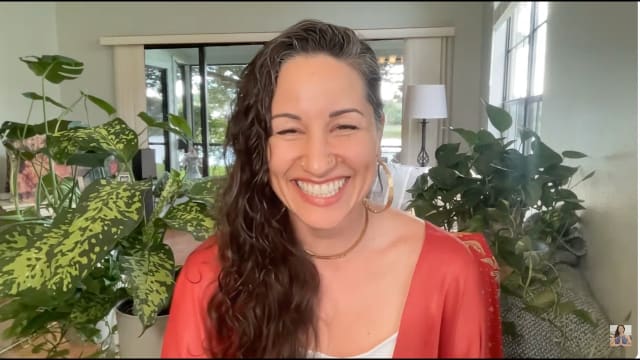
Nine minutes into a session she has just opened, Cassie Mendoza-Jones reaches for a card. She calls it her belief balance deck, and the card that drops out reads joy and self-love. Before anyone has tapped a single point, she has already changed the subject. The session is built for people who feel small in their business: stuck in a comparison loop, worn down by social media, unsure whether their voice and work are enough. Its method is EFT tapping, a short run of spoken statements paired with tapping on the body, and its premise is that you cannot solve a visibility problem by pushing harder on visibility. You have to return to the joy of the work first. The video runs under nine minutes and makes a case that is easy to underestimate: the way you feel while you create shapes what the people you're trying to reach will ever find.
The structure is clearer than the tone suggests, and it's worth laying out the way you'd map a song before playing it. The session begins with a naming. Mendoza-Jones says, in effect, that this is for the moment you feel really small in your business, and she lists the symptoms: visibility blocks, overwhelm from social media, a comparison loop. Naming the feeling comes before any attempt to fix it.
Then comes the card, which functions as the key change. Mendoza-Jones says it will bring the listener "back into alignment with yourself, with your voice, with your gift, with your magic," and she points the attention away from how you are being perceived. Only then does the tapping begin. Around the 1:41 mark she instructs you to tap the side of your hand and offers the first statement:
"Even though I have been giving myself such a hard time about how I've been showing up, I deeply and completely love and accept myself." (Mendoza-Jones, EFT tapping video, October 2026, at 1:41)
The grammar of that line is the method. Every statement opens with "even though," which holds the difficulty in plain view without granting it the final word. The first half admits the problem, the self-criticism or the feeling of smallness. The second half refuses to make acceptance conditional on fixing it. Over the next several minutes the statements repeat this pattern, moving through feeling small in your gifts, feeling small in your voice, and stress about being seen, and each round ends back in self-acceptance. If you have ever tried to talk yourself out of a bad feeling and felt the attempt backfire, this is a different approach: you keep the feeling in the room and change the sentence you're saying to it.
The reasoning is in her own words, and it inverts the usual logic of getting seen. Most business advice starts with the audience: find the people, reach them, then the creator's energy follows. Mendoza-Jones argues the sequence runs the other way. Joy, she says, "is such a magnet," and she draws a direct line from the creator's inner state to the people who will respond:
"You need to love what you're creating first. You need to love how you're showing up first. And you know what? You're actually going to do this for yourself first, and then the people who need your work, your message, your magic, all of that are going to find you." (Mendoza-Jones, EFT tapping video, October 2026, around 1:01 to 1:16)
She is also explicit about where this idea comes from in her work. She names her podcast, Love What You Create, and the phrase is the spine of the session: love what you make before you measure how it lands. Whether or not you accept the magnet claim in full, the practical implication is concrete. If your attention while creating is taken up by how you look next to someone else, the work tends to come out bent around that anxiety. If the attention is on why you started and what you still love about it, the work has room to be itself.
Mendoza-Jones is precise about the mechanism. Her tapping statements name the loop directly: "I've been looking around, comparing myself to people I don't even know on the internet. Telling myself that I am too small to create more success. Wondering and stressing about how is this going to work?" Two details matter here. The comparison targets strangers, the curated and visible people whose lives you see in fragments. And the loop isn't just envy; it's a series of unanswerable questions that keep you in place.
The session then gives the loop a name for what it's doing. The inner voice says that everyone else is moving forward while you fall behind or fail. Around the 5:44 mark, after laying out that narrative, Mendoza-Jones says: "Say that again. None of that is true." The repetition is a deliberate beat, the kind of thing a performer does to make a line land in a room full of people. Hearing the sentence twice gives it weight that a single pass would not.
The most useful moment in the session may be a correction she makes to her own phrasing. The first version of the belief is that someone else's success doesn't block yours. She stops and says she is going to say it again, then tightens it. She is not going to claim that another person's success paves the way for hers, because that is a new claim she may not be able to hold. She keeps only what she can stand behind: it doesn't block mine. A minimal, true sentence is easier to repeat than a grand one, and the tapping works better when the belief is small enough to actually believe.
The session comes back to volume again and again. At roughly the 7:27 mark, Mendoza-Jones names the belief that a bigger business and a bigger audience mean better work, and she separates the two: "Just because something feels louder than me doesn't mean I can't be heard. It doesn't mean it's more valuable. My work is meaningful." The distinction between being heard and being valuable is the quiet center of the video. Reach and worth are different measurements, and the anxiety of feeling behind often comes from treating the first as proof of the second.
The video's description points to a wider frame. Mendoza-Jones describes a free workshop called The Gap, which addresses the uncomfortable space between where you are and where you want to be, and promises to help you move through it without forcing, rushing, or losing trust in yourself. Those three failure modes map neatly onto the session. Forcing is pushing visibility before you're ready. Rushing is comparing your timeline to someone else's. Losing trust is the slide into believing that the gap itself is evidence you're not enough. The tapping is a few minutes of practice aimed at the third one, and the workshop, according to the description, is where the wider work of the gap lives. Note that this article is working from the video and its description; the full workshop is a separate offering from Mendoza-Jones.
The session closes with an instruction that is easy to skip past: "See what you can do today that's going to infuse your work and remind yourself in your work of the joy that it brings you and the joy you bring people in your work." It is not a task list. It is a prompt to find one concrete action that puts the joy back into the day's work.
A few ways to take it on: choose one of the statements that landed hardest and repeat it during a quiet moment, tapping in whatever way you know. Write the card's words, joy and self-love, somewhere you will see them before you open your social feeds. Before posting or sharing, ask the question she poses about why you are doing the work and what you love about it, and let the answer shape what you make next. None of this replaces the other things a business needs. It is a way to keep the work from being run by the comparison, which is the central claim of the session.
Mendoza-Jones frames her whole session around one line she returns to: "I am enough, and my work is enough, and the way I show up is enough." Whatever you make of the method, that is the note the video ends on, and it is a useful one to carry into a week when the feed makes you feel small.
If this session resonated, the natural next step is Mendoza-Jones's own material. Her free workshop, The Gap, is the fuller treatment of the uncomfortable middle space this video touches on. Her podcast, Love What You Create, is the source of the phrase that anchors the session. Her channel has further tapping sessions, and her own pages list the membership, mastermind, and one-to-one sessions she offers for those who want more structured support. Start with the video itself: play it once without tapping, then once with it, and notice where the feeling of being behind shows up in your body.