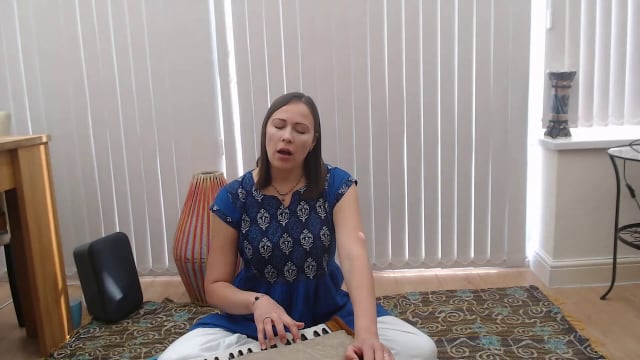
The invocation began at dusk on a Saturday in April 2020, as the pandemic had forced most of the world indoors. In a London home, a kirtan leader opened a live broadcast with a question: where are you joining from? The answers came in a stream of names and locations—an international congregation gathering not in a temple or concert hall, but through screens, each participant in their own space, yet reaching toward the same sacred center.
This is kirtan: a practice of devotional chanting drawn from bhakti-yoga, one of the oldest meditation disciplines in Hindu and yogic tradition. Unlike meditation that relies on silence or breath work alone, kirtan uses the human voice and call-and-response to invoke what practitioners call grace—a felt shift in consciousness toward divine presence. On that April evening, as lockdowns deepened and isolation became the defining fact of daily life, kirtan London was offering ten sessions each day at 7 p.m., plus Saturday and Sunday sessions, making the practice available to anyone with an internet connection.
The appeal was not incidental to the moment. The kirtan leader explained the spiritual reasoning clearly: "Even in these most challenging times, very strange times, we get to have sunshine at least here in England, we get to see beautiful green grass outside. We have our space, and most importantly, we have all of us have a sacred space inside us. So even if there is no one around, even if we are in a flat, perhaps, or somewhere in the middle of the city where we don't have much nature, there is still a sacred space inside us." This is the promise underlying every kirtan session—that refuge does not depend on external circumstance. It exists within, and chanting is a technology for accessing it.
WhatIsKirtan,andHowDoesItWork?
Kirtan operates through the repetition of sacred names—mantras drawn from Sanskrit texts and the Hindu devotional tradition. During the April session, two primary mantras anchored the practice. The first was om namo bhagavate vasudevaya, described as a greeting to the divine, a way of paying homage to divinity in all forms and saying thank you. The second was the Hare Krishna mantra: Hare Krishna, Hare Krishna, Krishna Krishna, Hare Hare; Hare Rama, Hare Rama, Rama Rama, Hare Hare.
Each mantra carries a specific intention. In the Hare Krishna version, the names invoke different qualities of the divine. Krishna is described as "all attractive," the supreme consciousness. Rama means "reservoir of joy" or "source of all bliss." Hare refers to the feminine divine energy. The prayer woven through the chanting asks for engagement in service: "Please engage me in your service. Please make me an instrument of your grace. Engage me in serving others."
The third mantra introduced during the session was Govinda Jaya Jaya Gopala Jaya Jaya, with additional names—Govinda, Gopala, Radha Raman—each describing specific divine qualities. Govinda, the leader explained, is "one who attracts all the senses and is able to protect all of our senses, all of our feelings, and give us shelter." The practice asks the vocalist and listener to hold these meanings in mind while singing—not as intellectual exercise, but as energetic intention that shapes the quality of sound and the state of consciousness it produces.
The format itself is simple and deeply communal. One person sings a line; the group responds by repeating it. The exchange builds momentum and creates what practitioners call a "mantra meditation"—a state in which individual effort gives way to something larger, in which the boundaries between singer and listener, self and community, begin to dissolve. Even for those unable to sing aloud—whether cooking, working, or caring for children—the invitation was to "tune in" when possible, to let the vibration of the chant pass through them.
WhyThisPracticeNow?
The timing of daily kirtan sessions during lockdown was not arbitrary. The spiritual philosophy underlying kirtan teaches that in times of difficulty, the voice and the repetition of sacred sound offer a direct channel to inner peace and divine connection. The leader spoke directly to this: the practice is meant to "alleviate some of the stress or pressure or depression or whatever [challenges] have led you" to the session. In a moment when isolation threatened mental and emotional wellbeing on a mass scale, kirtan offered a paradox—a way to be alone while remaining connected, to be at home while joining a congregation, to engage in something ancient and proven while using the technology of the present moment.
The practice also honors a lineage of gratitude. The opening invocation included specific thanks to the spiritual teachers who transmitted the practice of chanting through history. This is consistent with bhakti-yoga philosophy, which emphasizes devotion not only to the divine but to the guru or teacher lineage through which the practice has been preserved and passed on. By beginning with invocation and gratitude, each session anchored itself in a living tradition stretching back centuries, even as it unfolded in real time through streaming video.
TheSacredSpaceWithin
A core teaching emerged through the evening: the idea that each person carries an inner sanctuary regardless of outer circumstance. The leader described it as a space that must sometimes be cleared—"move the branches out of the way and sweep some dust away"—before it becomes a "little cozy space" where the soul connects with the divine. This is not metaphorical language for practitioners of bhakti-yoga; it describes an actual felt shift in consciousness, a stilling of mental turbulence that allows deeper awareness to emerge.
Kirtan is one tool among many in this clearing work. The repetition of mantra acts like a broom, sweeping aside scattered thought. The group response creates a field of coherence that makes this easier. The melody and rhythm engage the nervous system in a way that relaxes the body and focuses the mind. For some participants, the experience might be subtle—a sense of ease or focus. For others, it might be profound—a felt encounter with something transcendent. The practice honors both experiences without insisting on any particular outcome.
CommunityinaTimeofIsolation
The real-time comments pouring in during the session—names, locations, first-timers introducing themselves—created a visible proof of community. The leader actively welcomed newcomers, asked people to share where they were joining from, and encouraged questions. This is essential to kirtan as a living practice: it is not a performance to be passively received, but an invitation into co-creation. The repetition, the singing, the intention—all of it depends on the participation of those gathered, whether in a physical hall or scattered across time zones and homes.
For those dancing in their kitchens, singing with their children, or stepping away from work to tune in: the session honored all these ways of showing up. Kirtan does not demand perfection or pristine focus. It meets people where they are.
Wheretogofromhere
For readers drawn to this practice, kirtan is increasingly available online through dedicated communities and livestreamed sessions, many following the same daily rhythm that Kirtan London pioneered during lockdown. The practice requires no prior knowledge, no specific belief system, and no musical training. It asks only for willingness to repeat sacred names and to notice, over time, what shifts in the body and mind. For those curious about bhakti-yoga more broadly, the path begins with curiosity and a single mantra. The tradition teaches that the names themselves carry power, independent of the singer's understanding—that the vibration itself does the work. This is why communities continue to gather, in person and online, to sing together: not for belief, but for the direct experience of connection that emerges when many voices call the same names into the air.
Kirtan is a form of devotional chanting from bhakti-yoga that uses the repetition of sacred Sanskrit names, often in a call-and-response format, to invoke divine presence and reach an inner meditative state. Unlike silent meditation, kirtan actively uses the voice and melody to shift consciousness, creating a shared field of focus within a group or community.
Yes. Kirtan practitioners teach that the vibration and meaning of the mantras work regardless of prior belief. Many people come for the stress-relief and meditative benefits of chanting and repetition, without needing to adopt any particular spiritual worldview. The practice is open to anyone willing to repeat the names and notice what emerges.
Each mantra invokes specific qualities of the divine. For example, Krishna means 'all attractive,' Rama means 'reservoir of joy,' Govinda means 'one who attracts and protects all the senses,' and Hare refers to the feminine divine energy. Together, they create a prayer for protection, joy, and engagement in spiritual service.
Kirtan can be practiced alone or in groups. While the communal call-and-response creates a powerful shared field, individuals can also chant mantras solo as a form of personal meditation. Many people practice along with recordings or livestreamed sessions, creating a kind of distributed community.
Kirtan sessions are offered online through communities like Kirtan London and through many yoga centers, temples, and spiritual organizations. Many teachers offer free livestreamed daily sessions, similar to the model pioneered during lockdown, and no prior experience or musical ability is required to participate.
Bhakti-yoga is a path of devotion within Hindu and yogic traditions that emphasizes love, gratitude, and service to the divine. Kirtan—the practice of devotional chanting—is one of the primary tools within bhakti-yoga for cultivating this devotional connection and for reaching states of meditative absorption through sound and intention.