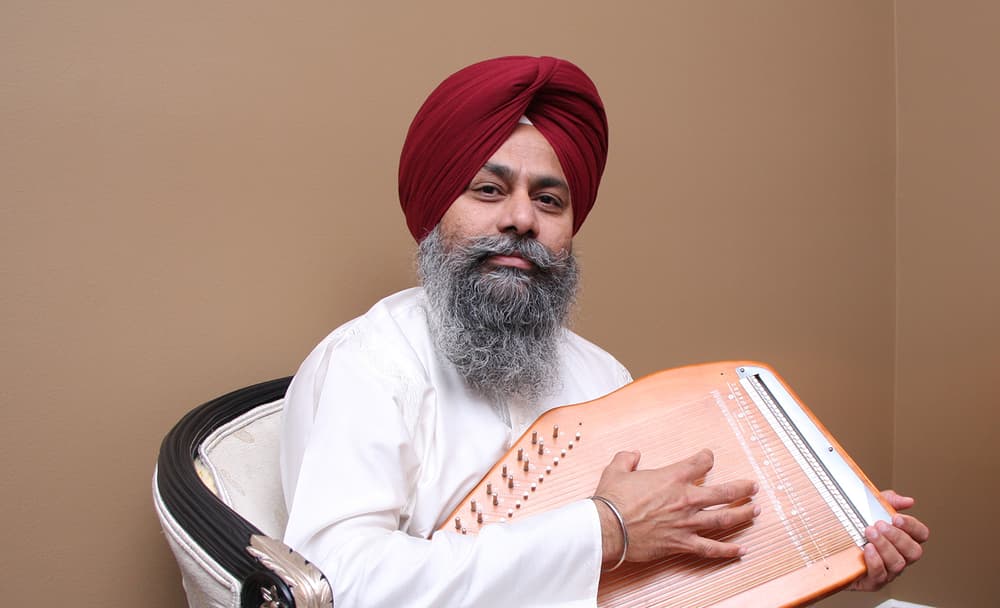
Professor Paramjeet Singh performs the Punjabi classical piece "Jatt Charhde Mirze Khan Nu," a traditional song that celebrates the audacity and bravery of legendary figures in Punjabi folklore. The performance showcases a sophisticated approach to raga construction, with the artist weaving multiple ragas throughout the composition to create depth and emotional resonance. This five-minute rendition exemplifies how classical Indian vocal training can be applied to Punjabi musical traditions, blending devotional rigor with narrative storytelling.
"Jatt Charhde Mirze Khan Nu" is a traditional Punjabi classical composition rooted in the region's folk and devotional heritage. The title itself references themes of valor and bravery—"jatt" referring to a member of an agricultural warrior caste in Punjab, while the phrase invokes legendary historical and semi-mythological figures. This type of composition typically draws from oral traditions passed down through generations of Punjabi musicians and storytellers.
The piece belongs to a broader category of Punjabi classical music that combines narrative elements with melodic sophistication. Unlike purely devotional forms such as kirtan or bhajan, these compositions often celebrate human courage, historical events, and cultural pride. They serve as both entertainment and cultural preservation, maintaining connection to Punjabi identity through musical performance.
Ragas form the melodic and emotional foundation of Indian classical music, including Punjabi traditions. A raga is not a fixed melody but rather a framework—a set of notes (swaras) and rules governing how those notes can be approached, emphasized, and sequenced. Each raga carries inherent emotional and aesthetic qualities that performers develop through improvisation within structured boundaries.
Professor Paramjeet Singh's approach in this performance involves interweaving multiple ragas, a technique that allows the musician to explore different emotional territories while maintaining coherence. By shifting between ragas, the performer can shift the listener's emotional landscape—introducing new colors, textures, and moods without abandoning the underlying compositional integrity. This requires both deep technical knowledge and artistic sensitivity, as poorly executed raga transitions can feel disjointed, while skillful ones feel inevitable and organic.
The practice of raga interweaving is common in advanced Indian classical performances, where musicians layer ragas based on traditional associations and contrasts. This approach demands that the performer understand not only each individual raga but also how audiences and the tradition itself perceive relationships between them.
Punjabi classical vocal training emphasizes several core technical elements. Breath control (prana) allows singers to sustain long phrases and execute rapid ornamentations without strain. Intonation precision (shruti) ensures that each note sits perfectly within the raga's tonal space, with particular attention to microtonal variations that distinguish one raga from another.
Ornamentation techniques include:
- Meend: Sliding between notes with continuous vocalization, creating smooth tonal transitions
- Gamak: Oscillating around a note to create texture and emphasis
- Khatka: Quick, articulated movements between non-adjacent notes
- Murki: Rapid runs of notes, often at the tail end of a phrase
- Alankar: Structured melodic phrases that explore the raga's possibilities
These techniques are not merely decorative—they encode emotional expression and allow the singer to communicate subtle shifts in mood and meaning. The control required to execute them cleanly, while maintaining proper breath support and intonation, represents years of disciplined study.
Punjabi classical pieces like "Jatt Charhde Mirze Khan Nu" operate on two levels simultaneously: the musical and the narrative. The lyrics reference specific cultural narratives—tales of bravery, loyalty, historical events, or mythological scenes. These narratives are not incidental to the music; they shape how the raga is deployed and what emotional arc the performance follows.
A skilled performer like Professor Paramjeet Singh uses the raga framework not just as a melodic structure but as a vehicle for bringing the story to life. The opening ragas might establish a sense of place or character; middle sections could build tension or explore conflict; and concluding passages might resolve the narrative arc or leave listeners with a particular emotional resonance.
This integration of story and music reflects Punjabi culture's oral traditions, where music was historically a primary mode of transmitting cultural memory, history, and values. Even in modern recorded performances, the narrative dimension remains central to how these pieces function and how audiences experience them.
Raga interweaving demands multiple layers of mastery. First, the performer must have internalized each raga deeply enough to execute it flawlessly in any context—to move between ragas smoothly rather than abruptly requires understanding how their note sets overlap, what tonal centers they share, and what emotional pathways connect them.
Second, the performer must respond to the composition's narrative and emotional requirements. The choice of which ragas to employ, in what sequence, and for how long, should feel motivated by the piece's content rather than arbitrary. This requires artistic judgment developed through years of listening to master performers and through trial and error in one's own practice.
Third, the performer must maintain listener engagement across transitions. An audience should feel that each shift opens new sonic and emotional possibilities rather than feeling lost or confused. This balance between exploration and coherence represents the mark of mature musical artistry.
While "Jatt Charhde Mirze Khan Nu" has a fixed compositional skeleton—the lyrics, the basic melodic contours, the raga framework—the rendition remains improvisational in significant ways. Professor Paramjeet Singh is not simply repeating a memorized performance but rather exploring the composition's possibilities within the constraints of its structure.
In each phrase, the performer makes micro-decisions: how long to linger on a particular note, which ornaments to apply, how to shape the breath and phrasing to serve the current emotional moment. Across the performance, larger decisions unfold: how much time to spend developing each raga, which emotional qualities to emphasize, where to build energy and where to create space.
This approach to performance—structured improvisation within a compositional framework—is characteristic of Indian classical music traditions. It allows each performance to be unique while remaining recognizable as the same composition, and it keeps the tradition alive by requiring each generation and each performer to bring fresh interpretation and understanding.
Professor Paramjeet Singh's rendition represents a continuation of Punjabi classical traditions that extend back centuries. These traditions were historically sustained through hereditary musician families (gharanas) who passed down knowledge orally and through performance apprenticeship. While formal training systems have evolved, the core approach to raga, composition, and performance remains grounded in these historical foundations.
The piece itself, referencing legendary jatts and khans, taps into Punjabi cultural identity rooted in agricultural and martial traditions. By performing such compositions in a classical vocal idiom, Professor Paramjeet Singh bridges the gap between folk narrative and sophisticated artistic expression—demonstrating that these forms of cultural memory and artistic achievement are not separate but deeply intertwined.
Modern performances like this one also represent an act of preservation. As oral traditions face pressure from cultural globalization and demographic shifts, recorded performances create accessible documentation of repertoire and techniques that might otherwise be lost. Simultaneously, by releasing the performance on YouTube and other platforms, performers extend the reach of these traditions beyond their original cultural contexts, allowing new audiences to encounter and appreciate Punjabi classical music.
To deepen engagement with this performance and related traditions, listeners can explore Professor Paramjeet Singh's broader body of work through his YouTube channel, website, and social media presence. Studying the raga system itself—understanding the note sets, emotional associations, and performance conventions of individual ragas—provides a foundation for appreciating how ragas function in performance.
Comparative listening to other renditions of traditional Punjabi compositions reveals how different performers approach the same material, highlighting the role of individual interpretation within collective tradition. Learning about Punjabi cultural history, particularly the historical and legendary figures referenced in compositions like this one, enriches understanding of what the music expresses and preserves.
For those interested in studying Punjabi vocal music formally, seeking out teachers trained in these traditions offers direct access to the techniques, repertoire, and interpretive wisdom that cannot be fully conveyed through video alone. The embodied knowledge of breath control, intonation, ornamentation, and emotional expression requires guided practice and personalized feedback from experienced practitioners.


