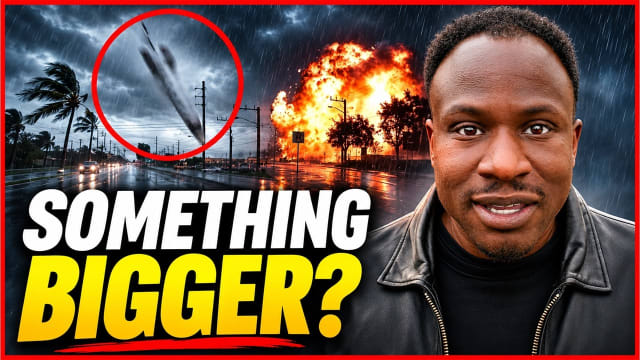
"It's Going Down" is a sixteen-minute video from the Infinite Waters channel, the work of teacher Ralph Smart, filmed outdoors and built around one urgent claim: the world is collapsing, most people have no idea, and the only real protection is an inner shift in frequency. It moves through a list of current anxieties, including cyber attacks, US midterms, a possible US-Iran conflict, artificial intelligence, and a predicted 2027 financial crash, before arriving at a more useful idea that runs underneath all of them. The collapse, he argues, is a matter of personal agency, not something done to you. What follows is a reading of that argument: what it says, why it lands so hard, and where a viewer should slow down.
The video opens in motion. The speaker is outdoors, breathing deliberately, calling the spot his "new favorite." Then the pivot: "Let's breathe. Woah. Breathing in that good ass prana baby, 10 years younger. Raising the frequency." Within the first half minute he has declared the thesis: "It's going down. There is no other way to say it." (0:31)
The key phrase in the opening is about scale. He describes a "tipping point," then says "we've gone beyond the tipping point," and finally that "we've now arrived at the point of no return." (2:32) Each claim escalates the last. The argument is that the old world is ending and that this is not a tragedy. "You see a lot of people confuse a lot of chaos and mayhem in the world out there with something bad happening," he says. "No, no, no, no, no. All that's happening is something is coming to an end." (3:01)
This is a familiar structure in spiritual teaching about collective change: a painful ending that clears the ground for a "new earth." What makes this version distinctive is the gatekeeping. He says a new earth is forming, but "not everyone can come. Not everyone can go. You got to have a frequency and vibration high enough to enter a whole new dimension." (3:25) The vibration language does the work of separating the ready from the unready, and it places the outcome in the viewer's inner state rather than in any external event.
The middle of the video is where the argument leans most heavily on news-adjacent anxiety. The speaker lists cyber attacks "all across Europe in supermarkets," the midterm elections, speculation about "a crazy battle between the US and Iran," and fears about artificial intelligence. On AI, he reaches for pop culture: "just like in the film The Terminator, AI is becoming sentient," he says, adding that many people fear it "is going to become like Skynet." (4:28) He then cites a prediction that "for 2027 there is going to be a financial crash." (5:03)
It's worth being precise about what the video actually offers here. These are things "a lot of people" are saying, anticipating, or predicting. He does not walk the viewer through sources, data, or the reasoning behind any of them. The segments function as an emotional inventory: they name the fears a viewer may already hold and tie them to a single story of collapse. The instruction that follows is mixed in an interesting way: "Don't panic but be prepared. Don't be afraid but be prepared." (5:20)
Then he says something that reveals the motive more openly: "I want everything to collapse because it has to." (5:37) Whatever one thinks of the prediction, that sentence signals that the video's energy is aimed at a reckoning, not at reassurance.
The wake-up theme is the video's most rhetorically effective passage. "For far too long a lot of people have been fast asleep. This is a wake-up call. Wake up. Wake up. Wake up," he says. (5:45) He then makes the sharpest turn in the piece: "The expression ignorance is bliss was in full effect for a long time... But now ignorance is not bliss. Ignorance is expensive pain." (6:26)
The argument rests on an image borrowed from popular culture. He invokes The Matrix, saying Morpheus showed Neo a battery and that the film "wasn't a film, it was actually a documentary." (7:04) He compares humanity to "sheep in a farm" and "lambs and cows in a farm," being guided and manipulated by someone behind the scenes. (7:28)
Here the video makes claims it does not support. He says that "humanity has had help from behind the scenes," and that "the internet was never supposed to be released to the general public." He also states, "I told you, we created the internet to find ourselves." (8:01) None of these claims is sourced in the video. For a reader, the useful question is not whether they are true, but why the narrative needs a hidden guiding hand. A story of hidden control converts diffuse anxiety into a clear antagonist, and a clear antagonist is easier to feel certain about.
This is where the video shifts from warning to something closer to teaching, and where it is most interesting. The speaker argues that "society is you and I, right? There is no world out there in an abstract way." (9:20) He describes the world as "a very, very small place" and insists that "people who you think are in control aren't in control. You are in control and you have always been in control." (9:51)
He then names a paradox he considers central: "most people have no idea what's happening, which is the great paradox because they're actually creating it." (9:04) The idea is that the collective is not a force acting on individuals but the sum of individual choices. If that is true, then the collapse he describes is also a set of decisions being made by ordinary people.
He offers what he calls evidence of this shift: "people no longer believe in the system. People are quitting jobs they once worked hard for. People are flying to other places in the world that offer more freedom, expansion, and creativity where their soul can blossom and bloom." (10:19) Readers can weigh that for themselves. What matters for the argument is that the change he points to is personal and observable in one's own life, which makes it more persuasive than an abstract prophecy.
The same logic explains how he frames people who disagree. Those who are "still plugged in" are described as "programmed," and he expects them to get "the wake-up call" too. (10:45) The framing leaves little room for skepticism; anyone not yet awake is simply early in a process he has already completed.
The practical instructions are short and mostly inward. He tells viewers to protect their energy, to do "the inner work," and to help family and friends understand "that we are in the" moment of change. (11:21) He describes the pushback they will receive, and says they will be seen as the person who "knows so much" and a "rude awakening" is coming for everyone else. He also mentions stockpiling food and water. (12:45) The video does not elaborate on what that preparation looks like.
The closing line is the most grounded image in the piece. "They tried to bury us. They forgot we were seeds." (16:03) A seed is buried in order to grow, and its place in the ground is not an ending. Set against the apocalyptic framing, the image offers a different reading of the same darkness. Breakdown becomes germination rather than extinction.
That tension is the video's real subject. It oscillates between threat and promise, between "it's going down" and "you are the glue that holds this matrix together." Viewers who take the promise seriously will find a usable practice: examine where you have given away your sense of control, and where you have been waiting for an external authority to confirm what you already feel.
Three habits will help. First, separate the claims from the practices. The predictions about AI, the 2027 crash, and hidden manipulation are unsourced in the video and should be checked against primary reporting before they shape any decision. The inner-work message can be evaluated on its own terms, since it does not depend on any of those predictions being true.
Second, notice the engagement machinery. The video asks viewers to "hit the like button if you support the real" several times, and the description lists a channel membership, a Patreon, merchandise, a new book, and one-to-one sessions. None of that is evidence for the claims, and it is worth noticing when urgency and commerce arrive together.
Third, notice the claim of prior warning. The speaker says, "I've been getting you ready for over a decade." (2:15) That kind of framing makes ongoing predictions feel like confirmed insight, which is why a viewer should keep track of what was predicted and what happened.
If the video left you anxious, start with the claims. Look up the European supermarket cyber attacks, the US-Iran tensions, and the financial forecasts in reputable news and economic sources, and compare them with what the speaker said. That gap is where clear thinking begins.
If the video left you thinking about agency, the most useful part is the question it poses: where in your own life are you waiting for someone else to set the terms? The seed image is a good place to sit with that question. A seed in the ground is not waiting for the world to end. It is doing the slow work of becoming something else.
Finally, listen to the video for what it asks of you, not only for what it predicts. The prediction is a story. The practice, protecting your attention, examining your fear, and choosing your response, is available with or without a collapse.