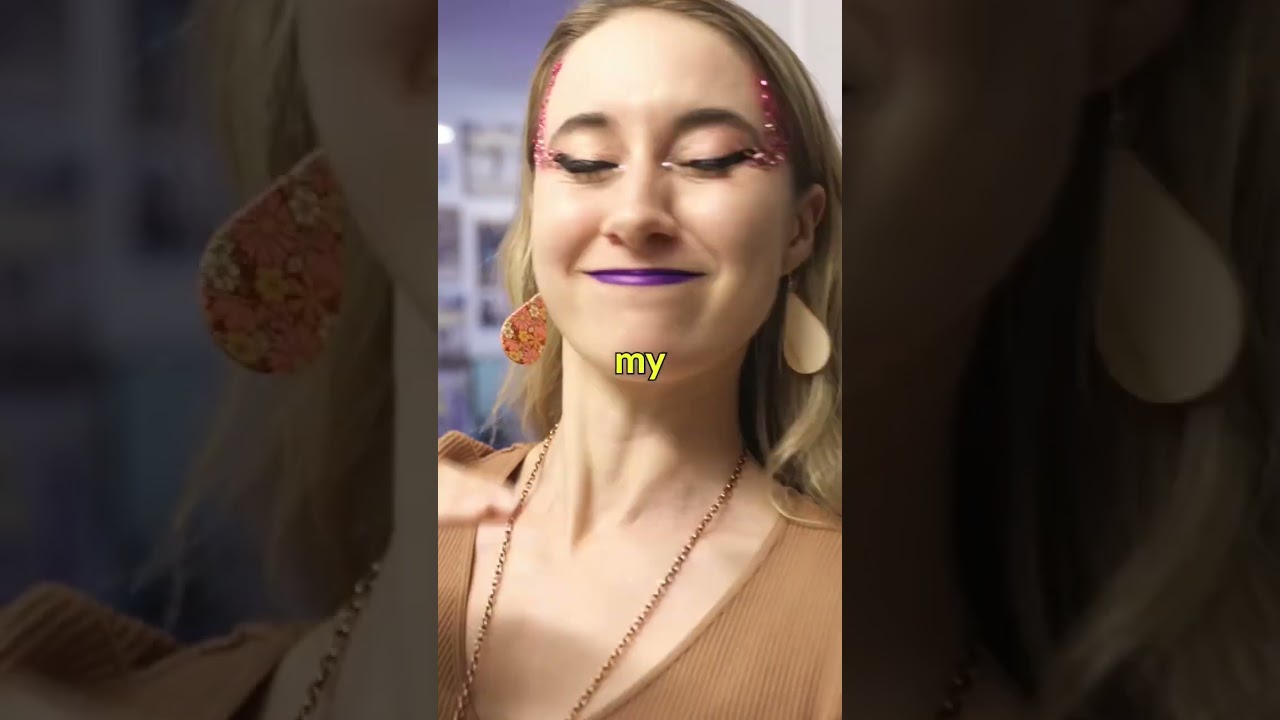
Sky Cowans documents a 24-hour immersion with Mint, someone who identifies as a real fairy and claims she can see and communicate with other fairies. Rather than dismissing the experience as implausible, Cowans approaches it as a genuine experiment in perspective-taking: entering a framework where fairy existence is treated as real, activating fairy rituals, visiting chakra vortexes designed to open portals, and remaining open to sensory phenomena that might otherwise be rationalized away. The video raises questions about the nature of belief, perception, and whether alternative reality frameworks—even ones that seem implausible—deserve experiential exploration rather than automatic skepticism.
What does it mean to approach alternative belief systems without immediate dismissal?
Cowans frames the 24-hour experiment as a deliberate methodological choice. Rather than treating Mint's identity and claims as something to debunk or laugh at (the phrase "riding her office crazy" suggests the temptation to ridicule), he commits to spending time from within her framework. This is an act of epistemic humility—acknowledging that the researcher's default skepticism may be filtering out valid perceptual or existential data. By choosing to participate in fairy activation practices and portal-opening rituals, Cowans treats the experience as an investigation into an alternate reality model, not as entertainment built on mockery. The video suggests that genuine understanding sometimes requires temporary suspension of disbelief, not as credulity, but as a tool for gathering firsthand information about how another person experiences and interprets the world.
What sensory phenomena emerged during the 24-hour fairy immersion?
Several concrete experiences are reported during the experiment. Mint first activated a "fairy light," a practice that appears to be part of her ritual repertoire for attracting fairy attention or energy. She then brought Cowans to a chakra vortex—a location believed to be energetically aligned with chakra systems—specifically to open what she calls a "fairy portal." According to her interpretation, this ritual successfully summoned fairies, and fairies "came out to play." Notably, Cowans himself experienced something: he reported hearing "little footsteps" multiple times, which he describes as genuinely unsettling ("freaking me out"). He asks Mint if she heard them too, suggesting his experience was real to him, whether or not it can be attributed to fairy activity or another cause. The presence of auditory phenomena—mysterious small sounds in a space dedicated to fairy interaction—becomes evidence within the frame of the 24-hour experiment, neither proven nor disproven.
How does belief itself function as a filter on reality?
Cowans introduces a cultural reference—the notion that "every time someone says I don't believe in fairies, a fairy drops dead." This is an allusion to the Peter Pan mythology, where public belief in fairies is literally life-sustaining for them. Rather than treating this as whimsy, Cowans uses it as a moral and epistemological argument: if there is even a remote possibility that disbelief causes harm to fairies, why take the risk of active skepticism? This reframes belief not as a question of external truth-value, but as an ethical choice about what reality you participate in creating. By choosing to believe—or at least, to declare belief—Cowans is acknowledging that belief systems are not merely passive descriptions of a fixed world, but active participations in worldmaking. The invitation at the end of the video, asking viewers to comment "I believe in fairies," is thus not an appeal to credulity, but an invitation to join a collective reality frame where fairy existence is affirmed.
What is a chakra vortex and how does it relate to fairy portals?
A chakra vortex is a location believed to align with the body's or Earth's energy meridian systems, typically associated with yoga, Tantra, and New Age spirituality. In Mint's framework, such vortexes are not merely metaphorical locations for internal practice—they are actual portals or gateways to other dimensions or realms where fairies reside. By traveling to a chakra vortex and performing portal-opening rituals, Mint is working within a cosmology where energy, geography, and interdimensional access are interconnected. The vortex becomes a thin place, a boundary where the human world and the fairy realm overlap. Cowans' participation in visiting this location and remaining open to sensory phenomena (the footsteps) suggests that, within a 24-hour frame, he is testing whether this cosmology produces consistent, reproducible phenomena—or at least phenomena that feel significant to those who are attuned to them.
How does sensory experience challenge the boundary between real and imagined?
One of the most striking elements of the video is Cowans' report of hearing "little footsteps" and his visible distress ("freaking me out"). This is not him observing Mint's behavior from outside; this is him reporting his own sensory experience. Whether or not these footsteps are attributable to fairies, animals, wind, or other causes, the fact that he heard something—and that it unsettled him—is real. The 24-hour experiment suggests that the dichotomy between "real" (materially verifiable, scientifically measurable) and "imagined" (subjective, internally generated) may be too crude. Sensory experience that arises within a particular perceptual framework (one that is attuned to fairy activity) may produce consistent, memorable, sometimes unsettling phenomena that cannot be easily dismissed as hallucination or fabrication. The video opens the possibility that alternate reality frameworks—ones that take fairy existence, chakra vortexes, and interdimensional portals seriously—are not false, but differently ontologically grounded: they operate according to different rules of what counts as real, what is worth paying attention to, and what relationships are possible.
What is the ethical dimension of belief in the context of interspecies or interdimensional relationships?
Cowans' decision to publicly affirm belief in fairies—and his invitation to viewers to do the same—is framed as an ethical act. The reasoning is clear: if fairies exist and if their existence is somehow dependent on human belief or affirmation, then active disbelief is a form of harm. This shifts the question from "Do fairies objectively exist?" to "What are the consequences of choosing to believe or not to believe?" From this angle, belief becomes a relational practice, not a epistemological assertion. To say "I believe in fairies" is to enter into a covenant of care with a species or form of being that may be more vulnerable, more dependent on recognition and acknowledgment, than humans. This is consistent with animist and indigenous philosophies that treat non-human beings—whether understood as spirits, ancestors, animals, or environmental presences—as worthy of respect and belief-affirmation, not because their materiality can be proven, but because the relational consequences of treating them as real are better than the consequences of dismissing them.
Where to go from here
If you find yourself moved by the 24-hour immersion framework, consider designing your own short-term belief experiments. Choose an alternative reality model—fairy realms, plant consciousness, ancestral presence, energy work, or any other system that intrigues you—and spend a defined period (24 hours, a week, a month) operating entirely within that framework. Pay attention to what phenomena emerge, what sensory shifts occur, what relationships become possible. You might explore other creator experiments and interviews with people who live within non-mainstream ontologies. Engage with indigenous philosophies and contemporary animism to understand how belief systems structure perception and relationship. Most importantly, remain curious about the gap between "scientifically verifiable" and "experientially real"—that gap is where genuine learning about consciousness, perception, and reality becomes possible.