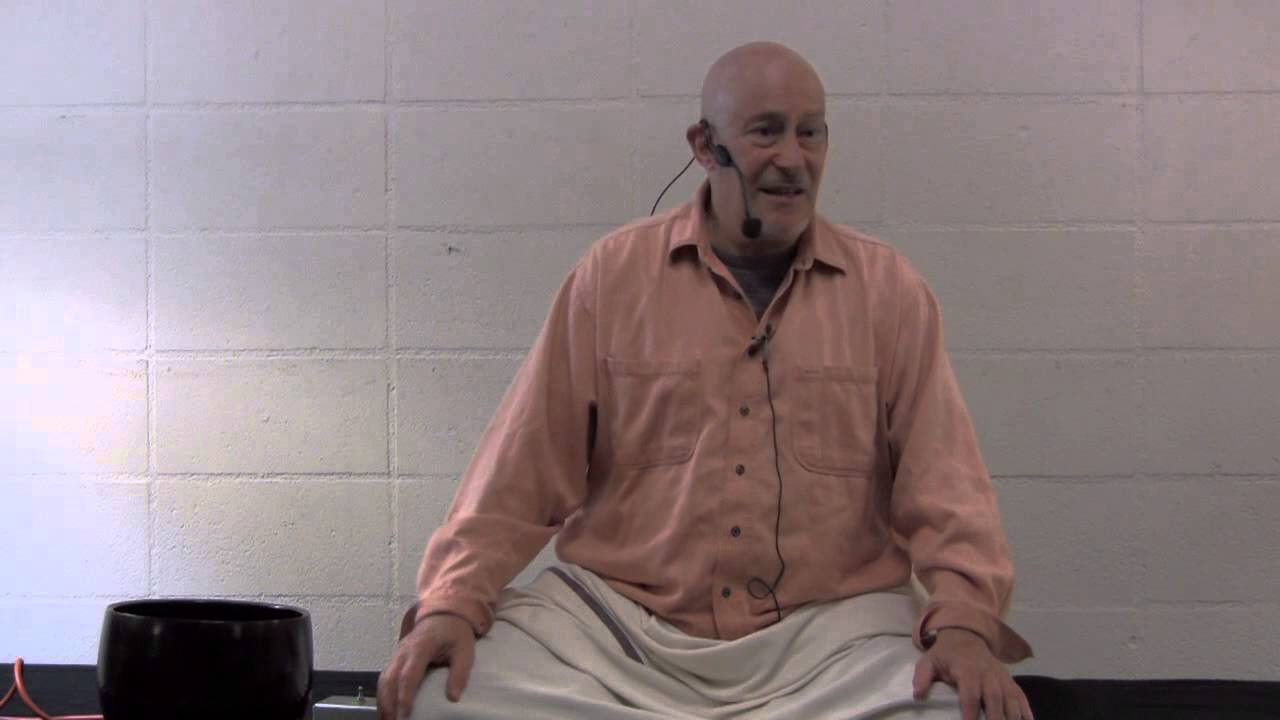
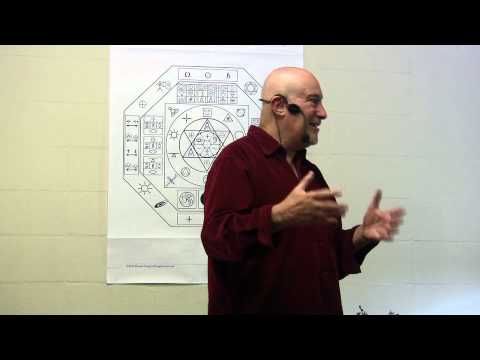
Filmed in November 2009 at Mt. Carmel Spiritual Centre in Niagara Falls, a five-minute clip from Shinzen Young's teaching makes an argument most spiritual seekers never hear spoken aloud: awakening comes with no informed consent. Young, a meditation teacher who speaks from within the territory he calls "no self, emptiness, and wisdom mind," makes two moves in quick succession. First he insists the experience is so valuable that most people who abide in it would trade a lifetime of ordinary ignorance for a single day of knowing. Then he turns the coin over. The "peculiar downsides" he names are a loneliness of understanding, a clear view of what humanity needs that goes unheeded, influence that flows without a self to claim it, and a free fall that never seems to land. Read slowly, the talk is less a warning than a field report from the other side of the threshold, written for people who have not yet crossed it and for those who have and are still adjusting.
Young opens with a deliberately playful phrase: "I sometimes like to somewhat jokingly say that there's no informed consent for enlightenment." The joke lands because it points at a real imbalance. Nobody can fully picture the state before entering it, and nobody can fully weigh its costs afterward. Seekers tend to build their expectations from stories, from teachers' language, and from their own longing, which means the picture they carry is usually distorted. Young's point is that the distortion runs in both directions. People overestimate what awakening will do for them, and they also underestimate how strange the terrain is once they arrive.
That framing matters for anyone reading spiritual literature as a prospective student. The talk asks you to hold two things at once: the value is real, and the price is unadvertised. It is a more honest pitch than most, and it works precisely because it refuses to sell.
Young takes the value seriously before he qualifies it. He asks the question directly, "How wonderful is it?" and answers with a thought experiment. Offer someone who abides in that world a choice: one day living with what they know, or a full lifetime without being allowed to know it. In his estimation, most would choose the single day.
"I'd rather have one day knowing what I know than a lifetime not being able to know this." That's how wonderful it is.
— Shinzen Young, Mt. Carmel Spiritual Centre talk, Nov. 2009 [1:10]
Notice how carefully he hedges the claim. "I can't speak for everyone," he says, before adding that most people in that world would make the same choice. That qualification is a small, consistent habit across the talk. He speaks from experience without pretending to universal authority.
Then he turns to the projection problem. Young is clear that the word "enlightened" covers a wide range, "from initial stream entry all the way up to arhats." Students often imagine a single, finished figure who has transcended ordinary imperfection. Against that fantasy he sets three specific myths: that an enlightened person never makes mistakes, that their life is perfect, and that everything is always bliss. Each is a way of pricing awakening as a kind of immunity. Young's implicit correction is that awakening changes how you relate to experience, not whether experience keeps arriving with its usual messiness.
The first downside Young names is communicative. "You can't describe it very well to other people." He reaches for an image: "It's like you know this secret." From the vantage point he describes, you look out at the state of humanity and see clearly what needs to be done, that it is doable by anyone, and that people are not doing it. The response he attributes to this vision is a split reaction, not knowing "whether to laugh or cry at the human condition."
What makes this painful is the gap between the clarity and the reception. You can try to explain. Young admits that a few people catch on. But for most listeners the words "go in one ear and out the other." The insight is not hidden; it is simply hard to transmit into minds that are not already tuned to receive it. That is a lonely position to occupy, and it helps explain why many long-term practitioners speak more guardedly than their enthusiasm would suggest.
To make the point he reaches for a figure from Greek mythology whose name he admits he has forgotten. The gods granted her the ability to know the future, but the flip side was that no one would believe her. Young maps this onto the modern teacher's predicament: you see clearly, you know the path is open to anyone, and still few people believe you. He frames this as "one of the downsides," which is the kind of plain speech that makes the talk feel credible rather than inspirational.
The second downside is subtler and, for a teacher, perhaps more disorienting. "You get to have all this influence, let's say, but you don't get to take any credit for it. You don't even know what you're doing." Young is describing a situation in which action and agency come apart. Your words and presence affect others, sometimes profoundly, but there is no owner standing behind the effect who can claim it.
He pushes this further in the passage where he discusses giving one's most powerful teachings: "You don't know what you're saying. You don't even know who you are." It is a striking admission from a teacher, and it is meant literally. The talk describes influence arriving "like a leaf falling from the tree." Nothing in that image is heroic. A leaf does not congratulate itself on falling, and the tree is not the one making the decision.
The practical implication is an antidote to spiritual ego. If awakening removed the self that wanted credit, then the cool-dude self-image Young mocks, "I'm this cool dude that can do this cool stuff," becomes not just unattractive but inaccurate. "No, that's not the way it works," he says flatly.
The talk's most evocative passage is about falling. "Enlightenment is like a free fall. It's like falling off a cliff that never ends, and you've acclimatized to it." The phrase carries two ideas. First, there is no ground to hit, so the usual sense of stability that comes from having solid footing is absent. Second, the falling becomes ordinary. You grow used to it, which is part of why it can go unnoticed for years.
He follows with a Zen image: "That's why the Zen people say it's like riding an ox backwards." The ox is a familiar figure in Zen literature for the mind being led, and riding it backwards suggests a posture where you are carried in a direction you are not facing and cannot fully see. Put the two images together and the picture is coherent. The practitioner is moving through a reality that doesn't yield to ordinary orientation, and that is precisely why the practitioner cannot fully know what they are doing or saying.
Young concludes the thought with a line that reads almost as a koan: "So, you can't even know, or enjoy, in a sense, you just have to occur." The verb is the key. Ordinary life centers on a doer who knows, enjoys, and takes credit. In the state he describes, those functions loosen, and what remains is simply occurring.
The clip is only about five minutes long, and it rewards repeated viewing. A reasonable first reading is cautionary: if you want awakening, know that it will not make you perfect, will not make you understood, and will not give you a self to be proud of. The sharper reading is that Young is describing consequences of a shift in identity, not punishments. The loneliness, the unrecognized influence, and the endless fall all follow from the disappearance of a separate self that could otherwise feel secure.
There is also a quieter invitation. If the "downsides" make you more suspicious of your own motives for practice, that is useful. Young's account suggests that some of what seekers want, recognition, credit, a finished personality, will not survive awakening. Whether that deters you or clarifies what you are actually after is the real informed choice the talk offers.
Start with the source. The full clip is on the Shinzen Young Teachings channel under the title "Enlightenment 'Downsides' ~ Shinzen Young," published in December 2009 and filmed at Mt. Carmel Spiritual Centre. Watch it once for the argument and once for the pauses, where Young's pacing carries as much as his words.
Then sit with the two questions he leaves open. Which would you choose: one day knowing what you know, or a lifetime without it? And if the price of that day included a fall with no floor and influence with no name attached, could you accept it? Neither question has a comfortable answer, and that discomfort is the point. Informed consent, in Young's framing, is not a document you sign once. It is a choice you keep making as the practice unfolds.