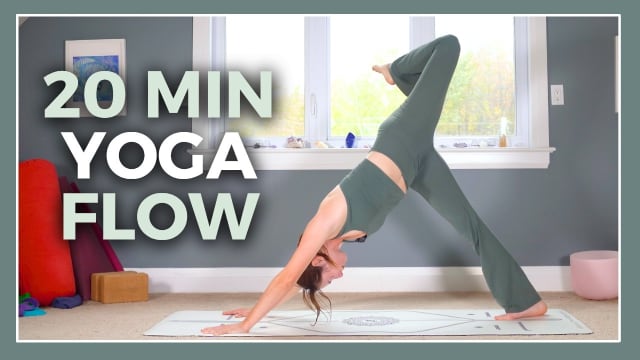
The first words are "Morning everyone," and the flow starts where most stiff mornings do, on hands and knees, palms set under the shoulders and knees under the hips. Over roughly twelve minutes, Kassandra Reinhardt leads a continuous, no-props practice on her Yoga with Kassandra channel, titled "10 min Morning Yoga Flow - Full Body Flexibility Flow." It is built around hip openers, hamstring and chest work, and a run of gentle backbends, and its structure repeats on each side of the body. What looks like a casual stretch is really a compact piece of sequencing, with each pose setting up the next, and a short, deliberate ending that asks you to choose a single word for the day.
Whatisthisten-minutemorningflowdesignedtodo?
Kassandra frames the class around a plain problem. She speaks to people who have "woken up feeling a little bit sore or stiff," and she names the target areas directly: "We are focusing on our hips, our hamstrings, but also trying to open up through our chest and upper back." The channel's description adds that this is "a great routine to do every single day to improve flexibility," suitable for all experience levels, with no props required.
That last point matters more than it sounds. A morning flow that needs a block, a strap, or a bolster asks you to set up before you have even warmed up. Here, everything happens on the mat, with the body's own weight and a few steps forward and back doing the work. The practice is also explicitly continuous. Kassandra describes it as "quite a flowy continuously moving practice," which means the poses are linked by breath and movement rather than held in isolation.
Whystartwithcatandcowbeforeanyrealstretch?
The class opens with a few rounds of cat and cow, and the instruction is precise about what each breath should do. On the inhale you "drop the belly, lift the gaze, tailbone up," and on the exhale you reverse it, "pushing the floor away from you, tailbone down, letting the head drop."
"Getting into all parts of the spine. From your neck down to the upper back, mid back, lower back, all the way to your tailbone. Trying to get that full range of motion."
— Kassandra, in the video at 1:02
This is the logic of spinal warm-up. Instead of asking the back to bend in one big movement, the cat-cow sequence moves the spine segment by segment, from the neck down to the tailbone, so each part gets a turn before the bigger shapes arrive later. The wrists get a caution in the same passage, a reminder to press through fingertips and knuckles and not to lean hard into the joint. It is a small detail, but it sets the tone for a flow where nothing is supposed to be forced.
Howdohipcirclesandgateposeopenthehips?
After the spine, the flow moves to the hips, and this is where the class's signature begins. From tabletop, Kassandra lifts one leg and traces circles with the knee. "Just as big as you can get them to be," she says, and then reverses the direction. The movement is simple, but it takes the hip joint through rotation before any deep stretch is asked of it. Around the 1:33 mark, the right leg begins its circles, and the same pattern returns on the left later in the practice, so both hips receive equal attention.
From the circles, the right foot steps out to the side and the body lifts into gate pose, with one arm reaching up and over into a big side-body stretch. The sequence then returns to center through what Kassandra calls the hovering table. The toes tuck under, the knees lift just off the mat, and the instruction is to find "a flat back here." The hovering table is a transition, but it is also a lesson in control. "A little bit of core engagement," she says, which is the first point in the flow where the abdominal wall does real work rather than simply supporting the stretch.
Whatisthepatternbehindthemirroredsequence?
The most useful thing to understand about this flow is that it is not a random list of poses. It is one loop, performed twice, first on the right side and then on the left. Once you have learned the first cycle, the second cycle is the same map run in reverse. The loop runs like this:
Tabletop cat-cow, then hip circles on one leg
Gate pose with a side bend, returning through the hovering table
Plank, then downward dog with the feet paddled out
Three-legged dog with a knee circle to open the hip
Warrior Two, flowing into extended side angle and a triangle variation
Pigeon pose, folded through the spine
The mirror has a practical benefit. It means a stiff hip on one side is not left to fend for itself, and it means the practice is teachable in short bursts. A beginner who learns the right-side cycle has already learned the left. The repetition also builds a kind of muscle memory for the transitions, the moments where most short flows fall apart.
The middle of the flow is where the standing work and the hip openers meet. Kassandra steps the right foot forward, between the palms, and sets the back foot parallel to the short edge of the mat. The breath then does the choreography: "as you inhale, you're going to straighten that front leg and reach that right arm all the way back. Exhale to your extended side angle, sinking the hips a little bit lower." She repeats this "twice more like this," then holds a last cycle and presses the knee open.
Pigeon is the payoff. The right knee comes behind the right wrist, the left leg extends back, and the flow asks for slow, rhythmic folds. Around 5:57 she sets it up, and the cues are specific. "Coming up onto the fingertips as you inhale, lift and lengthen. And exhale, folding down twice more." Then the stillness: five deep breaths, with the instruction to "soften through your shoulder blades and your arms." It is a deep hip stretch, and the class treats it as the place to slow down rather than to push.
Between these poses, the backbends are quiet but steady. The plank-to-downward-dog transition includes "a back bend as you breathe in," so the flow never stays in one direction for long. The class description calls the whole sequence "hip openers and gentle backbends," and the transitions are where those backbends live.
Whyclosewithaone-wordintentioninsteadofalastpose?
The class ends with a seated pause and a question rather than another stretch. Kassandra asks everyone to sit up tall, roll the shoulders away from the ears, and take ten deep breaths. Then comes the invitation, which appears at 10:16: "I like to invite you to choose a one-word intention for your day." The prompt is open: "what is one word that captures how you want to feel today, what you want to focus on, or what matters to you right now."
"My word for the day is energetic. I'm hoping to get a good boost of energy today."
— Kassandra, in the video, closing remarks near 11:40
Her own word is a useful model because it is so plain. She does not pick a lofty virtue. She names the feeling she wants from the morning. The hands come together at the heart, and the class closes with one chant of "Om," breathed in with the inhale. The ritual takes less than a minute, but it gives the flow a shape: stiff body, moving body, quiet mind, and a single, chosen direction for the day ahead.
Howcanyoupracticethisflowathome?
The flow's most useful feature for home practice is its tolerance for variation. When she asks you to paddle the feet in downward dog, she adds "whatever feels comfortable." In the arms, she says to keep them straight "without necessarily having to lock the elbows. There can be a tiny little micro bend there." In the plank-and-dog transitions, she offers the choice to "stay in this downward dog if you would like, or you can find your flow." These are small permissions, and they make the practice accessible to a range of bodies.
The channel's description carries a standard disclaimer that is worth taking seriously: consult a physician before beginning any exercise program, and participate at your own risk. If you have a wrist, hip, or back condition, the flow's most demanding moments, such as pigeon and the repeated extended side angles, deserve a slower pace or a shorter version.
Wheretogofromhere
If this ten-minute structure appeals to you, the video's description points to more of Kassandra's short classes in a dedicated playlist, along with a free 30-day morning challenge and a free weekly class series. The most valuable next step, though, is simple: take the first cycle of this flow, learn the right-side loop until the hovering table and the pigeon transition feel familiar, and then repeat the whole thing on the left. Let the one-word intention at the end be your own, not hers. Her word, energetic, is a good example of how small the choice can be, and how much it can shape a morning.
Comments
Loading the conversation…
Transcript
[0:00] Morning everyone. Thank you for joining
[0:02] me. This is a short morning flow
[0:04] [snorts]
[0:05] and this really is quite a flowy
[0:08] continuously moving practice. We are
[0:11] focusing on our hips, our hamstrings,
[0:13] but also trying to open up through our
[0:15] chest and upper back. So if you've woken
[0:17] up feeling a little bit sore or stiff,
[0:20] hopefully this will give you a lot of
[0:22] relief and get you feeling really
[0:24] comfortable in your body. No props
[0:26] required. We are going to start table
[0:29] top pose just for a few rounds of cat
[0:31] and cow.
[0:32] So palms go underneath the shoulders.
[0:35] >> [snorts]
[0:36] >> Knees underneath your hips.
[0:38] And starting by targeting the spine here
[0:40] as you inhale, you drop the belly, lift
[0:42] the gaze, tailbone up.
[0:45] And as you exhale, reverse that motion.
[0:47] Almost thinking of pushing the floor
[0:49] away from you, tailbone down, letting
[0:51] the head drop and going in and out of
[0:54] those two poses.
[0:58] >> [sighs]
[1:02] >> Getting into all parts of the spine.
[1:06] From your neck down to the upper back,
[1:08] mid back, lower back, all the way to
[1:11] your tailbone. Trying to get that full
[1:13] range of motion.
[1:17] Pushing into fingertips and knuckles,
[1:19] being careful with our wrists.
[1:22] >> [snorts]
[1:31] >> Let's come back into a neutral table top
[1:33] pose. We're going to lift our right leg
[1:36] up. And just trace some circles with
[1:39] your knee, trying to get some movement
[1:41] through our right hip.
[1:43] So we don't need to overthink this one.
[1:46] Just as big as you can get them to be
[1:48] and let's reverse the direction of the
[1:50] circles.
[1:56] Now we'll step that right foot out to
[1:58] the side, flatten the to the mat. Keep
[2:01] yourself in line, knees and hips, and
[2:03] we'll lift ourselves up coming into our
[2:05] gate pose. Left arm reaches up and over.
[2:09] Big side body stretch here.
[2:14] Coming all the way back through to
[2:16] center from our tabletop stance. We're
[2:19] going to tuck the toes under and just
[2:21] hover the knees a little bit off of the
[2:24] mat. So, a little bit of core
[2:26] engagement.
[2:28] And now go ahead and walk the feet back
[2:30] so you're in your plank pose.
[2:34] Strong.
[2:36] Pressing the floor away from you.
[2:38] Drawing the lower belly in.
[2:41] Broadening through the upper back.
[2:44] And let's find downward facing dog. Lift
[2:46] your hips up and back.
[2:48] >> [snorts]
[2:48] >> And just paddle out the feet.
[2:52] Getting into your ankles and your
[2:53] calves.
[2:56] Keep your arms nice and straight without
[2:58] necessarily having to lock the elbows.
[3:02] There can be a tiny little micro bend
[3:03] there.
[3:05] But I want you to feel the length
[3:07] through the upper body.
[3:09] As you lift the tailbone up. Last breath
[3:12] in here.
[3:14] And let's come back tabletop pose onto
[3:17] hands and knees and we'll find our knee
[3:18] circles the other way. So, left leg this
[3:21] time is going to lift up, around, and
[3:24] down.
[3:32] >> [snorts]
[3:32] >> And you might hear my hip pop a little
[3:34] bit.
[3:35] You can reverse the direction of those
[3:37] circles.
[3:40] Hi Daisy.
[3:43] You're a little in the way.
[3:46] And let's find our gate pose. So, left
[3:48] foot steps out to the side.
[3:51] >> [gasps]
[3:51] >> Lifting yourself up. And you're going to
Kassandra presents this class as a routine to do every single day to improve flexibility, and it is built to be repeated rather than done once. Ten minutes can warm the whole body and build consistency, but how much it changes your range of motion depends on your goals and how often you practice.
The flow opens the hips with standing and tabletop knee circles, gate pose with a side bend, three-legged dog with a knee circle, warrior two into extended side angle, and pigeon pose held for five deep breaths. The sequence is mirrored so both sides get the same attention.
No props are required for this class, and it is described as suitable for all experience levels. Beginners can follow the video's permissions, such as keeping a micro bend in the elbows and paddling the feet only as far as feels comfortable.
In this flow, cat and cow moves the spine segment by segment, from the neck down to the tailbone, so each part warms up before deeper shapes. Kassandra asks for full range of motion through the spine and careful pressure through the wrists.
The hovering table is a transition in this flow where you tuck the toes under and lift the knees a couple of inches off the mat while keeping a flat back. Kassandra describes it as a moment of core engagement that links the floor work to the plank.
Kassandra suggests choosing one word that captures how you want to feel today, what you want to focus on, or what matters to you right now. Her own word for the day was energetic, which she chose because she hoped for a boost of energy.