
The Minnesota Ground
Robert Elwood Bly was born in 1926 in Madison, Minnesota, a small farming town whose landscape—snow-covered fields, sparse trees, vast silences—would become the emotional and imagistic bedrock of his poetry. The rural Midwest wasn't merely a setting for Bly; it was a spiritual condition, a place where solitude opened into vision and the natural world spoke in the language of the unconscious.
Bly's path to poetry was circuitous. He attended Harvard University, served in the Navy during World War II, and spent years in New York before returning to Minnesota. But it was during a transformative period abroad—living in Norway in the 1950s on a Fulbright fellowship—that he encountered the poets who would reshape his understanding of what verse could do. Reading the Spanish surrealists and Scandinavian modernists, Bly discovered poetry that worked through image and intuition rather than linear thought, that trusted leaps of consciousness over rational development.
The Deep Image and the Inner Life
When Bly returned to the United States, he brought with him a mission: to challenge the dominant modes of American poetry, particularly the confessional strain that focused on personal trauma and domestic detail. Along with poets like James Wright and Donald Hall, Bly helped establish what became known as the Deep Image movement—a poetics that sought to access myth, symbol, and the unconscious mind through startling juxtapositions and archetypal resonance.
His 1962 debut, Silence in the Snowy Fields, exemplified this approach. The poems were quiet, meditative, rooted in the Minnesota landscape but reaching toward something beyond description—a spiritual presence in the everyday. Lines moved by association rather than argument, image rather than explanation. The collection established Bly as a distinctive voice in American letters, someone who could make the ordinary luminous through attention and restraint.
But Bly was never content to remain purely inward. His 1967 collection The Light Around the Body turned the Deep Image method toward political engagement, particularly the Vietnam War and domestic inequality. The poems retained their surreal leaps and symbolic density while addressing contemporary violence and injustice. When the book won the National Book Award for Poetry in 1968, Bly famously donated the prize money to the draft resistance movement—a gesture that aligned his literary practice with his political convictions.
The Translator's Art
Alongside his own poetry, Bly's work as a translator proved equally influential. He introduced English-language readers to Pablo Neruda, Rainer Maria Rilke, Tomas Tranströmer, Antonio Machado, and the medieval Indian poet Kabir, among many others. These weren't academic translations; they were acts of poetic communion. Bly approached translation as a creative practice, seeking to capture not just meaning but the emotional and spiritual tenor of the original.
His translations of Spanish and Scandinavian poets revealed his own aesthetic lineage. The leaping imagery, the trust in metaphor over statement, the political urgency tempered by mystical awareness—all these qualities that marked Bly's verse could be traced to the poets he championed. Through his literary magazine The Fifties (later The Sixties and The Seventies), and through his translation projects, Bly functioned as a cultural intermediary, expanding the boundaries of what American poetry could be.
Iron John and the Men's Movement
In 1990, Bly published Iron John: A Book About Men, a work that brought him fame—and controversy—far beyond the poetry world. Drawing on Jungian psychology and the Brothers Grimm fairy tale "Iron Hans," Bly explored masculinity, initiation, and male psychology. The book became a surprising bestseller, selling hundreds of thousands of copies and making Bly the unofficial face of the mythopoetic men's movement.
Iron John argued that contemporary men lacked meaningful initiation rituals and had become disconnected from both mature masculinity and deep feeling. Bly led retreats where men gathered in the woods to tell stories, drum, and explore emotional life through myth and poetry. The movement attracted both devoted followers and fierce critics, who saw it as everything from essential consciousness-raising to regressive nostalgia.
Whatever one's view, Iron John demonstrated Bly's willingness to follow his interests beyond the conventional boundaries of literary culture. He brought the same tools he'd applied to poetry—attention to symbol, trust in story, insistence on the inner life—to questions of gender and psychology.
The Later Work
Bly continued writing poetry well into his later years. Collections like The Night Abraham Called to the Stars (2001) showed an aging poet still capable of surprise, still willing to leap between the personal and the mythic, the political and the numinous. His earlier collection Sleepers Joining Hands (1973) had explored similar territory, weaving together long-form meditation and lyric fragment.
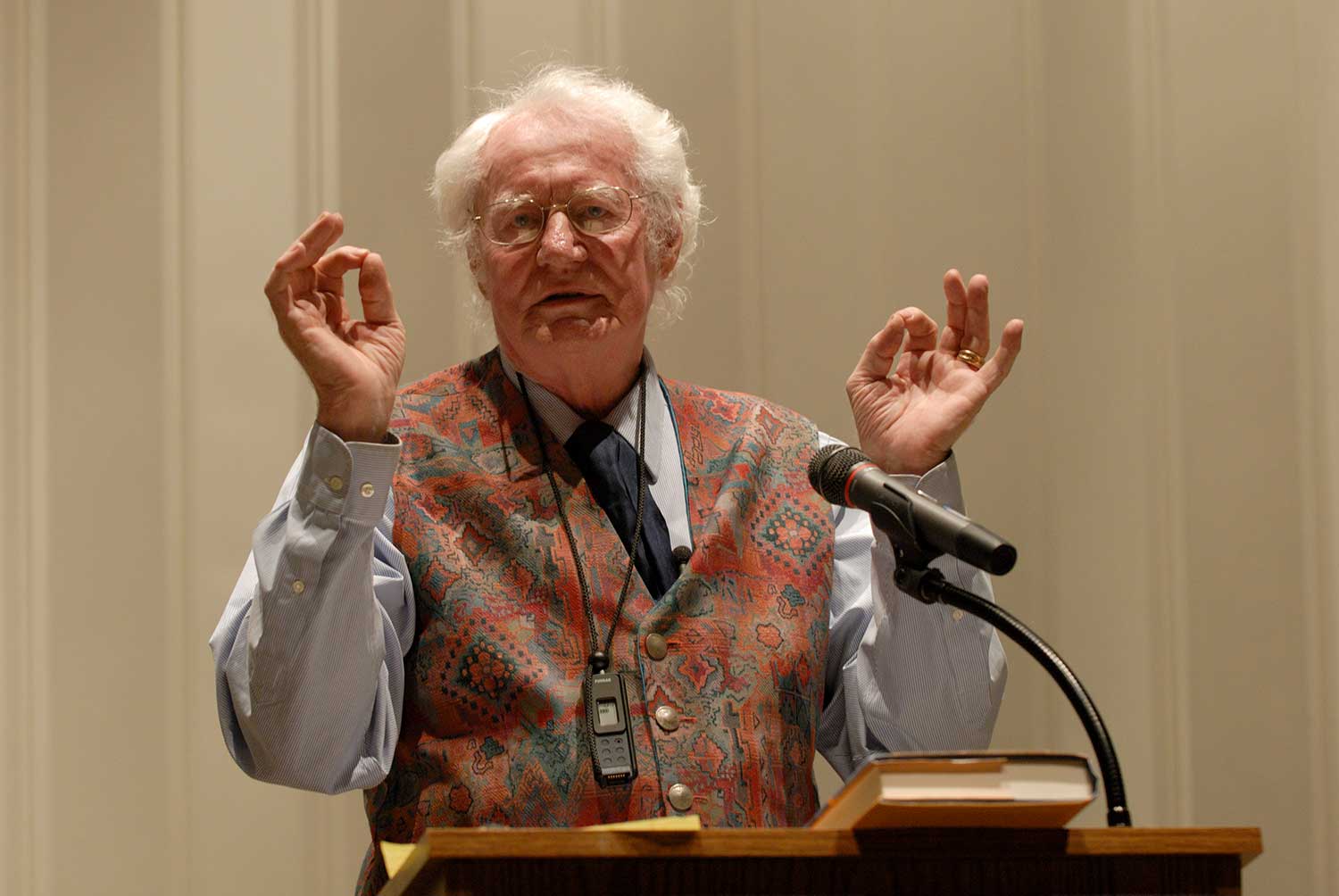
Throughout his career, Bly refused easy categorization. He was a political poet who wrote about inner life, a champion of the irrational who engaged social justice, a translator who shaped his own voice through encounters with foreign traditions. He performed his poems with theatrical flair, using storytelling and sometimes music to create events rather than mere readings.
A Contested Legacy
Robert Bly died in 2021, leaving behind a body of work that continues to provoke debate and admiration. His poetry expanded American verse's tonal and imagistic range, introducing methods borrowed from European and world traditions. His translations remain vital conduits to poets who might otherwise languish in obscurity. And his willingness to address masculinity and male psychology—however controversial his particular answers—opened conversations that continue today.
Bly mattered because he insisted poetry could address both the personal and the political, the inward and the engaged. He showed that attention to image and symbol wasn't escapism but a way of seeing more clearly. His Minnesota fields contained multitudes, and his leaping lines traced paths between solitude and solidarity, silence and speech.