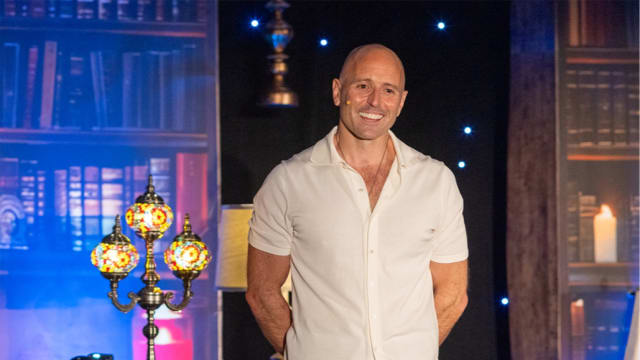

"I Am Enough" arrived on November 28, 2025, as a single with one track. It is a small release in a large body of work. Lee Harris has been writing and producing music since 1998, and he is also a channeler, author, teacher and mentor. His monthly Energy Update videos reach hundreds of thousands of people, and his channeled books Energy Speaks, Conversations with the Z's and The Future Human are Amazon best-sellers.
This single belongs to the mantra-and-affirmation strand of his catalog, the line that runs through the Medicine Mantras series. It came out in the same stretch of late 2025 as Mantramorphs (September 2025) and Rising in Love: Medicine Mantras 3 (December 2025). Think of it as a focused tool in a toolbox that already holds longer albums.
Harris's recordings are vocal-forward. His voice is the primary melodic instrument, and it carries warmth and presence rather than ethereal distance. The arrangements around it are spare: guitar, subtle synth textures and occasional percussion, all placed so they support the voice without crowding it. The pacing is slow and contemplative, and the music avoids sudden dynamic shifts or crescendos that would pull a listener out of an inward state.
The mood is steady and reassuring. The title is the mantra, a single statement of self-worth. The structure follows the Harris template: one affirmation, repeated and varied, with the music acting as a container for the words. I can't offer a verse-by-verse account of the lyrics or the exact running time, so treat what follows as a description of approach rather than a transcript.
"I Am Enough" is the only track, so the single is the signature piece. What makes it land is the directness of its premise. Many affirmation songs stack several ideas together. This one commits to a single sentence and lets repetition do the work, which is the logic of mantra practice. A listener doesn't need to analyze it. The phrase is meant to be absorbed, felt in the body and returned to.
It is also named in Harris's own materials among the Medicine Mantras-style songs suited to self-love work, alongside titles like "I Call Back My Power" and "I Awaken My Heart to Love." That placement tells you how it is meant to be used: as a practice, not as a showpiece.
Harris's work sits outside traditional lineage structures. There are no Sanskrit chants, no guru-initiated mantras and no claimed descent from a particular school. So this is not bhakti or kirtan in the strict sense. It borrows the function of mantra, repeated sound that shapes inner states, but expresses it in plain English and in a contemporary voice.
Its real home is modern sound healing and the Western wellness world, where meditation, energy work and affirmation have merged. It is closer to devotional-minded affirmation music than to ambient. Unlike much New Age ambient production, it keeps a grounded, human voice at the center instead of dissolving into texture.
This single will resonate most with sensitive, intuitive listeners, the people Harris's work is built for, who are already comfortable with the vocabulary of energy and intention. It suits someone going through a stretch of self-doubt, a creative or professional transition, or a period of rebuilding after burnout, when the message "I am enough" is a need and not a slogan.
It is less likely to suit listeners who want instrumental virtuosity, avant-garde composition or confrontational spiritual work. The repetition and affirmation-based approach can feel saccharine or undersaturated to people conditioned by pop production, and anyone skeptical of New Age framing may find it a stretch.
Give it your full attention at least once. Listen alone, ideally in the evening, with headphones so the voice sits close and the spare arrangement reveals its details. Sit or lie down comfortably, and consider speaking the phrase quietly along with the track, or silently on each exhale.
Because the single is short and built on repetition, it works well on loop. Play it two or three times in a row and notice how your response shifts as the phrase stops being a sentence and becomes a sensation. It can also serve as an opening or closing ritual, whether before journaling, at the start of a yoga or somatic session, or as the last thing you hear before sleep.
If it resonates, the next step is the Medicine Mantras series, especially Rising in Love: Medicine Mantras 3, which offers more short, intention-focused pieces in the same spirit.