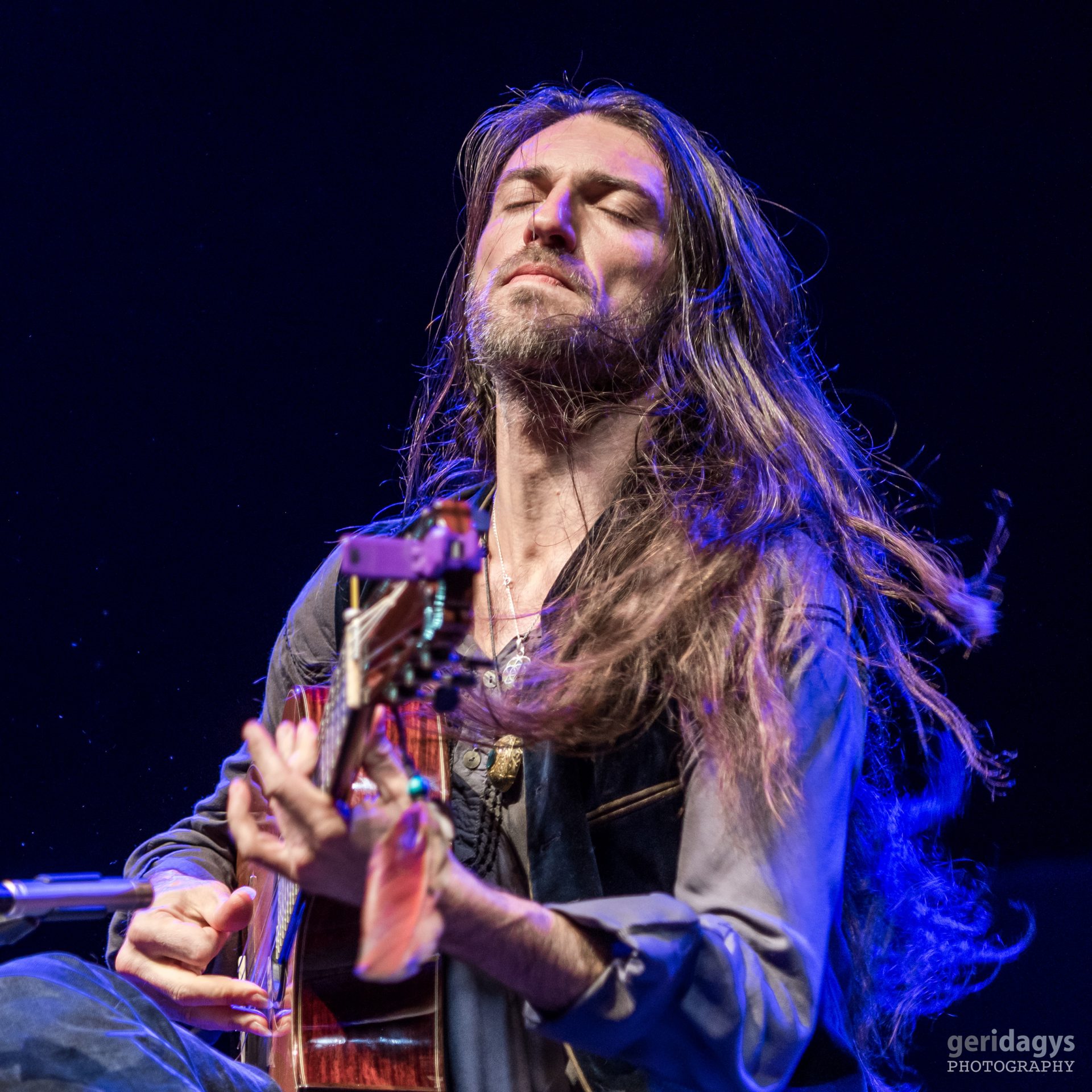

Estas Tonne occupies a peculiar space in contemporary music—neither fully of the concert hall nor the commercial mainstream, yet reaching hundreds of millions through a screen. He is a self-described "spiritual guitarist" whose performances blur the line between recital and ritual, drawing from flamenco, Armenian folk, and Romani traditions while serving something harder to categorize: the pursuit of transcendence through sound.
His most widely known piece, "The Song of the Golden Dragon," has accumulated over half a billion views online, a staggering number for an instrumental guitarist working outside conventional music industry structures. But raw statistics only tell part of the story. Tonne's work exists in a liminal zone where technique meets trance, where virtuosity is deployed not for display but for dissolution—of thought, of boundary, of the ordinary experience of listening.
Tonne's journey was marked early by an unexpected constraint: a hearing defect in one ear that prevents him from perceiving musical notes in the conventional manner. This condition closed the door to formal conservatory training, the traditional path for a classical guitarist of ambition. What might have been a career-ending limitation instead became a defining characteristic of his approach. Unable to rely on perfect pitch or standard musical training, Tonne developed an intensely personal relationship with the guitar, one rooted more in feeling and intuition than in academic rigor.
This physical condition may explain, in part, his deep investment in improvisation. When you cannot trust your ears in the way most musicians do, you must trust something else—instinct, the response of an audience, the energy in a room. Tonne's music became less about replicating established forms and more about channeling something immediate and unrepeatable.
The pivotal shift in Tonne's work came in 2012, during what he describes as extensive travels "all over the planet." It was during this period of movement—performing in streets, festivals, yoga retreats, and intimate gatherings—that he felt what he calls "the call to 'stretch' and extend already existing songs." He began allowing improvisations to unfold over extended durations, sometimes lasting five hours.
These marathon sessions occurred in wildly varied contexts: meditation festivals, yoga retreats, street festivals, formal concerts, mental health institutions, elderly care homes, house gatherings, and large parties. The consistency wasn't the venue—it was the intention. Tonne describes witnessing "an incredible magic" in these performances, a transformation he characterizes as "thought into eternal smiling silence."
This was the crucible in which his current practice was forged. He ceased to be simply a guitarist and became something more difficult to name: a facilitator of experience, a sound healer, a guide through sonic landscapes designed not for passive listening but for what he calls a "flying experience."
What Tonne offers is not entertainment in the conventional sense. His performances function as immersive sound environments, designed to create space for meditation, introspection, and what he describes as transformation. He speaks of "holding the space" for those present, maintaining an energetic consistency that allows listeners to move beyond ordinary consciousness.
"I still have no idea what I do during these sessions," he has written, with a candidness unusual for performing artists. "It seems indeed, just holding a guitar, as it becomes much more than music—and it's not about the music—and surely it's not about me—but all that is involved in the process—either visible or invisible."
This approach places Tonne firmly in a lineage that includes devotional musicians, trance-inducing performers, and sound healers who use music as technology for altered states. His fusion of gypsy, Armenian folk, and flamenco fingerpicking provides the technical foundation, but the structure is ultimately in service of something experiential rather than compositional.
With over 6,000 followers on Spotify—modest by commercial standards—Tonne's true reach exists elsewhere. His YouTube videos have found audiences in the millions, his street performances captured and shared across platforms, introducing his work to people who might never attend a yoga retreat or meditation festival.
This digital presence has created an interesting paradox. Tonne emphasizes that recordings can never replicate the live experience, that "it is never the same as it could be experienced Live!" Yet it is precisely through recordings that most people encounter his work. The screen becomes a portal to something designed to transcend mediation—a contradiction he navigates by treating even recorded sessions as attempts to preserve "the original energy."
Tonne matters because he represents an alternative model for what a musician can be in the 21st century. He exists outside record label infrastructure, beyond genre boundaries, serving communities—yoga practitioners, meditation seekers, festival-goers, spiritual explorers—who value music for its capacity to facilitate inner experience rather than external achievement.
As a yoga teacher and meditation musician, he embodies the integration of Eastern contemplative practices with Western instrumental virtuosity. His work speaks to audiences seeking authenticity, transformation, and music that serves purposes beyond entertainment. In an era of algorithmic playlists and three-minute singles, Tonne offers five-hour improvisations. In a landscape of careful branding, he admits to not knowing what he does.
That honesty, combined with undeniable technical skill and a commitment to service over spectacle, has carved out a unique space. Estas Tonne is not famous in the traditional sense, but he is influential in circles that value presence over performance, being over doing. His legacy is still unfolding in real-time sessions across the globe—wherever people gather seeking transformation through sound.