What's Happening
Coming Up
Listening Journey
Sound Journey
Discography
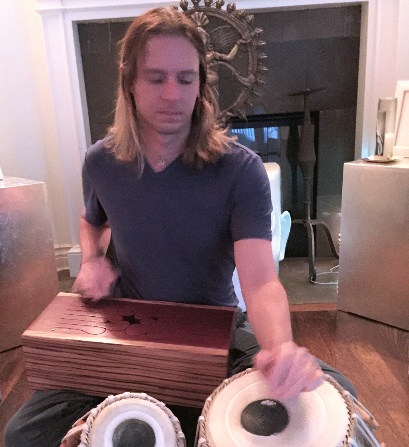

Tabla Musician
Arjun Bruggeman was born into a family deeply rooted in the rich traditions of Indian classical music. Growing up in a multicultural environment, he was exposed to various musical styles from an early age. His fascination with rhythm and percussion led him to the study of tabla, a traditional Indian drum, which he began learning as a child. Under the guidance of esteemed teachers, he honed his skills and developed a profound connection to the instrument, which became a central part of his identity. This early immersion in music laid the foundation for his lifelong journey as a musician and educator.
As a teacher and performer, Arjun Bruggeman has dedicated himself to sharing the beauty and intricacies of tabla and percussion with a diverse audience. He has conducted numerous workshops and masterclasses, focusing on both the technical aspects of playing and the cultural significance of the music. His discography includes collaborations with various artists across genres, showcasing his versatility and ability to blend traditional Indian rhythms with contemporary styles. Through his work, he aims to inspire a new generation of musicians and foster a deeper appreciation for the art of percussion.
Arjun's musical lineage is deeply intertwined with the traditions of Indian classical music. He has studied under renowned tabla maestros, absorbing their teachings and philosophies. His influences extend beyond the tabla, drawing inspiration from various percussion styles around the world. This rich tapestry of influences informs his unique approach to music, allowing him to create a sound that is both authentic and innovative. His commitment to preserving the traditional aspects of tabla while exploring new musical territories makes him a vital figure in the contemporary music scene.
Today, Arjun Bruggeman stands out as an important voice in the world of tabla and percussion. His dedication to teaching and performing not only keeps the tradition alive but also makes it accessible to a broader audience. In an era where cultural exchange is more vital than ever, his work bridges gaps between different musical traditions, fostering understanding and collaboration. Arjun's contributions to music and education continue to resonate, making him a significant figure in the ongoing evolution of percussion music.
What's Happening
Listening Journey
Discography
Worth Knowing
Arjun Bruggeman is a tabla and percussion maestro who has positioned himself as a bridge between the classical Indian rhythmic tradition and contemporary global music practice. Born into a family steeped in Indian classical music, he began tabla study as a child under esteemed teachers, developing the kind of foundational rigor that marks serious practitioners in the lineage. What distinguishes his profile is not just technical mastery of the tabla—the traditional Indian drum central to Hindustani and Carnatic music—but his willingness to collaborate across genres and his commitment to demystifying percussion for audiences outside the classical Indian music world. As both a performer and educator, he has conducted numerous workshops and masterclasses that emphasize both the technical mechanics of playing and the deeper cultural significance embedded in the instrument itself. His albums—including Arjun (2016), Dreaming Spirits (2017), and Otherworld (2019)—document an artist actively exploring how traditional Indian rhythms can coexist with contemporary production and instrumentation. People who follow his work tend to be musicians seeking authenticity without dogmatism, educators interested in cross-cultural music pedagogy, and listeners curious about how percussion functions in non-Western musical systems.
Arjun Bruggeman's lineage is rooted in Indian classical music—specifically, the rhythmic and percussive traditions of the tabla, which occupies a foundational role in both Hindustani (North Indian) and Carnatic (South Indian) classical systems. He studied under renowned tabla maestros whose names and specific teaching lineages are preserved within his family background, though the public record emphasizes the depth and rigor of this transmission rather than any single guru-shishya relationship. His work honors the traditional aspects of tabla technique—the complex finger patterns (bols), compositional forms (bandishes), and rhythmic cycles (taals) that have evolved over centuries—while consciously refusing to treat the instrument as a museum piece frozen in time. Rather than positioning himself as a purist guardian of an unchanging canon, Bruggeman's approach acknowledges that Indian classical music itself has always adapted to new contexts and collaborators; his recordings with artists across genres reflect this philosophy of cultural exchange rather than cultural isolation. The tabla's role as the primary rhythmic voice in Indian classical music means mastery of it requires understanding not just percussion technique but harmonic relationships, melodic phrasing, and the mathematical structures underlying raga and tala systems. His commitment to both preservation and innovation places him within a lineage of modern tabla practitioners who see traditional Indian rhythms not as artifacts but as living, evolving practices.
For listeners unfamiliar with tabla or Indian classical percussion, Arjun (2016) serves as the most direct entry point—a six-track album that introduces his approach without the extended compositional forms that can require patience from ears accustomed to Western song structures. The album functions almost like a primer, showcasing the tabla in conversation with other instruments and production choices that contemporary listeners will recognize, while still maintaining the integrity of the rhythmic and melodic traditions underlying each piece. From there, Dreaming Spirits (2017) expands the sonic palette across fourteen tracks, allowing newcomers to hear how Bruggeman develops ideas over longer forms and integrates percussion within more complex arrangements that blur genre boundaries. Otherworld (2019) represents his most adventurous recorded work to date, pushing the tabla into unexpected textural and harmonic territory while preserving the technical precision and cultural grounding that define his voice. A practical approach is to begin with Arjun on headphones, paying particular attention to how the tabla's rhythmic patterns evolve—notice the relationship between the hand technique (which produces different tones and volumes) and the underlying mathematical cycles that structure Indian classical music. If that album resonates, move to Dreaming Spirits to understand how he sustains longer musical conversations; Otherworld then reveals how far those conversations can extend without losing their roots.
The tabla itself—a pair of hand drums consisting of a larger bass drum (bayan) and a smaller treble drum (dayan)—produces a range of tones from deep, resonant bass to sharp, articulate treble pitches, and Bruggeman's technique draws out these tonal colors with precision while maintaining the rhythmic cycles that are fundamental to Indian classical music. Across his albums, the tabla rarely appears in isolation; instead, it sits within ensemble contexts where other instruments—strings, winds, keyboards, and contemporary production elements—create textural landscapes that ground rather than overwhelm the percussion voice. The pacing of his recordings tends toward restraint: pieces unfold gradually, with rhythmic patterns establishing themselves over time rather than announcing themselves immediately, which rewards attentive listening but may feel slow to ears accustomed to four-on-the-floor electronic music or quick harmonic changes in Western popular music. Production-wise, his albums avoid the reverb-heavy, overly mystical sonics that sometimes plague Western-produced Indian music; instead, the sound is relatively dry and present, allowing individual instruments to be heard with clarity and the relationships between them to emerge naturally. Melodies, when they appear, tend to move in ways that reflect raga phrasing rather than Western diatonic scales, and the harmonic language sometimes incorporates ambiguity or modal stasis rather than functional chord progressions. Vocalists, when present, typically carry Sanskrit-derived text or phonetic syllables that reflect the oral transmission traditions of Indian classical music rather than English-language lyrics. The overall aesthetic is one of structured exploration: the frameworks of classical Indian rhythm and melody are always present, but within them, Bruggeman pursues contemporary sonic possibilities.
Arjun (2016) is the foundational statement—six tracks that establish his sonic vocabulary and prove that tabla-centered music can coexist with production choices and ensemble arrangements that feel neither dated nor culturally diluted. This album functions as a declaration of principle: traditional Indian percussion technique married to contemporary listening contexts, without either element compromising the other. Dreaming Spirits (2017) doubles the track count to fourteen and widens the compositional ambitions, suggesting that Bruggeman was gaining confidence in longer forms and more complex textural development; listeners noting strong responses to Arjun often find this album rewards repeated listening because the individual pieces begin to build thematic and rhythmic conversations across the collection. Otherworld (2019) represents a significant leap in experimental confidence—the tabla continues to appear, but the surrounding sonic environment becomes more abstract, more willing to stretch harmonic expectations, and more engaged with contemporary production techniques that earlier albums approached more cautiously. The progression from album to album charts an artist becoming increasingly secure in his identity; rather than retreating into pure classicism or abandoning the tradition entirely, Bruggeman deepens both aspects simultaneously. Together, the three albums create a document of evolution without rupture: each builds on the previous work's discoveries rather than abandoning them for new directions. For collectors interested in the full arc of his recorded thought, the three-album sequence tells a coherent story about how traditional Indian rhythm can live and grow within contemporary musical contexts.
Listeners seeking high-energy, beat-driven music will likely find Bruggeman's recordings frustrating; his approach emphasizes rhythmic subtlety and compositional patience over the kind of percussive propulsion that powers electronic dance music, funk, or other genres organized around kinetic momentum. Those approaching Indian music primarily as exotic texture or spiritual wallpaper may find his insistence on technical clarity and structural precision alienating—he offers engagement with actual musical systems rather than vague atmospherics. Musicians or listeners invested in the idea that classical Indian music should remain frozen in its pre-colonial, pre-British forms may struggle with his cross-genre collaborations and willingness to integrate contemporary production; his work assumes that tradition is alive precisely because it can adapt. Anyone seeking comprehensive liner notes and detailed discographical information will be disappointed—the available documentation online is relatively sparse, with most substantive information concentrated on his teaching and workshop offerings. Audiences expecting his albums to function as meditation soundtracks or passive background music should know that his compositions demand attention; the rhythmic patterns and textural developments require engagement to fully register. Finally, people drawn to tabla music primarily for the display of virtuosic finger technique and rapid-fire rhythmic improvisation may find the more ensemble-oriented, textural approach of his recordings less immediately impressive than some solo tabla performances by other artists. Bruggeman's work is for listeners willing to sit with complexity, patience, and cultural specificity—not everyone's appetite.
Rather than separating technical instruction from cultural context, Bruggeman's workshop and masterclass approach integrates the two; students learning tabla technique from him simultaneously engage with the history, philosophy, and cultural significance of the instrument, which distinguishes his pedagogy from purely mechanical skills training. His teaching emphasizes that technique—the specific hand positions, finger movements, and striking patterns that produce different sounds on the tabla—only makes sense within the larger framework of Indian classical music's rhythmic structures, particularly the taal (rhythmic cycle) and the relationships between percussion and melody that define ensemble practice. What students report about his sessions is a balance between precision and permission; he maintains high technical standards while creating space for students to explore how the traditions they're learning might extend into their own musical contexts and interests. His workshops tend to move from fundamental technique (how to hold the drum, how to produce clean tones from different striking positions) toward increasingly complex compositional and improvisational frameworks, assuming that embodied understanding develops through structured progression rather than inspiration alone. The cultural significance of music—what makes these rhythmic patterns and tonal relationships matter beyond the purely technical—appears throughout his teaching as the connective tissue between drill work and deeper musical understanding. He operates from an assumption that someone learning tabla is not merely acquiring a skill but entering a lineage and a way of understanding rhythm, melody, and musical time that differs from Western classical or popular music conventions. His dedication to both preservation and accessibility means his teaching attempts to honor the rigorous traditions from which he learned while making those traditions legible and meaningful to students from diverse cultural backgrounds.
The primary repository for Arjun Bruggeman's publicly available educational content appears to be through his association with Mantralogy (his website listing at mantralogy.com/offerings/arjun-bruggeman/), which suggests his teaching offerings may be accessed through that platform's channels, though the specific format of recordings or courses is not detailed in widely available sources. His YouTube presence (under the mantralogy account) likely contains workshop footage, performance documentation, or instructional segments, though a comprehensive archive of independent lectures or talks has not been extensively publicized through mainstream music platforms. The emphasis in publicly available information about his work centers on direct, in-person teaching—workshops and masterclasses—rather than recorded lecture content, which may reflect both his approach to pedagogy (privileging embodied, real-time instruction in percussion and rhythm) and the practical challenges of documenting tabla technique clearly for distance learners. For those seeking Bruggeman's voice on the cultural significance and practice of tabla outside of direct workshop attendance, his three recorded albums may be the most accessible documents of his musical thinking, as the choices he makes about instrumentation, arrangement, and composition communicate his philosophy even without explicit verbal exposition. Interested students or researchers seeking more extensive educational material from him should investigate direct workshop attendance or contact through his Mantralogy affiliation, as the public recording archive appears limited compared to his active teaching practice.
While Bruggeman's primary instrument is tabla and percussion, his recorded work features ensemble contexts where the percussion voice coexists with strings, winds, keyboards, and contemporary production elements, suggesting collaborations across instrumental families rather than tabla-only projects. The specific names of collaborators are not extensively documented in the available public record, though the discography itself (particularly Dreaming Spirits and Otherworld) suggests working relationships with multi-instrumentalists, producers, and musicians capable of integrating Indian classical rhythmic frameworks with contemporary compositional sensibilities. His versatility across percussion instruments—tabla is his primary focus, but his expertise encompasses broader percussion study—suggests willingness to work with musicians who understand rhythm across multiple cultural traditions, not just the Indian classical system. The production choices across his three albums indicate either self-production or collaboration with producers sympathetic to a sonic aesthetic that avoids heavy reverb, excessive mysticism, or the kind of slick fusion production that can flatten cultural specificity. The absence of extensive feature collaborations or prominent guest artist credits on the albums suggests Bruggeman may construct these projects somewhat independently or with close collaborators whose names don't appear prominently in marketing, which reflects a philosophy of ensemble unity over star billing. What listeners can infer from the albums themselves is that his collaborators—whoever they may be—understand the tabla not as an exotic percussion addition to Western instrumental configurations, but as a voice with its own harmonic and rhythmic logic that must be heard and accommodated seriously within the mix.
All three of Arjun Bruggeman's albums (Arjun, Dreaming Spirits, and Otherworld) are available on Spotify, where they can be streamed at no cost with a Spotify account, making them the most accessible entry point for listeners curious about his work. His Spotify artist profile (spotify.com/artist/2nIOY5jfkuhF4f6aYiQrjP) displays all released material and provides the pathway to his full discography. Beyond Spotify, the albums should be available through standard digital music retailers and streaming services, though Apple Music, Bandcamp, or other platforms are not explicitly documented in readily available sources—checking directly on those services or through his Mantralogy website affiliation may reveal additional purchase or streaming options. Physical copies (CD or vinyl) are not confirmed in available documentation, though fans interested in physical formats should contact him directly through Mantralogy or inquire via his YouTube channel (youtube.com/user/mantralogy), where he may maintain additional information about formats and ordering. His website listing on Mantralogy (mantralogy.com/offerings/arjun-bruggeman/) may also provide direct links to purchase or stream his work, particularly if he offers materials through that platform. Given his relatively modest Spotify following (392 followers), his work operates somewhat outside mainstream discovery algorithms, which means intentional seeking is required; using direct artist searches or genre-specific playlists focused on Indian classical music, world percussion, or spiritual/meditative music may surface his albums more readily than algorithmic recommendations.
Discover More
Continue your journey
BrightStar is the global directory of artists, teachers, and healers in the wellness and spiritual movement. Find your next experience — or add yourself.
Browse 14,000+ curated profiles across kirtan, yoga, meditation, and beyond.
Explore directory →Kirtan, retreats, sound baths, breathwork, ceremonies — happening this week.
Browse events →Are you an artist, teacher, or healer? Get listed — free, AI-assisted, live in minutes.
Get started →


