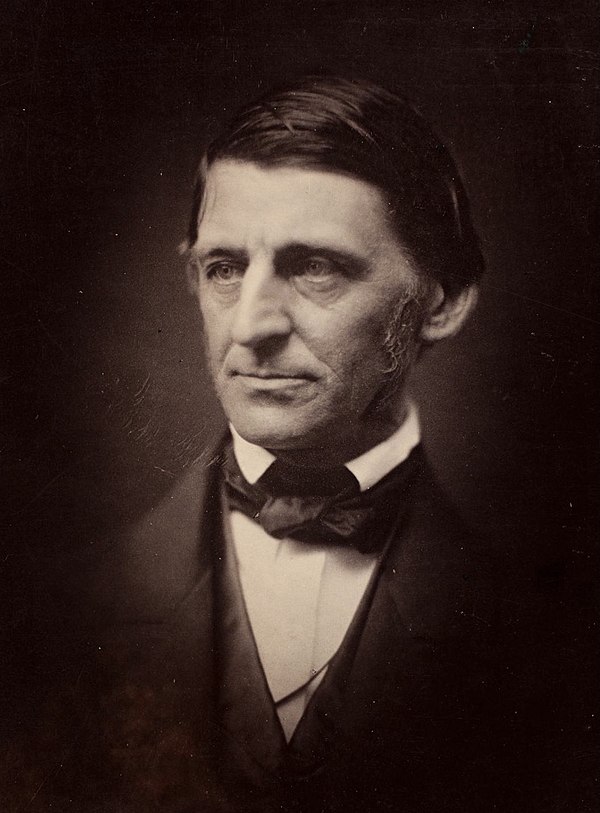
The Weight of Thought: Emerson's Call to Directness
Ralph Waldo Emerson's poignant inquiry, "What help from these fineness or pedantries? What help from thought?" invites us to reflect on the utility of intellectual refinement and abstract contemplation in our lives. In a world often enamored with complexity and nuance, Emerson challenges us to consider whether such intricacies truly serve our deeper needs. This question resonates profoundly in an age where distractions abound, urging us to seek clarity and directness in our thoughts and actions.
Emerson's words compel us to examine the essence of our pursuits and the value we place on intellectualism. Are we, in our quest for knowledge and understanding, losing sight of the fundamental truths that guide our existence? By questioning the efficacy of "fineness" and "pedantries," he beckons us to strip away the layers of unnecessary complexity and return to a more authentic, straightforward way of being. This exploration is not merely philosophical; it is a call to action, inviting us to engage with life more directly and meaningfully.
The image / the metaphor
In this quote, Emerson employs vivid imagery to convey a sense of urgency and clarity. The terms "fineness" and "pedantries" evoke a world of intricate details and trivialities that can obscure our understanding. By juxtaposing these concepts with the question of their utility, he emphasizes a stark contrast between the convoluted nature of excessive thought and the straightforwardness of genuine experience. The verbs "help" and "thought" further highlight a tension: while thought can be a tool for understanding, it can also become a hindrance when it veers into the realm of the overly complex.
Delving deeper into the metaphor, we can see that Emerson is not merely critiquing intellectualism; he is advocating for a more profound engagement with life itself. The "fineness" he mentions can represent the delicate intricacies of human thought, while "pedantries" may signify the trivial pursuits that distract us from our true purpose. In this light, Emerson's inquiry becomes a clarion call to prioritize direct experience over abstract theorizing, urging us to seek wisdom in the simplicity of being rather than the convolutions of thought.
In the speaker's tradition
Emerson's philosophy is deeply rooted in the tradition of transcendentalism, which emphasizes the inherent goodness of people and nature, as well as the importance of individual intuition. This perspective aligns with concepts such as dharma, which calls for living in accordance with one's true nature, and prajna, the wisdom that arises from direct experience rather than intellectual abstraction. Emerson's challenge to the value of thought resonates with the transcendentalist belief that true understanding comes from a connection to the self and the world, rather than from the confines of scholarly pursuits.
In his essay "Nature," Emerson articulates the idea that the natural world serves as a mirror for our own inner truths. He writes, "In the presence of nature, a wild delight runs through the man, in spite of real sorrows." This sentiment echoes the essence of his quote, suggesting that it is through direct engagement with our surroundings and experiences that we can find clarity and meaning. By situating his inquiry within the broader context of transcendentalism, we see that Emerson is not dismissing thought altogether; rather, he is advocating for a balance between intellectual pursuits and the richness of direct experience.
Living the teaching
Consider a modern scenario where this teaching resonates: a professional caught in the web of endless meetings and strategic planning. In striving for success, they may find themselves entangled in a cycle of overthinking, where the nuances of every decision become paralyzing. Emerson's call to question the utility of such thought encourages this individual to step back and assess what truly matters. By simplifying their approach and focusing on direct action, they can reclaim their sense of purpose and clarity, allowing for more authentic engagement with their work and colleagues.
This teaching can also be applied within personal relationships, particularly during moments of conflict. Often, we become ensnared in the complexities of our emotions and the intricacies of communication, leading to misunderstandings and distance. Emerson's insight prompts us to seek directness in our interactions, encouraging open and honest dialogue that transcends the pedantries of miscommunication. By prioritizing clarity and authenticity, we can foster deeper connections and navigate challenges with greater ease.
A reflection
As we contemplate Emerson's inquiry, we are invited to reflect on the nature of our own thoughts and the ways they shape our experiences. Are we allowing the fineness of our intellect to obscure the simplicity of our truths? In what areas of our lives can we embrace a more direct approach, shedding the unnecessary complexities that hinder our growth? This contemplation invites us to engage with our lives more fully, seeking clarity and authenticity in every moment.


