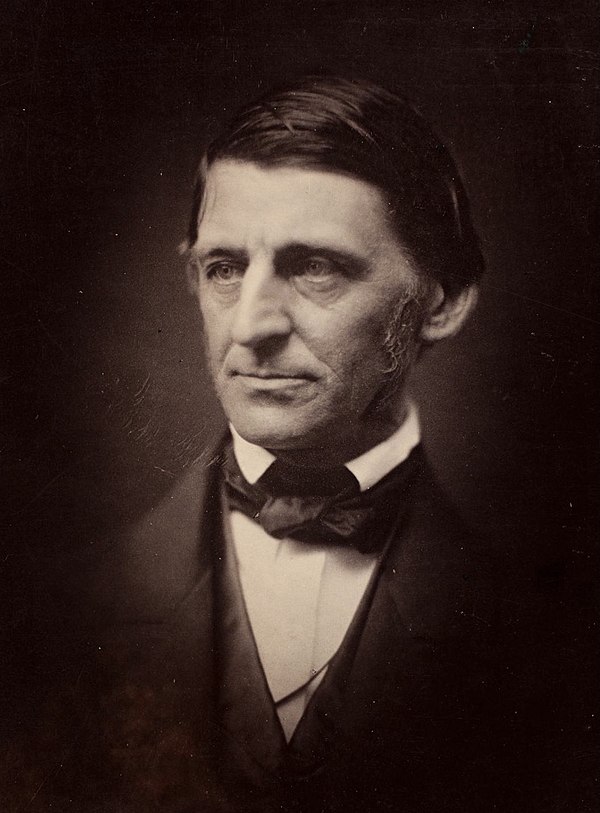
Ralph Waldo Emerson's assertion that "There is a property in the horizon which no man has but he whose eye can integrate all the parts" invites us to explore the profound relationship between perception and understanding. In essence, Emerson suggests that true insight is not merely about seeing the individual elements of our experience but about synthesizing them into a cohesive whole. This perspective is vital in a world often fragmented by distractions and superficiality, where the ability to perceive the interconnectedness of all things becomes a rare and valuable skill.
As we delve deeper into Emerson's words, we recognize that this integration of vision is not just a passive observation but an active engagement with the world around us. It challenges us to cultivate a holistic awareness that transcends the mere accumulation of knowledge. This call to integrate our perceptions resonates with the core tenets of transcendentalism, where the individual is encouraged to seek a deeper understanding of nature and self, ultimately leading to a more profound connection with the universe.
The image / the metaphor
The imagery of the horizon in Emerson's quote evokes a sense of vastness and potential. The horizon represents not only the physical boundary where earth meets sky but also the metaphorical limits of our understanding. The verb "integrate" suggests a dynamic process, one that requires effort and intention. To truly possess the "property" of the horizon implies a mastery over one's perception, an ability to see beyond the isolated parts of life and recognize their interrelation. This evokes a sense of responsibility; it is not enough to merely observe; one must engage with the world in a way that fosters unity.
Diving deeper into the metaphor, we can consider the horizon as a symbol of our aspirations and the potential for growth. Just as the horizon expands as we move toward it, so too does our understanding deepen as we integrate our experiences. Emerson's call to integrate all parts suggests a journey toward wholeness, where the fragmented pieces of our lives—our joys, sorrows, and challenges—come together to form a richer tapestry of existence. This integration is not only a personal endeavor but also a communal one, as our perceptions influence and are influenced by those around us.
In the speaker's tradition
Emerson's thought is deeply rooted in the transcendentalist tradition, which emphasizes the inherent goodness of people and nature, as well as the importance of individual intuition. This philosophy aligns with concepts such as dharma, which speaks to the individual's path and purpose, and prajna, the wisdom that arises from understanding the interconnectedness of all things. Emerson's vision of integrating the parts reflects a transcendental understanding that to perceive the whole is to engage with the divine essence present in all aspects of life.
In his essay "Nature," Emerson articulates the idea that nature is a reflection of the divine and that through our engagement with it, we can achieve a deeper understanding of ourselves. This notion parallels the Buddhist concept of sunyata, or emptiness, which teaches that all phenomena are interconnected and devoid of inherent existence. Just as Emerson encourages us to see beyond the surface, so too does the practice of mindfulness invite us to recognize the interdependent nature of our thoughts and experiences, fostering a more profound sense of awareness and compassion.
Living the teaching
Consider a modern scenario where this teaching might resonate: a bustling city street filled with noise, distractions, and hurried individuals. In such an environment, it is easy to become overwhelmed by the chaos and lose sight of the connections that bind us. However, by consciously choosing to integrate our perceptions—observing the interactions between people, the rhythm of the city, and the beauty of nature interspersed within the urban landscape—we can cultivate a sense of belonging and purpose. This practice of integrating our experiences allows us to find meaning even in the most mundane moments.
Another application of Emerson's teaching can be found in our relationships. Imagine a difficult conversation with a loved one, where emotions run high and misunderstandings abound. By striving to integrate all parts of the dialogue—listening deeply, acknowledging feelings, and recognizing the underlying motivations—we can foster a more compassionate and constructive exchange. This approach not only enhances our relationships but also nurtures our capacity for empathy, allowing us to see the broader context of our interactions and the shared humanity that connects us all.
A reflection
As we reflect on Emerson's profound insight, we might ask ourselves: How can I cultivate a more integrated vision in my daily life? This question invites us to explore the ways in which we perceive our experiences and the connections we draw between them. By engaging with this inquiry, we open ourselves to the possibility of seeing the world not as a collection of isolated events but as a harmonious whole, rich with meaning and interconnection.